


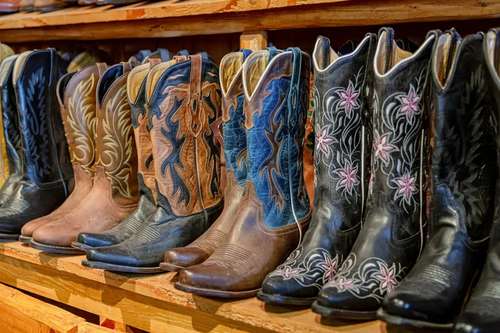
Walk into almost any Western wear store in Texas and you'll probably find several familiar names on the boot shelves. Lucchese, Justin, Tony Lama, and Tecovas all make cowboy boots, but they represent very different chapters of Texas history. Each company was founded during a different era, built its reputation in a different way, and appeals to a different kind of customer today.
That diversity is part of what makes Texas bootmaking so interesting. Cowboy boots have never been just one thing. They started as practical riding equipment for ranchers and cowboys, evolved into handcrafted luxury goods, became everyday work boots, and today are also fashion pieces worn by people who may never step onto a ranch.
Understanding these four companies helps explain how Texas itself has changed. Their stories reflect immigration, ranching, manufacturing, entrepreneurship, craftsmanship, and the continuing popularity of Western culture. Rather than competing to tell the same story, each brand highlights a different part of what Texas has become.
Texas Bootmaking Was Built During the Ranching Boom
Before looking at the individual companies, it's worth understanding why Texas became the center of the cowboy boot industry in the first place.
After the Civil War, Texas experienced an enormous expansion of the cattle business. Millions of longhorn cattle grazed across the state, and cowboys spent weeks or months driving herds north to railheads in Kansas. That work demanded dependable footwear capable of handling long days on horseback, changing weather, rough terrain, and constant wear.
Bootmakers responded by creating footwear designed specifically for riding. Tall shafts protected riders' legs from brush and saddle rub, raised heels helped keep feet secure in the stirrups, and smooth leather soles allowed riders to move comfortably while mounted.
As ranching expanded, skilled leatherworkers established businesses across Texas. Some remained local custom shops, while others grew into companies recognized throughout the country. Among those businesses, four names would eventually stand out for very different reasons.
Justin Boots Built Its Reputation on Working Cowboys
If one company best represents the practical side of Texas bootmaking, it is Justin Boots.
The company began in 1879, when H.J. Justin started making handmade boots in Spanish Fort, Texas. Rather than opening a large factory immediately, Justin traveled to ranches and communities where cowboys needed properly fitted boots for daily work.
That personal approach helped establish the company's reputation. Cowboys depended on their boots every day, and poor fit could quickly become painful during long hours in the saddle. Justin built boots specifically for working riders, adjusting patterns and measurements based on real-world experience instead of producing generic footwear.
As demand increased, the company eventually relocated to Nocona before later establishing its long-standing headquarters in Fort Worth, where Justin Boots remains closely associated today.
Justin Focused on Function Before Fashion
One reason Justin became such an influential company was its commitment to practical performance.
The boots were designed for ranchers, cattlemen, horse trainers, and rodeo competitors rather than luxury buyers. Durability mattered more than decoration. Leather had to withstand daily use, stitching needed to hold up under demanding conditions, and the boots had to remain comfortable after countless hours of riding or walking.
As the company expanded, Justin gradually introduced more styles while maintaining that practical reputation. Work boots, ranch boots, dress boots, occupational footwear, and casual Western styles eventually became part of the catalog, allowing the company to serve a much wider audience without abandoning its ranching roots.
Even today, Justin is often viewed as one of the brands most closely connected to everyday working life in Texas.
Lucchese Took a Different Path
While Justin became known for practical ranch footwear, Lucchese developed a reputation for exceptional craftsmanship and luxury.
Founded in San Antonio in 1883 by Salvatore Lucchese, the company brought Italian shoemaking traditions to Texas. Instead of focusing primarily on large-scale production, Lucchese emphasized precision, comfort, premium materials, and elegant construction.
The difference became apparent in the finished product. Lucchese boots often featured finer leather, more intricate stitching, carefully shaped lasts, and an attention to detail that appealed to customers looking for more than basic work boots.
Although ranchers certainly wore Lucchese boots, the company gradually attracted another audience as well. Business leaders, entertainers, politicians, and collectors began purchasing them because of their craftsmanship as much as their practicality.
Lucchese Made Cowboy Boots Into Luxury Goods
Lucchese helped change public perception of cowboy boots.
Rather than viewing Western boots only as work equipment, customers increasingly saw them as products that reflected personal style and skilled craftsmanship. The company demonstrated that a cowboy boot could be both functional and elegant.
That reputation continues today. Lucchese remains one of the few major Texas bootmakers regularly associated with luxury retail, custom fitting, premium exotic leathers, and handcrafted construction.
The company's story reflects another side of Texas culture. While ranching remains central to the state's history, Texas has also long appreciated craftsmanship, entrepreneurship, and products built to exceptionally high standards.
Tony Lama Expanded the Reach of Texas Boots
The story of Tony Lama begins with another immigrant craftsman.
Born in Italy, Tony Lama learned shoemaking from his father before eventually settling in El Paso, Texas. In 1911, he founded the company that would eventually become one of the best-known Western boot brands in the world.
Tony Lama shared Lucchese's respect for craftsmanship, but the company's growth followed a somewhat different path. It focused on producing high-quality handcrafted boots while expanding into broader markets across the United States.
As rodeos grew in popularity and Western culture became more visible nationwide, Tony Lama boots appeared far beyond Texas ranches. The company helped introduce authentic Texas-made cowboy boots to customers who admired Western traditions but had never worked cattle themselves.
El Paso Became an Important Bootmaking City
Tony Lama's success also highlighted the importance of El Paso in Texas bootmaking history.
Located near the U.S.-Mexico border, El Paso had access to skilled leatherworkers, experienced craftsmen, transportation routes, and suppliers that supported a growing footwear industry. Over time, the city became home to several respected boot manufacturers.
The concentration of expertise benefited everyone. Craftsmen shared techniques, suppliers improved material quality, and the city's reputation for handcrafted Western boots continued to grow.
Even today, El Paso remains one of the country's most respected centers for cowboy boot production. Many boot enthusiasts specifically seek out boots made there because of the city's long history of craftsmanship.
Tecovas Represents a New Generation
Unlike the other three companies, Tecovas tells a much newer Texas story.
Founded in Austin in 2015 by Paul Hedrick, Tecovas entered an industry already filled with established names that had been around for more than a century. Instead of competing directly through traditional Western retailers, the company adopted a direct-to-consumer business model, selling primarily online before gradually opening branded retail stores.
This approach reflected changes happening throughout the retail industry. Many younger customers preferred shopping online, researching products themselves, and buying directly from manufacturers rather than visiting large Western wear stores.
Tecovas recognized that opportunity and built a business around simplicity, transparent pricing, and a carefully focused product line.
Tecovas Made Cowboy Boots More Approachable
One of Tecovas' biggest contributions has been making quality cowboy boots feel less intimidating to first-time buyers.
Traditional Western stores can be overwhelming for newcomers. Customers often face dozens of brands, numerous leather types, multiple toe shapes, various heel heights, and countless style options.
Tecovas intentionally simplified that experience. Instead of offering hundreds of models, the company introduced a smaller collection with straightforward descriptions, classic styling, and educational resources explaining fit, leather care, and sizing.
That strategy attracted many customers who admired cowboy boots but had never purchased a pair before. Rather than replacing older Texas bootmakers, Tecovas introduced a new generation to Western footwear.
Four Different Ideas of Craftsmanship
Although all four companies produce cowboy boots, they define craftsmanship in different ways.
Lucchese has long emphasized meticulous handcrafting, premium materials, and refined finishing. Its boots are often associated with traditional techniques, carefully selected leathers, and a fit that many longtime boot enthusiasts consider among the best in the industry. The company continues to manufacture many of its premium lines by hand, reflecting a philosophy that quality should come before production volume.
Justin Boots approaches craftsmanship from the perspective of reliability. The company has spent decades building boots that can withstand ranch work, construction, farming, and everyday wear while remaining comfortable enough for long hours on your feet. That focus on durability helped establish Justin as one of the most trusted names among working Texans.
Tony Lama sits somewhere between those two approaches. The company has always emphasized handcrafted quality, but it also became known for offering a wide range of boots that appealed to ranchers, rodeo competitors, business professionals, and casual Western wear enthusiasts alike. Its reputation rests on balancing craftsmanship with broad accessibility.
Tecovas, meanwhile, has concentrated on producing well-made boots at competitive prices by simplifying the buying process rather than offering hundreds of different models. Instead of trying to compete on heritage alone, the company focuses on delivering consistent quality through carefully selected materials and a direct relationship with customers.
They Serve Different Customers
Another reason these companies tell different Texas stories is that they speak to different types of boot buyers.
Someone purchasing their very first pair of cowboy boots often discovers Tecovas because of its beginner-friendly website, educational guides, and simplified product selection. The company removes much of the uncertainty that first-time buyers often experience.
A rancher or someone looking for dependable everyday work boots may naturally gravitate toward Justin, whose reputation has long been built on functionality and durability. The company continues to produce boots designed for demanding jobs as well as casual Western wear.
Collectors, professionals, and longtime boot enthusiasts often view Lucchese differently. Many customers save for years before purchasing a premium pair because they see the boots as long-term investments rather than ordinary footwear.
Tony Lama appeals to a broad audience that falls somewhere in between. Its extensive catalog includes work boots, classic Western styles, dress boots, exotic leather models, and performance-oriented designs, making it one of the most versatile names in the industry.
Leather Selection Reflects Each Brand's Philosophy
Leather has always been central to cowboy bootmaking, and each company approaches material selection in its own way.
Lucchese has built much of its reputation on premium calfskin, full-grain leather, and carefully sourced exotic leathers such as ostrich, caiman, alligator, and lizard. These materials are often chosen not simply for appearance but also for comfort, flexibility, and longevity.
Justin offers a wide variety of materials as well, but practicality often comes first. Many of its work-oriented boots emphasize durability, weather resistance, and ease of maintenance while still offering premium leather options for customers seeking dressier styles.
Tony Lama combines both approaches, offering everything from rugged everyday boots to finely crafted exotic leather models. Tecovas has likewise expanded beyond traditional cowhide, incorporating ostrich, caiman, and other premium materials while maintaining a relatively streamlined lineup.
The result is that customers are often choosing not only a boot but also a philosophy about how that boot should be used.
All Four Companies Help Preserve Western Traditions
Despite their differences, these bootmakers share something important.
Each company continues to preserve aspects of traditional cowboy boot construction that might otherwise disappear. Pull straps, leather soles, Goodyear welt construction, decorative stitching, riding heels, and classic silhouettes remain recognizable because companies like these have continued producing them decade after decade.
They also help preserve knowledge that extends beyond footwear itself. Bootmaking requires skilled pattern makers, leather cutters, stitchers, finishers, designers, and craftspeople whose expertise has often been passed from one generation to the next.
Without sustained demand for quality cowboy boots, much of that specialized craftsmanship could have been lost.
Their Boots Still Reflect Texas Culture
Cowboy boots remain common across Texas because they continue to fit naturally into everyday life.
You'll see them at RodeoHouston, the Fort Worth Stock Show & Rodeo, the San Antonio Stock Show & Rodeo, county fairs, livestock auctions, country concerts, and dance halls. They're also worn in restaurants, churches, offices, weddings, graduation ceremonies, and family celebrations.
Each bootmaker contributes to that visibility in a slightly different way.
Justin remains closely associated with working ranches and practical Western living. Lucchese often represents craftsmanship and heritage. Tony Lama reflects decades of Western tradition shared across the United States, while Tecovas appeals to younger buyers discovering cowboy boots for the first time.
Together, they help ensure that Western footwear remains part of everyday Texas culture rather than becoming something reserved only for museums or historical reenactments.
Texas Officially Recognized the Importance of Cowboy Boots
The connection between cowboy boots and Texas became official in 2007, when the Texas Legislature designated the cowboy boot as the Official State Footwear of Texas.
That designation reflects more than the popularity of a particular style. It acknowledges the role boots have played in ranching, agriculture, rodeo, manufacturing, and Texas identity for well over a century.
Companies like Lucchese, Justin, Tony Lama, and Tecovas all contributed to that recognition in different ways. Some preserved traditional craftsmanship, others expanded manufacturing, and newer companies introduced Western boots to audiences that may never have considered wearing them before.
Heritage Looks Different for Every Generation
Perhaps the most interesting difference between these four companies is how each defines heritage.
- For Justin, heritage is closely tied to the everyday work of ranchers and cowboys. Its story is one of practicality and dependability.
- For Lucchese, heritage centers on exceptional craftsmanship and the idea that cowboy boots can be heirloom-quality products.
- For Tony Lama, heritage reflects the spread of authentic Texas bootmaking beyond the state's borders, helping establish Western boots as an international symbol of the American West.
- For Tecovas, heritage means introducing traditional cowboy boots to modern consumers through contemporary retail, clean design, and accessible education.
None of these definitions is wrong. Together, they demonstrate that Texas history is constantly evolving while remaining connected to its past.
Comments (0)
No comments yet. Be the first to share your thoughts.
Leave a comment