


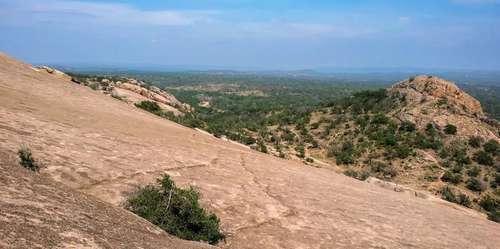
For most visitors, Enchanted Rock State Natural Area is a daytime destination. They arrive early to hike the famous pink granite dome, explore the trails, climb the rock formations, and take in sweeping views of the Texas Hill Country before heading home.
But once the crowds thin out and the sun drops below the horizon, the experience changes completely. The massive granite dome takes on a different appearance, wildlife becomes more active, and the sky fills with thousands of stars that are hidden from much of Central Texas by city lights. It's one of the reasons Enchanted Rock has earned recognition as one of Texas's premier places for stargazing.
Although nighttime access is more limited than many visitors realize, those who experience Enchanted Rock after dark often discover an entirely different side of one of the state's most famous natural landmarks.
Darkness Is Part of What Makes Enchanted Rock Special
Enchanted Rock sits about 18 miles north of Fredericksburg in Gillespie County, far enough from Austin, San Antonio, and other growing cities that much of the surrounding Hill Country remains relatively free of light pollution.
That natural darkness led DarkSky International to designate Enchanted Rock as an International Dark Sky Park in 2014, making it one of the first Texas state parks to receive the honor. The designation recognizes both the quality of the night sky and the park's ongoing efforts to protect it through responsible lighting, public education, and astronomy programs.
Unlike many parks that simply happen to be in remote locations, Enchanted Rock actively works to preserve its nighttime environment. Rangers regularly host educational programs, encourage visitors to use red-light flashlights during astronomy events, and promote awareness of how artificial lighting affects both wildlife and the night sky.
The result is a place where visitors can still experience a sky filled with stars while remaining only a couple of hours from some of Texas's largest metropolitan areas.
The Granite Dome Creates an Unforgettable Setting
The night sky would be impressive almost anywhere in the park, but Enchanted Rock's landscape makes it especially memorable.
The enormous pink granite dome rises roughly 425 feet above the surrounding terrain and reaches an elevation of about 1,825 feet above sea level. It is the largest pink granite batholith in the United States and one of the most recognizable natural landmarks in Texas.
During daylight, the dome reflects shades of pink, orange, and gray as the sun moves across the sky. After sunset, however, the granite slowly loses its color, becoming a dark silhouette beneath an increasingly brilliant canopy of stars.
Unlike heavily forested parks, Enchanted Rock offers broad, open views in nearly every direction. The surrounding Hill Country creates a wide horizon that allows visitors to watch constellations rise, satellites cross the sky, and meteor showers unfold without many visual obstructions.
For photographers, that combination of exposed granite and dark skies creates some of the most recognizable nightscape images in Texas.
The Night Sky Is Better Than Many People Expect
Many first-time visitors assume they need to travel all the way to Big Bend for outstanding stargazing.
While Big Bend certainly offers darker skies overall, Enchanted Rock consistently provides excellent conditions for observing the night sky because it falls within a Bortle Class 3 dark-sky area. Under these conditions, the Milky Way is plainly visible on clear, moonless nights, and many deep-sky objects can be seen with binoculars or a small telescope.
The difference is immediately noticeable for anyone accustomed to suburban lighting. Instead of seeing only a few dozen bright stars, visitors can often make out thousands, along with the hazy band of the Milky Way stretching across the sky during the warmer months.
Planets such as Jupiter and Saturn appear exceptionally bright, while winter skies bring Orion, Taurus, and the Pleiades into sharp view. During meteor showers like the Perseids in August or the Geminids in December, the park offers an excellent vantage point away from much of Central Texas's light pollution.
Astronomy Has Become Part of the Park's Identity
Stargazing is not simply something visitors do on their own.
Enchanted Rock has hosted organized astronomy events for years, working with groups such as the Hill Country Astronomers, the Austin Astronomical Society, the Texas Dark Sky Association, and university astronomy organizations. These events typically feature telescopes, guided tours of the night sky, and educational presentations suitable for beginners as well as experienced observers.
Texas Parks and Wildlife also schedules ranger-led programs throughout the year, including star parties, introductory astronomy sessions, moon-viewing events, and seasonal meteor-shower programs when conditions allow.
Many of these events are free with park admission, although registration is often required because attendance is intentionally limited. Weather also plays a significant role, and events may be canceled if cloud cover prevents meaningful observation.
These programs have helped introduce thousands of visitors to astronomy while reinforcing the importance of protecting natural darkness.
Night Hiking Offers a Different Perspective
Experiencing Enchanted Rock after dark does not simply mean climbing the summit whenever you like.
Under normal park rules, the Summit Trail closes about 30 minutes after sunset, and elevated trails are generally unavailable at night except during authorized ranger-led programs or special events. The Loop Trail, however, remains open later, allowing visitors to enjoy the nighttime environment while protecting sensitive natural resources and reducing safety risks.
Texas Parks and Wildlife occasionally offers guided night hikes that take participants to the summit under ranger supervision. These hikes allow visitors to experience the granite dome in darkness while learning about nocturnal wildlife, astronomy, and the geology of Enchanted Rock. Because group sizes are intentionally small, reservations typically fill quickly.
These restrictions surprise some visitors, but they help protect both the park and its guests. Granite can become slippery after rain, wildlife is more active at night, and navigating exposed rock without adequate lighting carries additional risks.
The Granite Has Inspired Legends for Centuries
Part of Enchanted Rock's nighttime appeal comes from the stories people have told about it for generations.
Long before European settlement, Indigenous peoples including the Tonkawa, Apache, and Comanche associated the granite dome with spiritual significance. Some traditions described mysterious sounds echoing across the rock after sunset or linked the formation to supernatural events, helping inspire the name "Enchanted Rock."
Scientists now understand that some of the unusual sounds likely result from the granite expanding during the heat of the day and contracting as temperatures fall at night. Small shifts within the rock can create creaking or popping noises that earlier visitors interpreted as something mysterious.
Whether viewed through folklore or geology, the transition from daylight to darkness remains part of what makes the park memorable.
Camping Makes the Experience Even Better
Visitors hoping to enjoy the park after sunset often choose to camp overnight.
Unlike day visitors, campers can remain inside the park after the entrance gate closes. That allows them to attend astronomy programs, enjoy the quiet of the evening, and experience sunrise the following morning without leaving the property.
Camping also makes it easier to spend several uninterrupted hours under the stars. Rather than rushing back to Fredericksburg after sunset, campers can wait for astronomical darkness, allow their eyes to adjust naturally, and enjoy changing sky conditions throughout the night.
Because Enchanted Rock is one of Texas's most popular state parks, campsites often book well in advance, especially during spring, fall, holiday weekends, and major astronomy events.
Timing Makes a Big Difference
Even an International Dark Sky Park cannot overcome poor observing conditions.
The new moon offers the darkest skies because moonlight does not wash out faint stars. Visitors hoping to photograph the Milky Way or observe deep-sky objects should plan around the lunar calendar whenever possible.
Clear weather is equally important. Clouds, haze, and high humidity reduce visibility, while dry, transparent air produces noticeably sharper views. Texas Parks and Wildlife recommends checking forecasts before traveling, particularly if stargazing is your primary goal.
Allowing your eyes 20 to 30 minutes to adjust to darkness also improves what you can see. During astronomy events, visitors are encouraged to avoid white flashlights and bright phone screens because even a brief exposure resets night vision.
Protecting the Night Sky Matters
The popularity of Enchanted Rock also highlights a broader conservation issue.
As Central Texas continues to grow, artificial lighting spreads farther into rural areas each year. Increased development around the Hill Country makes preserving dark skies more challenging than it was several decades ago.
DarkSky International designation requires parks like Enchanted Rock to monitor lighting, educate visitors, and encourage lighting practices that reduce unnecessary sky glow. These efforts benefit not only astronomers but also migratory birds, insects, nocturnal mammals, and other wildlife that depend on natural cycles of light and darkness.
The park therefore protects more than scenic views. It preserves one of the increasingly rare opportunities to experience a naturally dark night in Central Texas.
Why Enchanted Rock Continues to Shine After Dark
Enchanted Rock has long been one of Texas's best-known outdoor destinations because of its remarkable granite dome and Hill Country scenery. After sunset, however, it offers something that many visitors never expect: one of the finest accessible night-sky experiences in the state.
Its International Dark Sky Park designation, well-established astronomy programs, relatively dark skies, and dramatic landscape combine to create an experience that is very different from a typical daytime visit. Whether someone comes to photograph the Milky Way, attend a ranger-led star party, or simply sit quietly beneath the stars, the park reveals a side of Texas that is becoming harder to find.
The same granite dome that has attracted travelers for generations becomes even more striking beneath a sky filled with constellations. That combination of geology, history, and natural darkness is exactly why Enchanted Rock continues to shine long after the sun goes down.
Comments (0)
No comments yet. Be the first to share your thoughts.
Leave a comment