


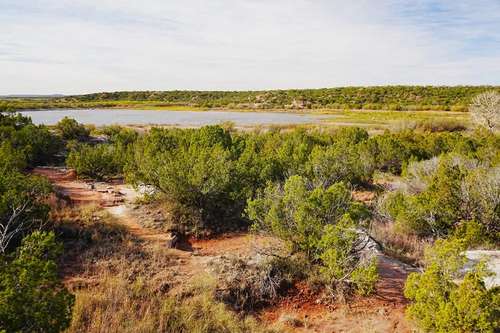
Some Texas landscapes feel enclosed by forests or hills. Copper Breaks State Park feels exactly the opposite. Located in the Rolling Plains of North Texas, this rugged park is defined by long views, broad horizons, red rock canyons, open grasslands, and an enormous sky that changes character from sunrise until well after midnight.
Although it covers only about 1,900 acres, Copper Breaks offers an experience that feels much larger because there is very little to interrupt the landscape. Visitors come to hike, fish, camp, photograph wildflowers, or mountain bike, but many leave talking just as much about the sky as they do the terrain beneath it.
That combination of dramatic scenery and exceptionally dark nights has helped Copper Breaks become one of Texas Parks and Wildlife's standout destinations for outdoor recreation and stargazing.
A Landscape Shaped by Millions of Years of Change
Copper Breaks State Park sits about 12 miles south of Quanah in Hardeman County, near the Texas-Oklahoma border. The park lies within the Rolling Plains, a region that serves as a transition between the High Plains to the west and the Cross Timbers farther east.
Its name comes from two natural features. "Breaks" describes the deeply eroded canyons, gullies, and rugged terrain carved by water over millions of years, while "Copper" refers to the small amounts of copper minerals found in the area's reddish clay and rock. Despite the name, there was never enough copper here to support commercial mining.
The exposed red sandstone, layered rock formations, and rolling mesas tell a much older story. Some of the park's rock layers date back to the Permian Period, when this part of Texas lay beneath an ancient inland sea. Visitors hiking through the park can even see preserved ripple marks left behind by those prehistoric waters, offering a visible reminder of a landscape that existed nearly 300 million years ago.
Big Views Are Part of Every Visit
One of Copper Breaks' defining characteristics is how open it feels. Unlike parks surrounded by dense forests, much of the landscape here allows visitors to see for miles. Hills rise gradually above broad valleys, while rocky overlooks provide uninterrupted views across grasslands, canyons, lakes, and distant ranch country.
Several trails take advantage of these vistas. The Juniper Ridge Nature Trail is only about 0.7 mile long, but its steep climb rewards hikers with one of the park's best panoramic overlooks. Nearby, the Rocky Ledges Loop winds through red rock outcrops before climbing to elevated viewpoints, while the Pease River Valley overlook offers sweeping views across Lake Copper Breaks and Devil's Creek.
Because the terrain remains relatively open, sunrise and sunset become major attractions themselves. Early morning light highlights the red sandstone formations, while evening brings long shadows that emphasize the park's rugged topography.
The Park Is Home to One of Texas's Best Night Skies
Once daylight fades, Copper Breaks becomes known for something entirely different. In 2014, DarkSky International designated Copper Breaks State Park as an International Dark Sky Park, making it one of the first Texas state parks to receive the recognition. The designation reflects both the quality of the night sky and the park's commitment to protecting it through responsible lighting and public education.
The park receives a Bortle Class 2 rating, meaning the skies are exceptionally dark. Under these conditions, visitors can easily see the Milky Way on clear, moonless nights, along with thousands of stars that remain invisible from cities and suburbs.
Unlike many popular stargazing destinations that require backpacking into remote wilderness, Copper Breaks makes dark skies relatively accessible. Campers can often enjoy outstanding views directly from their campsites, while the park also maintains a designated Dark Sky Viewing Area for visitors attending astronomy programs or observing on their own.
Stargazing Has Become Part of the Park's Identity
Copper Breaks did not become a dark-sky destination overnight. The park has hosted Star Walks and astronomy programs since the mid-1990s, long before dark-sky tourism became widely popular. Rangers and local astronomy volunteers have spent years introducing visitors to constellations, planets, galaxies, and seasonal celestial events through guided programs and telescope viewing.
Today, Texas Parks and Wildlife continues that tradition with monthly star parties from April through November, along with additional night-sky programs scheduled throughout the year. Visitors don't need specialized equipment to participate, and many first-time observers discover that the Milky Way alone provides an unforgettable experience without using a telescope.
The park also provides online resources covering moon phases, sky conditions, star maps, and weather forecasts so visitors can better plan nighttime visits.
The Wide Sky Makes Wildlife Easier to Appreciate
The openness of Copper Breaks benefits more than photographers and astronomers. Because visibility extends across large sections of prairie and canyon, wildlife can often be spotted at considerable distances. Roadrunners, eastern collared lizards, white-tailed deer, wild turkey, bobwhite quail, and numerous songbirds inhabit the park throughout the year. During spring, blooming wildflowers add color across the grasslands and attract butterflies and pollinators.
One of the park's best-known residents is the Official State of Texas Longhorn Herd. Visitors frequently see these cattle grazing in the south pasture near the entrance, providing a living connection to the ranching history that helped shape much of North Texas.
The landscape also supports birdwatching because the mixture of prairie, wetlands, mesquite, and rocky habitat attracts different species throughout the seasons.
Hiking Shows Off the Park's Variety
Although Copper Breaks is known for open scenery, its trail system reveals a surprising amount of variety. Texas Parks and Wildlife maintains roughly 10 miles of hiking and biking trails that range from short family walks to more challenging routes across rocky terrain.
The Bull Canyon Short Loop provides an easy introduction to the landscape, while the Equestrian Trail passes through prairie, woodland, and wetland habitat before looping back toward the trailhead. Mountain bikers often head toward Power Line Trail and Chris' Link, where wider paths and rolling terrain create enjoyable riding conditions.
Along the way, visitors encounter sandstone ledges, juniper-covered slopes, seasonal wildflowers, historic ranch features, and overlooks that reinforce why the park feels much larger than its acreage suggests.
Water Adds Another Dimension
In a landscape often associated with dry plains, the park's lakes provide welcome contrast. Lake Copper Breaks and Big Pond support fishing, paddling, wildlife viewing, and seasonal swimming. Texas Parks and Wildlife stocks the lakes with several fish species, and visitors do not need a fishing license when fishing within the park.
The lakes also create attractive reflections during sunrise and sunset, making them popular stops for photographers. At night, calm water can mirror the stars above, producing images that have helped make Copper Breaks increasingly popular with astrophotographers.
Because the surrounding terrain remains relatively undeveloped, artificial lighting rarely interferes with those reflections.
The Park Preserves More Than Natural Beauty
Copper Breaks also preserves pieces of North Texas history. The area was historically part of the homeland of the Comanche and Kiowa, whose presence shaped the Southern Plains for generations before large-scale Anglo settlement. Nearby Medicine Mounds, visible from Highway 6, remain an important ceremonial and cultural site for the Comanche people, although they sit on private property and are not open to public access.
The park itself opened after Texas acquired the property from a private landowner in 1970, protecting the area's distinctive geology and scenery for future generations.
Historic windmills, ranching features, and nearby museums in Quanah and Crowell further connect the landscape to the agricultural history of the Rolling Plains.
Planning a Visit
Copper Breaks offers something different in every season. Spring brings comfortable temperatures, blooming wildflowers, migrating birds, and some of the park's busiest camping weekends. Summer can be hot, with average July highs around 97 degrees, making early morning hikes and nighttime programs especially popular. Fall offers cooler temperatures and clear skies, while winter provides crisp air and excellent conditions for stargazing.
Visitors hoping to experience the park's famous night sky should plan around the new moon, when moonlight interferes least with viewing the Milky Way and faint stars. Allowing 20 to 30 minutes for eyes to adjust to darkness also makes a remarkable difference.
Reservations are recommended, particularly during spring and astronomy events, since campsites and day-use capacity often fill quickly.
Why Copper Breaks Stands Out
Texas has many beautiful state parks, but Copper Breaks offers a combination that is difficult to duplicate.
The park blends rugged geology, broad prairie landscapes, quiet lakes, excellent hiking, abundant wildlife, and one of the finest protected night skies in the state. Visitors can spend the day climbing rocky overlooks, watching longhorns graze, fishing on the lake, or photographing wildflowers before ending the evening beneath a sky filled with stars.
Its International Dark Sky designation certainly draws attention, but the park's appeal extends well beyond astronomy. The same openness that creates outstanding stargazing also defines the entire experience, giving visitors an uncommon sense of space that has become increasingly difficult to find.
For anyone wanting to experience the wide-open character of the Texas Rolling Plains, Copper Breaks State Park remains one of the best places to start. It captures both the vastness of the landscape and the beauty of the sky above it, reminding visitors that some of Texas's greatest attractions are simply the views in every direction.
Comments (0)
No comments yet. Be the first to share your thoughts.
Leave a comment