

Compaq Computer Corporation began when three Texas Instruments engineers met at Houston’s House of Pies in 1982, investing $1,000 each alongside $2.5 million from venture capitalist Ben Rosen.
Within five years, they’d transformed into a computing powerhouse that legally created IBM-compatible machines, introduced the groundbreaking portable PC, and eventually surpassed IBM as the world’s largest PC seller. Compaq’s journey proves tech innovation doesn’t require a California address.
The House of Pies Meeting That Changed Computing History
While many tech giants originated in garages or dorm rooms, Compaq Computer‘s billion-dollar journey began in a far more modest setting: a Houston pie shop.
In 1982, three Texas Instruments engineers—Rod Canion, James Harris, and William Murto—gathered at the House of Pies restaurant to map out their vision for a new computer company. They aimed to build portable PCs that could legally compete with IBM’s dominant machines. Each founder contributed just $1,000 of personal funds, while Ben Rosen provided the critical $2.5 million investment that launched their enterprise.
This humble meeting of “nerdy engineers and middle managers” sparked what would become an industry-transforming company. Within five years, Compaq graced magazine covers and grew into a computing powerhouse, proving that Houston‘s tech ecosystem could produce innovations that would reshape the personal computer landscape.
Rod Canion, Jim Harris, and Bill Murto: Texas Instruments’ Rebel Engineers

Before founding Compaq Computer in 1982, Rod Canion, Jim Harris, and Bill Murto had established themselves as talented engineers at Texas Instruments, where they developed the technical expertise that would later revolutionize the PC industry.
These three rebels took a bold leap when they founded Compaq, investing just $1,000 each to launch what would become the first company to successfully reverse-engineer IBM PCs. Their journey from TI to tech stardom included:
- Legally creating IBM-compatible machines when others couldn’t
- Transforming from engineers to executives of a billion-dollar enterprise
- Building Compaq Computer into a tech powerhouse in just five years
- Establishing Houston as a legitimate tech hub outside Silicon Valley
Their technical backgrounds enabled them to solve compatibility challenges that revolutionized personal computing, turning their modest $3,000 investment into one of tech history’s greatest success stories. Similar to Atlassian’s founders, they demonstrated how a strong foundation in agile development could disrupt an established industry.
The First IBM-Compatible Portable PC: Engineering Brilliance in a Suitcase
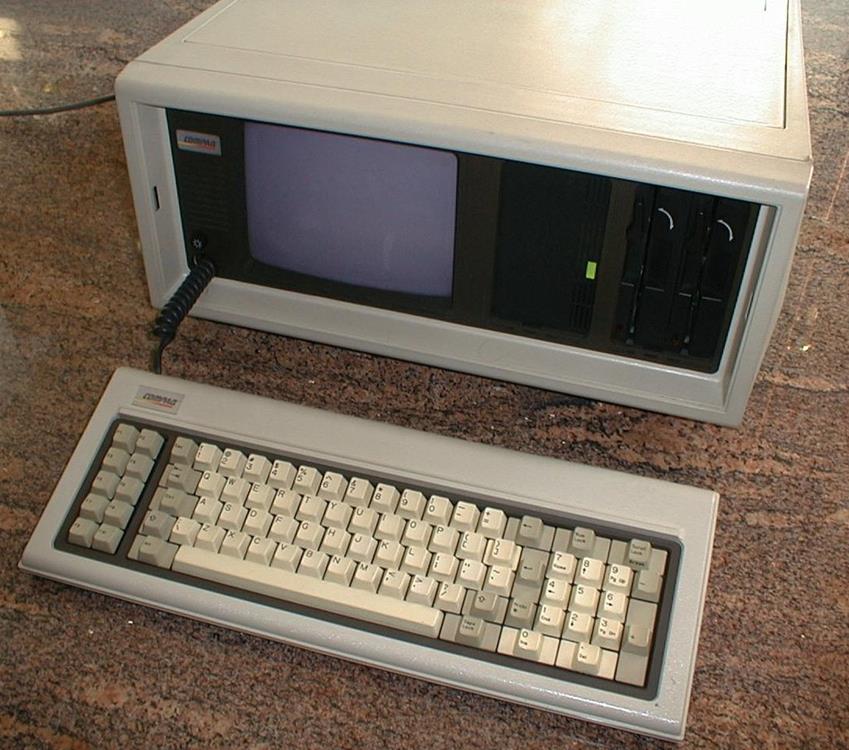
In 1983, Compaq Computer Corporation stunned the tech world with its breakthrough Compaq Portable, the first truly IBM-compatible portable PC that fit inside a suitcase-like enclosure. This revolutionary device emerged from a daring engineering challenge: creating a machine that could run IBM software while offering unprecedented mobility.
You’d be amazed how Compaq’s engineers reverse-engineered the IBM BIOS, matching performance while shrinking it into a transportable form factor. This wasn’t just a technical achievement—it was a market disruption that established Compaq as a formidable competitor to IBM’s dominance.
The Compaq Portable’s success demonstrated that computing power no longer needed to be tethered to a desk, laying the groundwork for today’s mobile computing revolution and cementing Compaq’s place in tech history.
Taking on Big Blue: How Compaq Challenged IBM’s Market Dominance
The success of the Compaq Portable marked only the beginning of the company’s bold assault on IBM’s market position. With their innovative portable computer serving as a launchpad, Compaq systematically dismantled IBM’s dominance through strategic moves that reshaped the PC industry.
How did Compaq outmaneuver the computing giant?
- Speed-to-market advantage – Compaq consistently brought Intel’s latest processors to consumers before IBM could respond
- Technical superiority – The DESKPRO 386 performed significantly faster than IBM’s best offerings
- Global expansion – By 1994, they’d overtaken IBM as the world’s leading PC seller
- Strategic acquisitions – Their $9.6 billion purchase of Digital Equipment Corporation in 1998 solidified their position as IBM’s most formidable competitor
Compaq’s relentless focus on performance and quality fundamentally altered the PC landscape, proving that even tech giants weren’t invulnerable.
Silicon Valley’s Texas Rival: Houston’s Tech Revolution
Three thousand miles from California’s famed technology corridor, Houston quietly built its own tech powerhouse throughout the 1980s and 1990s. At the center of this revolution stood Compaq, founded by former TI engineers who transformed the city into a computer hardware hub.
While Silicon Valley dominated headlines, Compaq’s meteoric rise challenged the status quo. By the mid-1990s, this Houston upstart had accomplished the unthinkable—dethroning IBM as the world’s largest personal computer seller.
Their bold $9.6 billion acquisition of Digital Equipment Corporation in 1998 further cemented Houston’s position as a legitimate tech contender.
Though Compaq eventually merged with HP, its legacy lives on in Houston’s thriving technology ecosystem, proving innovation doesn’t require a California address.
From Billion-Dollar Startup to Industry Leader in Record Time
Few startups achieve billion-dollar status within their first five years, yet Compaq Computer Corporation blazed through this milestone with remarkable velocity. What would take most tech companies decades, Compaq accomplished in just four years, transforming Houston into a legitimate tech powerhouse.
Compaq’s meteoric rise included:
- Launching the Compaq Portable, their first product that directly challenged IBM’s dominance
- Reaching $1 billion in sales faster than any company in American business history at that time
- Expanding annual sales to over $2 billion by the late 1980s
- Pioneering advancements like the DESKPRO 386 that reshaped PC performance standards
You’re witnessing a rare example of a company that didn’t just enter the market—it redefined it, establishing Houston as an entrepreneurial hub outside Silicon Valley.
The DESKPRO 386: The Product That Left IBM Behind

While IBM had dominated the PC landscape since 1981, Compaq’s introduction of the DESKPRO 386 in 1986 marked a seismic shift in the industry’s power dynamics. The machine performed significantly faster than IBM’s offerings—a gap IBM struggled to close.
Compaq made a strategic decision to accelerate development, beating competitors to market with Intel’s 386 processor. They didn’t stop there—they also created a portable version before IBM could deliver a comparable solution.
This performance advantage, combined with innovative features, propelled Compaq’s meteoric rise. By 1994, Compaq surpassed IBM as the world’s leading PC seller, forever changing the computing landscape.
Comdex Undercover: The Secret Mission That Transformed Compaq’s Strategy
A covert operation at the Comdex trade show became the catalyst for Compaq’s most dramatic strategic pivot. In the early days of PC manufacturing, strategic decisions could take time, but this undercover mission accelerated everything.
Compaq employees, without company badges, secretly gathered intelligence from vendors, collecting:
- Pricing information on components
- Product samples for analysis
- Market positioning data
- Technical specifications unavailable through official channels
This intelligence enabled development of a groundbreaking low-cost product, despite internal resistance. When forecasted volumes exceeded financial comfort levels, Richard Swingle faced pushback from both vendors and internal teams.
Meanwhile, Compaq’s founders used the data to pitch a new strategy to Ben Rosen, who greenlit the project.
Ben Rosen’s Boardroom Gamble and Compaq’s Second Chapter
Ben Rosen made one of the most consequential decisions in PC history when he confronted Rod Canion during a pivotal board meeting. Presenting the low-cost DESKPRO/M and PORTABLE 486/C product lines, Rosen triggered a leadership shift that ended with Canion’s departure and Eckhard Pfeiffer’s rise to CEO.
Pfeiffer immediately entrusted Richard Swingle with leading development of the new lines, relocating the team to work in isolation. Despite resistance from Compaq’s finance team, the secret project paid off spectacularly.
What began as undercover reconnaissance transformed Compaq’s position in the market. This pivot toward affordable computing helped the company counter low-cost competitors and cement its place as a PC industry powerhouse.
The HP Merger and Compaq’s Technological Legacy Today
The $25 billion merger between Hewlett-Packard and Compaq in 2002 marked the end of Compaq’s independent journey but established a computing powerhouse that reshaped the tech industry.
While the Compaq brand eventually disappeared, its DNA remains embedded in today’s PC world. You’ll find its influence in four key areas:
- Enterprise computing innovations that strengthened HP’s IT solutions
- Pioneering work in 64-bit x86 processors
- Server and storage technologies foundational to HP’s lineup
- Price competition principles that shaped today’s consumer market
Though Houston’s tech giant no longer exists as a separate entity, Compaq’s engineering legacy continues to shape HP’s technological evolution.