


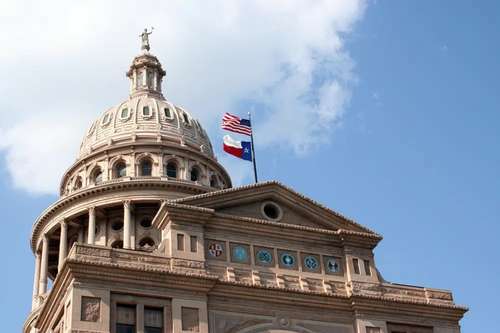
Anyone who follows Texas politics eventually notices that the state does not operate quite like many others. The governor often has less formal authority than governors elsewhere. The Legislature meets only once every two years in regular session. Texans elect a long list of statewide officials instead of giving most executive power to one person. Even the state's highest court system is divided into separate civil and criminal courts.
None of these features happened by accident. They are the result of nearly two centuries of constitutional decisions, political conflicts, and historical experiences that shaped how Texans wanted their government to operate.
Understanding those decisions helps explain why Texas government often moves differently from other states. Many of its unusual features were intentionally designed to limit centralized power, strengthen local control, and make more officials directly accountable to voters.
The Constitution of 1876 Still Shapes Nearly Everything
The single biggest reason Texas government looks different today is the Texas Constitution of 1876. Although it has been amended hundreds of times, it remains the state's governing document nearly 150 years later.
Delegates wrote the constitution after Reconstruction ended. Many Texans believed the previous Constitution of 1869 had given Governor Edmund J. Davis and the state government too much authority during Reconstruction. As a result, the 1875 constitutional convention deliberately designed a government that would make it difficult for any one person or institution to accumulate excessive power.
Instead of creating a strong executive branch, the constitution divided authority among many elected officials, limited state spending, emphasized local government, and carefully described what each branch could and could not do. Many policy details that other states leave to ordinary legislation were placed directly into the constitution itself.
That approach remains one of Texas government's defining characteristics. Because so many subjects are written into the constitution, lawmakers often need voter-approved constitutional amendments instead of simply passing a new statute.
The Governor Is Powerful—But Not as Powerful as Many People Assume
Many people assume the governor controls the executive branch in the same way the President oversees the federal government. Texas does not work that way.
The governor serves as the state's chief executive, can veto legislation, call special legislative sessions, appoint thousands of individuals to boards and commissions over time, and represent Texas publicly. However, many other executive officials are elected independently and do not answer directly to the governor.
That means the governor cannot simply dismiss the attorney general, comptroller, land commissioner, agriculture commissioner, or railroad commissioners because they disagree on policy.
This system intentionally limits executive authority. Rather than concentrating power in one office, Texas spreads executive responsibilities across several independently elected officials who each answer directly to voters.
Texas Uses a "Plural Executive"
Political scientists describe Texas as having a plural executive. Instead of one executive leader controlling the entire branch, authority is divided among multiple statewide offices.
Voters separately elect the governor, lieutenant governor, attorney general, comptroller, commissioner of the General Land Office, agriculture commissioner, and members of the Railroad Commission. The secretary of state is one of the few major executive officials appointed by the governor rather than elected.
Because these officials hold independent constitutional authority, disagreements are common. An attorney general may issue legal opinions that differ from the governor's priorities, while the comptroller independently certifies whether enough revenue exists for the state budget.
Supporters argue that this structure prevents excessive executive power. Critics counter that it can make government slower and leave voters unsure who deserves credit—or blame—for particular decisions.
The Legislature Meets Only Every Other Year

Source: texashappens
One of the most unusual features of Texas government is its legislative calendar. The Texas Legislature normally meets in regular session only once every two years, beginning in January of odd-numbered years. Those sessions are constitutionally limited to 140 days, making Texas one of only a few states with a true biennial legislature.
Lawmakers therefore must complete the state budget, consider thousands of bills, and address major policy questions within a relatively short period.
If additional legislation becomes necessary after adjournment, only the governor may call a special session. The governor also decides which subjects legislators may consider during those special sessions.
This arrangement reflects the constitution's original goal of limiting government activity and reducing the cost of state government. Whether it remains practical for one of America's largest states continues to be debated.
Local Government Has Traditionally Been Strong
Texas has long favored local control. Counties, cities, school districts, hospital districts, groundwater districts, community colleges, and hundreds of special-purpose districts perform many governmental functions that might be handled more centrally elsewhere.
County governments maintain roads, administer elections, operate local courts, keep property records, and provide many public services. Independent school districts oversee public education, while numerous special districts manage water resources, emergency services, flood control, transportation, and other local responsibilities.
This decentralized structure reflects both Texas's enormous geographic size and the longstanding political preference for allowing local communities to manage many of their own affairs.
Although the Legislature has recently expanded state preemption in some policy areas, local government remains an essential part of how Texas operates.
The Lieutenant Governor Has an Unusually Important Role
In many states, lieutenant governors perform mostly ceremonial duties unless the governor leaves office.
Texas gives the lieutenant governor much greater legislative influence. As presiding officer of the Texas Senate, the lieutenant governor appoints committee chairs, refers bills to committees, recognizes senators to speak, and plays a major role in determining which legislation reaches the Senate floor. Because committee assignments often determine whether bills advance, this position can significantly shape the legislative agenda.
The office therefore combines executive and legislative responsibilities in a way that surprises observers from many other states.
Texas Divides Its Highest Courts
Texas also has an unusual judicial system. Instead of one supreme court hearing every type of appeal, Texas divides its highest appellate authority between two separate courts.
The Supreme Court of Texas handles civil and juvenile matters, while the Texas Court of Criminal Appeals serves as the state's highest court for criminal cases. This bifurcated system exists in only two states—Texas and Oklahoma.
Supporters argue that specialization improves expertise. Critics contend that maintaining two highest courts adds complexity that most states avoid.
Texans Vote for Many Judges
Texas also differs from states where governors appoint most judges. Many Texas judges, including district judges, appellate judges, Supreme Court justices, and Court of Criminal Appeals judges, are chosen through partisan elections.
The practice reflects the state's historical preference for making public officials directly accountable to voters rather than concentrating appointment authority in the executive branch.
The system has remained controversial for decades. Supporters view elections as democratic accountability, while critics argue judicial campaigns may create political pressure for offices intended to remain impartial.
Independent Agencies Play Major Roles
Texas government also relies heavily on specialized agencies with substantial independent authority.
The Railroad Commission of Texas is perhaps the best-known example. Despite its name, it no longer regulates railroads. Instead, it oversees much of the state's oil and natural gas industry, pipelines, surface mining, and related energy regulation.
Other major agencies administer transportation, education, environmental protection, healthcare, public safety, insurance regulation, and taxation.
Many agency leaders are appointed, while others are elected or serve on multi-member boards. This further disperses governmental authority across different institutions rather than concentrating it in one executive office.
The Constitution Is Amended Frequently
The U.S. Constitution has been amended only 27 times since 1789. The Texas Constitution follows a very different approach.
Because it contains extensive operational details instead of broad governing principles alone, amendments are often needed to authorize new policies, financing methods, or governmental powers. Since 1876, voters have approved hundreds of constitutional amendments, making it one of the world's longest and most frequently amended constitutions.
Texas voters regularly decide constitutional amendments during statewide elections, sometimes considering more than a dozen proposals on a single ballot.
The result is a constitution that evolves continuously while preserving the governmental framework created nearly 150 years ago.
Texas Government Reflects Texas History
Many features of Texas government make more sense when viewed historically.
The homestead protections reflect frontier concerns about protecting families from financial ruin. Community-property rules reflect Spanish and Mexican legal traditions. The plural executive reflects distrust of concentrated authority after Reconstruction. The biennial Legislature reflects nineteenth-century beliefs that government should be limited in both size and cost.
Even agencies like the Railroad Commission grew from specific historical challenges. It began by regulating railroad monopolies in 1891 before evolving into one of the country's most influential energy regulators as oil production transformed the Texas economy.
Rather than replacing earlier institutions completely, Texas generally layered new responsibilities onto existing structures. That explains why some parts of state government still reflect priorities established well over a century ago.
Why the System Continues to Generate Debate
Texas government was intentionally designed to slow the concentration of power.
Dividing authority among independently elected officials, limiting legislative sessions, requiring constitutional amendments for many policy changes, and emphasizing local government all make sweeping institutional change more difficult than in many states.
Supporters argue this encourages stability, accountability, and restraint. They believe government should move carefully, with multiple officials checking one another rather than allowing one office to dominate decision-making.
Critics argue the same features can make government slower to respond to rapidly changing challenges. Because responsibility is divided among many institutions, it can also be harder for voters to determine who should be held accountable for policy successes or failures.
Both perspectives stem from the same constitutional design. The system was never intended to maximize efficiency; it was designed to limit concentrated power.
Why Texas Government Looks Different Today
Texas government reflects nearly two centuries of political choices rather than one grand design.
Its constitution deliberately weakened centralized authority after Reconstruction. Its plural executive distributes executive responsibilities among several elected officials. Its Legislature meets only every other year, while many judges and executive officers answer directly to voters instead of the governor.
These features can sometimes make Texas government appear unusually complicated, but they all follow the same historical philosophy. Texans repeatedly chose a system that divides authority, encourages multiple checks on power, and relies heavily on elections rather than appointments.
Whether someone views that structure as a strength or a weakness, it explains why Texas often governs differently than much of the rest of the country—and why many of those differences have endured for nearly 150 years.
Comments (0)
No comments yet. Be the first to share your thoughts.
Leave a comment