


The story of Texas law did not begin when Texas joined the United States. The state’s legal foundations were shaped under Spanish and Mexican rule, rewritten during the Republic of Texas, altered by statehood and the Civil War, and repeatedly challenged by disputes over property, race, voting, education, business, and individual rights.
Some milestones created legal protections that remain distinctively Texan, including community-property rules and strong safeguards for the family homestead. Others left damaging legacies, such as slavery, segregation, and laws designed to prevent Black residents from voting.
The most important moments in Texas legal history were therefore not simply new statutes. They were changes in who held power, which rights the law recognized, and how far state government could reach into public and private life.
1821–1827: Mexican Rule Established Texas’s Early Legal Foundation
Source: silviamariee2u
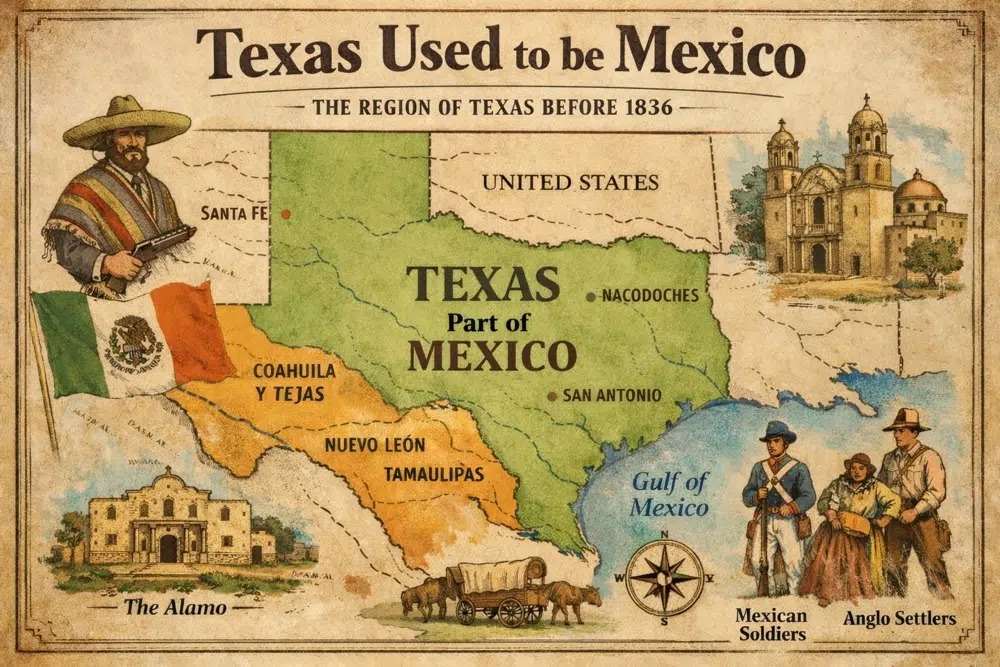
When Mexico gained independence from Spain in 1821, the territory that became Texas operated under a civil-law tradition rather than the English common law used in most of the United States. Land titles, marriage, inheritance, and local government were influenced by Spanish and Mexican legal principles.
The Mexican Constitution of 1824 created a federal republic and joined Texas with Coahuila as the state of Coahuila y Tejas. Its state constitution, adopted in 1827, established local government, courts, and a legislature while recognizing Roman Catholicism as the official religion.
Mexican law also contributed concepts that survived long after independence. The most important was community property, under which property acquired during marriage generally belonged to both spouses rather than automatically falling under the husband’s sole ownership.
Land grants issued by Spanish and Mexican authorities also remained important after sovereignty changed. Texas courts and lawmakers spent decades resolving disputes involving old grants, surveys, boundaries, and conflicting claims.
1836: The Republic Created Its Own Constitution
Texas declared independence from Mexico on March 2, 1836. Delegates at Washington-on-the-Brazos then drafted a constitution for the new republic, creating a president, a two-house Congress, and a judicial system headed by a Supreme Court.
The Constitution of the Republic of Texas borrowed heavily from the U.S. Constitution and Southern state constitutions. It created three branches of government and included protections involving religion, speech, property, criminal procedure, and trial by jury.
It also protected slavery and excluded enslaved people, free Black people, and Native Americans from full citizenship. Congress could not emancipate enslaved people without an owner’s consent, and slaveholders entering Texas were allowed to retain ownership of those they brought with them.
The document remained in force until annexation in 1845. Its combination of American governmental structure, Southern racial policy, and earlier Mexican property law became the starting point for the legal system Texas carried into statehood.
1839: Texas Protected the Family Homestead
One of the Republic’s most lasting laws was enacted in January 1839. It protected a family homestead from seizure by most creditors, generally covering up to 50 rural acres or an urban residence valued at no more than $500.
The law responded to the financial instability of frontier life. Crop failures, business debts, land disputes, and limited access to dependable credit could otherwise leave a family without a home or the tools needed to support itself.
Later Texas constitutions preserved and expanded the protection. Modern homestead law still prevents many unsecured creditors from forcing the sale of a primary residence, although exceptions exist for mortgages, property taxes, certain home-improvement liens, and other constitutionally permitted debts.
Texas also limits a spouse’s ability to sell or place a lien on the family homestead without the other spouse’s consent. The protection became so strong that conventional home-equity loans remained unavailable in Texas until voters approved a constitutional amendment in 1997.
1840: Married Women Gained Important Property Protections
The Republic of Texas adopted a married women’s property law in 1840. It recognized property owned by a woman before marriage, along with property later received through inheritance or gift, as her separate property and protected it from many debts incurred by her husband.
The measure reflected Spanish and Mexican community-property principles already familiar in Texas. It also responded to the practical danger that a husband’s failed business venture could leave his wife and children with no property of their own.
The law did not give married women full control over their finances or equal legal status. Women continued to face restrictions involving contracts, lawsuits, employment, and management of community assets.
Its basic distinction between community and separate property nevertheless survived. Texas remains a community-property state, and those rules continue to affect divorce, inheritance, debt, real estate, retirement accounts, and business ownership.
1845–1846: Statehood Brought Texas Into the Federal System
Texas voters approved annexation and a new state constitution in 1845. The United States formally admitted Texas as the 28th state on December 29, and the first state government took office in February 1846.
Statehood placed Texas under the U.S. Constitution and federal courts while preserving substantial authority over property, criminal law, elections, education, and local government. The new constitution retained slavery and continued many legal traditions developed during the republic.
Texas also kept its public lands rather than surrendering them to the federal government. That decision gave the state control over millions of acres that later supported railroads, settlement, public schools, universities, and the Permanent School Fund.
Annexation did not erase earlier law. Courts continued recognizing many land titles, contracts, and property relationships created under Spain, Mexico, and the Republic of Texas, giving the state a layered legal system unlike that of many newer states.
1861–1870: Civil War and Reconstruction Rewrote State Law
Texas seceded from the United States in 1861 and adopted another constitution aligning the state with the Confederacy. That document explicitly protected slavery and replaced references to the United States with the Confederate States.
Confederate defeat required another constitutional reset. The Constitution of 1866 acknowledged the end of slavery but did not create political equality for formerly enslaved Texans. Federal Reconstruction authorities later rejected Texas’s political arrangements as inadequate.
The Constitution of 1869 created a stronger centralized state government, expanded the governor’s authority, and established a statewide public-school system. It also recognized Black male suffrage under federal Reconstruction requirements.
Texas was readmitted to congressional representation in 1870. The period permanently ended legal slavery, but white political leaders soon worked to reduce the power gained by Black voters and the Republican state government.
1869: Texas v. White Rejected Unilateral Secession
One of the most important cases connected to Texas arose from a dispute over U.S. bonds transferred during the Civil War. In Texas v. White, the U.S. Supreme Court ruled in 1869 that Texas had remained a state even while participating in the Confederacy.
The Court described the Union as permanent and held that a state could not unilaterally secede. Actions taken to separate Texas from the United States were therefore legally void, although many ordinary acts needed to maintain civil society remained valid.
The decision still shapes discussions of Texas secession. Whatever political arguments may be raised, Texas v. White remains the central judicial authority rejecting the idea that Texas can simply vote to leave the Union.
1876: A New Constitution Limited State Government
Texas voters approved the state’s current constitution on February 15, 1876. It was written after Reconstruction by delegates who distrusted centralized government and wanted to reduce the powers created under the 1869 Constitution.
The new document weakened the governor, divided executive authority among several independently elected officials, limited regular legislative sessions, protected local control, and placed detailed restrictions on taxation, debt, spending, and public institutions.
It also created the basic structure Texas still uses: a plural executive, a part-time Legislature meeting in regular session every two years, and an elected judiciary with separate high courts for civil and criminal cases.
Because the constitution contains detailed policy language rather than broad principles alone, Texas voters are frequently asked to amend it. From 1876 through 2024, the Legislature proposed more than 700 amendments, and voters approved more than 500.
The document has changed substantially, but its original distrust of concentrated authority still defines Texas government.
1891: The Railroad Commission Introduced State Regulation
Railroads became indispensable to Texas agriculture, ranching, settlement, and trade during the nineteenth century. Their economic power also generated complaints about high freight rates, discriminatory pricing, and unequal treatment of towns and customers.
After voters approved a constitutional amendment, the Legislature created the Railroad Commission of Texas in 1891. The agency initially regulated freight classifications, rates, railroad records, and business practices.
Its role expanded when oil and natural-gas production transformed the state’s economy. The commission gained authority over pipelines, drilling, production levels, waste prevention, and natural-gas utilities.
During the mid-twentieth century, its power to limit Texas oil production allowed it to influence national and international supplies. The agency stopped regulating railroads in 2005 but still oversees oil, gas, pipelines, natural-gas utilities, alternative fuels, and surface mining.
1918–1920: Women Entered the Electorate
Texas suffrage advocates repeatedly failed to secure full voting rights through a state constitutional amendment. In 1918, however, the Legislature passed a law allowing women to vote in party primary elections.
That was a major gain because Democratic primaries usually determined who won office in one-party Texas. Hundreds of thousands of women registered in the short period before the July 1918 primary, immediately changing the state’s political electorate.
Texas ratified the proposed Nineteenth Amendment on June 28, 1919, becoming the first former Confederate state to do so. The amendment took effect nationally in August 1920 and prohibited denying the right to vote because of sex.
The change did not remove poll taxes, racial discrimination, citizenship barriers, or intimidation. Black women, Mexican American women, and low-income voters continued facing major obstacles even after women gained formal voting rights.
1923–1944: The White Primary Was Created and Defeated
Texas law also used elections to exclude citizens. In 1923, the Legislature barred Black Texans from participating in Democratic primary elections, effectively removing them from the contests that usually determined officeholders.
The U.S. Supreme Court struck down that statute in 1927, but Texas and the Democratic Party repeatedly changed the system to preserve white-only primaries. Officials argued that the party was a private organization entitled to control its membership.
The Supreme Court rejected that position in Smith v. Allwright in 1944. It ruled that Texas could not delegate control of a central part of the election process to a party and then allow racial discrimination prohibited by the Fifteenth Amendment.
The decision ended the legal foundation of the white primary and encouraged Black voter registration. Poll taxes and discriminatory local practices remained, however, until later court rulings and federal voting-rights legislation removed additional barriers.
1950: Sweatt v. Painter Challenged Segregated Education
Heman Marion Sweatt applied to the University of Texas School of Law in 1946 and was denied admission because he was Black. Rather than integrate UT, Texas created a separate law school for Black students.
The U.S. Supreme Court ruled unanimously for Sweatt in 1950. It found that the separate school could not provide an education equal to UT’s because it lacked comparable faculty, library resources, professional contacts, reputation, and interaction with the wider legal community.
At the time, UT’s law school had approximately 850 students and a 65,000-volume library. The separate school had only 23 students and about 16,500 volumes, along with far fewer faculty members and professional opportunities.
The decision weakened the “separate but equal” doctrine four years before Brown v. Board of Education. It also made a Texas dispute an important milestone in the national legal campaign against segregated education.
1973: Open-Government Laws Expanded Public Accountability
The Sharpstown stock-fraud scandal damaged public confidence in Texas government during the early 1970s. Investigations implicated state officials and helped produce convictions, electoral defeats, and calls for major reform.
In 1973, the Legislature adopted laws governing ethics, campaign disclosures, open meetings, and access to records. The Texas Open Records Act, now the Public Information Act, established that government records are generally available unless a specific exception allows them to be withheld.
The law applies to state agencies, cities, counties, school districts, public universities, police departments, and many other governmental bodies. Requesters generally do not have to explain why they want the information.
The related Open Meetings Act requires covered public bodies to post notices and conduct official deliberations openly, except when a legally authorized closed session applies. These reforms gave residents and journalists practical tools for examining contracts, spending, salaries, correspondence, and official decisions.
1989: Edgewood Forced Texas to Confront School-Funding Inequality
In Edgewood Independent School District v. Kirby, property-poor school districts challenged a funding system that depended heavily on local property taxes. Wealthy districts could raise far more money at lower tax rates than districts with smaller tax bases.
The Texas Supreme Court ruled in 1989 that the system violated the state constitution’s requirement for an efficient system of public free schools. The decision forced the Legislature to revise school finance and equalize access to taxable wealth.
The resulting reforms remained controversial and produced further litigation. Texas still struggles with disputes over school funding, property taxes, recapture payments, and whether the Legislature is providing adequate resources.
Even without a final solution, Edgewood established that education funding was not solely a local political choice. It was also a constitutional responsibility subject to judicial review.
1997–1998: Home-Equity Lending Became Legal
Texas’s homestead laws long prevented homeowners from using their primary residences as collateral for conventional home-equity loans. Voters changed that rule through a constitutional amendment approved in November 1997.
Home-equity lending became available in January 1998, but Texas imposed stricter limits than many other states. Total qualifying debt secured by a homestead generally cannot exceed 80 percent of the property’s fair market value.
The amendment expanded access to credit for home repairs, education, medical expenses, and other major costs. It also introduced foreclosure risk for a type of debt that Texas had previously refused to allow against the homestead.
Research has estimated that the ability to use home equity as collateral increased Texas home values by about 4 percent, showing that buyers placed measurable value on the new borrowing option.
2003: Tort Reform Changed Civil Litigation
House Bill 4 revised Texas law involving medical liability, product claims, expert reports, proportionate responsibility, and other civil lawsuits. Its most prominent provisions limited noneconomic damages in healthcare-liability cases.
The law generally placed a $250,000 cap on noneconomic damages against individual physicians and healthcare providers. Separate caps applied to healthcare institutions, while economic damages such as medical expenses and lost wages were treated differently.
Voters also approved Proposition 12, confirming the Legislature’s authority to limit certain damages. Supporters argued the reforms reduced insurance costs and attracted physicians, while opponents said the caps limited compensation for seriously injured patients.
The measure changed how Texas attorneys evaluate medical-malpractice cases and strengthened the state’s reputation for restricting civil liability in the name of economic and professional stability.
2021–2022: Firearm and Abortion Laws Marked a New Era
House Bill 1927 took effect in 2021 and allowed many adults who could legally possess a handgun to carry it openly in a holster or concealed without obtaining a state License to Carry. It continued a policy shift that began with concealed-carry licensing in 1995 and later expanded to open carry and campus carry.
That same year, Senate Bill 8 prohibited most abortions after embryonic cardiac activity could be detected. Instead of relying primarily on state enforcement, it allowed private individuals to sue people who performed or knowingly assisted a prohibited abortion.
The U.S. Supreme Court’s 2022 decision overturning Roe v. Wade then allowed Texas’s separate trigger ban to take effect. Together, these measures placed Texas at the center of national disputes over firearms, abortion, private enforcement, and the limits of state authority.
Texas Law Is Still a Work in Progress
Texas legal history does not move in a straight line toward either greater freedom or stronger government. The state protected homes and married women’s property early, yet also protected slavery and later constructed legal barriers to Black political participation.
It created a constitution designed to weaken government but also built one of the world’s most influential energy regulators. Courts dismantled white primaries and segregated education, while later legislatures imposed new limits on lawsuits, abortion, and local policymaking.
Those tensions remain central to modern Texas. Property rights, local control, business regulation, education, voting, firearms, and individual liberty are still debated through the same institutions created by earlier constitutions and legal battles.
The biggest milestones matter because they did more than settle individual disputes. They changed who could participate, what government could regulate, and which rights Texans could demand from the state.
Comments (0)
No comments yet. Be the first to share your thoughts.
Leave a comment