


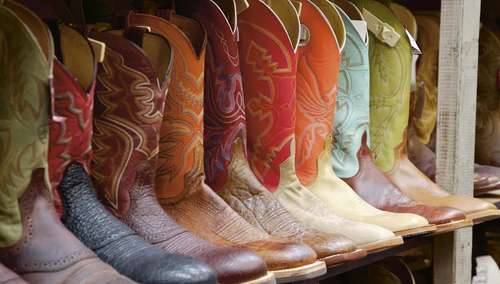
Few items of clothing are as closely connected to Texas as the cowboy boot. Whether you're walking through the Fort Worth Stockyards, attending RodeoHouston, visiting a small-town county fair, or simply eating at a local barbecue restaurant, you'll probably see people wearing boots alongside jeans and button-down shirts. In many parts of the state, they don't stand out—they simply look normal.
That connection wasn't created by advertising or Hollywood. Cowboy boots became part of Texas because they were practical long before they became fashionable. Their history is tied to ranching, horseback riding, cattle drives, skilled bootmakers, and generations of Texans who continued wearing them even as the state grew into one of the country's largest urban economies.
Today, cowboy boots remain an important part of Texas culture because they represent both the state's past and its present. They're worn by ranchers and rodeo competitors, but also by teachers, business owners, musicians, and people who simply appreciate the craftsmanship and tradition behind them.
Cowboy Boots Began as Working Equipment
The first cowboy boots were designed for one purpose: making life on horseback easier.
Texas ranchers and cowboys spent long days moving cattle across rough terrain, repairing fences, checking livestock, and riding for hours at a time. Ordinary shoes wore out quickly and didn't provide the support or protection riders needed.
Several features that people now recognize as classic cowboy boot design were developed for practical reasons:
- A high shaft protected the lower leg from brush, rope burns, and saddle rub.
- A raised heel helped keep the foot securely in the stirrup.
- A smooth leather sole allowed riders to reposition their feet easily.
- A pointed or narrow toe made slipping into the stirrup faster.
None of these features were originally intended as fashion statements. They solved everyday problems faced by people who worked with horses and cattle across Texas.
Texas Inherited a Strong Vaquero Tradition
Many people assume cowboy boots are purely an American invention, but their roots go much deeper.
Spanish settlers introduced cattle ranching to what is now Texas centuries ago, and Mexican vaqueros developed many of the riding techniques, tools, and clothing traditions that later shaped the American cowboy. Early Texas ranchers adopted much of that knowledge, including approaches to horsemanship and leather gear.
As Anglo settlers expanded ranching across Texas during the nineteenth century, those traditions blended with frontier workwear and local craftsmanship. The result was the distinctive Texas cowboy style that people recognize today.
Understanding this history helps explain why cowboy boots feel authentically Texan. They represent centuries of ranching traditions rather than a single moment in history.
Texas Became Home to Legendary Bootmakers
Another reason cowboy boots feel inseparable from Texas is that the state became one of the country's leading centers for bootmaking.
Some of America's most respected Western boot companies either began in Texas or established deep roots here. Among the best known are:
- Justin Boots, founded in Spanish Fort, Texas, in 1879 before moving operations to Fort Worth.
- Lucchese, established in San Antonio in 1883 and still regarded as one of the world's premier custom bootmakers.
- Nocona Boots, founded in the North Texas town of Nocona in 1925.
- Tony Lama, founded in El Paso in 1911 and recognized internationally for handcrafted Western boots.
These companies helped transform cowboy boots from simple ranch footwear into products known for quality craftsmanship, custom fitting, and distinctive design.
Today, Texas is also home to respected custom makers such as Rocketbuster Handmade Custom Boots in El Paso and Heritage Boot in Austin, both of which continue the tradition of handcrafted Western footwear.
Boots Became Part of Everyday Texas Life
Unlike many regional traditions that remain limited to special occasions, cowboy boots became part of everyday life across Texas.
In rural communities, boots remained practical work footwear. They were worn on ranches, farms, construction sites, livestock auctions, and horse facilities because they continued to perform well in demanding environments.
At the same time, boots also became acceptable in everyday public life. It's common to see Texans wearing cowboy boots to restaurants, church services, school events, concerts, weddings, and even professional offices.
That everyday visibility is one reason visitors often notice boots immediately. In many other states, they might seem like costume pieces. In Texas, they're simply another pair of shoes.
Rodeos Help Keep the Tradition Alive
Texas hosts some of the largest rodeos in the world, and those events continue to reinforce the connection between boots and Texas culture.
Major events such as RodeoHouston, the Fort Worth Stock Show & Rodeo, the San Antonio Stock Show & Rodeo, and the Rio Grande Valley Livestock Show attract millions of visitors combined each year. Cowboys, competitors, volunteers, vendors, musicians, and spectators all contribute to an atmosphere where Western clothing feels completely natural.
While rodeo competitors rely on boots designed specifically for performance, many visitors wear their favorite boots simply because they feel appropriate for the occasion.
These events introduce new generations to Western traditions and remind longtime Texans why cowboy boots remain relevant today.
Country Music Strengthened the Image
Texas music also played an important role in keeping cowboy boots visible.
Artists from George Strait, Willie Nelson, and Lyle Lovett to Pat Green, Randy Rogers Band, and Cody Johnson have regularly appeared on stage wearing boots. That consistency reinforced the idea that Western wear belonged not only on ranches but also in everyday Texas entertainment.
Dance halls across the state—from Gruene Hall, the oldest continually operating dance hall in Texas, to venues in Fort Worth, Luckenbach, and countless small towns—continue to be places where cowboy boots fit naturally.
For many Texans, boots are associated just as much with live music and dancing as they are with ranch work.
Craftsmanship Still Matters
One reason cowboy boots continue to appeal to Texans is the amount of craftsmanship involved in making them.
Quality boots often include hand-cut leather, hand-stitched uppers, stacked leather heels, welt construction, and carefully shaped lasts designed for comfort and durability. Some custom bootmakers measure each customer's feet individually before building a pair from scratch.
Materials also vary widely. Traditional cowhide remains popular, but boots may also be made from ostrich, caiman, alligator, lizard, elephant (where legally sourced), or other specialty leathers.
For many buyers, purchasing boots is less about fashion trends and more about investing in footwear that can last for many years with proper care.
Boots Have Become Part of Texas Celebrations
Cowboy boots appear at many of life's biggest moments in Texas.
It's common to see brides and grooms wearing boots during weddings, especially at ranch venues and rustic celebrations. Graduates pose for senior portraits wearing boots, and many families include them in holiday photos.
County fairs, livestock shows, barbecue festivals, country concerts, and community celebrations also bring out Western footwear. Even people who don't wear boots every day often own at least one pair for these occasions.
That broad acceptance helps explain why boots continue to feel like part of everyday Texas culture instead of something reserved for historical reenactments.
They Adapted Without Losing Their Identity
Modern cowboy boots are far more diverse than they were a century ago.
Classic ranch boots remain widely available, but manufacturers now produce dress boots, fashion boots, work boots with composite or steel toes, riding boots, exotic leather boots, and styles designed specifically for women and children.
Decorative stitching, colorful leather, embroidered shafts, intricate inlays, and custom artwork have also become more common.
Despite those changes, the essential design remains recognizable. A cowboy boot made today still shares the same basic shape and function as one worn during the cattle drive era.
Texas Officially Recognized Their Importance
Source: texashappens
The importance of cowboy boots to Texas culture became official in 2007, when the Texas Legislature designated the cowboy boot as the Official State Footwear of Texas.
The designation recognized what many Texans already considered obvious: cowboy boots represent the state's ranching heritage, Western traditions, and continuing cultural identity.
Unlike many official state symbols that receive little public attention, this one reflects something people continue to use. Boots are still worn across Texas every day, making the designation feel especially appropriate.
Visitors Often Notice Boots Right Away
Many first-time visitors are surprised by how often they see cowboy boots in Texas.
They're not limited to rodeos or tourist attractions. You'll find them at airports, grocery stores, sporting events, downtown business districts, suburban restaurants, and university campuses.
Of course, not every Texan owns boots, and many people prefer sneakers, dress shoes, or work boots. But compared to most other states, cowboy boots remain much more common in everyday life.
That visibility reinforces their status as one of Texas' most recognizable symbols.
More Than Footwear
Cowboy boots have also become family heirlooms for many Texans.
Parents often buy children's first pair of boots before they attend their first rodeo or county fair. Older boots are repaired instead of replaced, and well-made pairs are sometimes passed down through generations.
Custom boots can also mark important milestones such as graduations, anniversaries, retirements, or career achievements. For many families, boots carry memories that go well beyond their practical use.
Why They Still Feel Like Texas
Cowboy boots continue to feel like Texas because they were never just a passing trend. They grew out of the state's ranching history, were refined by generations of skilled bootmakers, and remained useful even as Texas became increasingly urban.
Their connection to rodeos, country music, livestock shows, ranch work, and community celebrations keeps them visible across the state. At the same time, modern craftsmanship allows them to evolve without losing the characteristics that made them practical in the first place.
Most importantly, cowboy boots have become part of how many Texans express their connection to the state's heritage. Some wear them every day, while others save them for concerts, weddings, or rodeos, but the meaning remains similar.
Cowboy boots still feel like Texas because they continue to reflect the state's history, craftsmanship, independence, and pride. They're not simply a piece of Western fashion—they're one of the clearest symbols of a tradition that remains alive in communities across Texas.

Comments (0)
No comments yet. Be the first to share your thoughts.
Leave a comment