


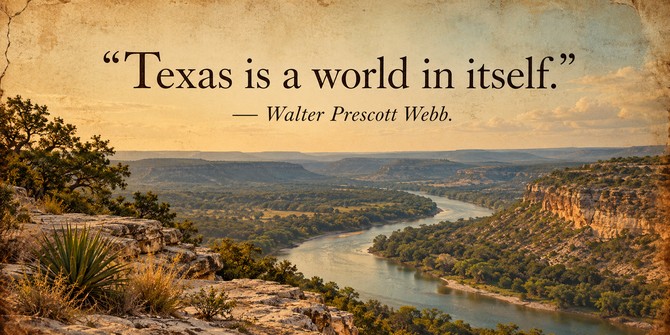
Texas is often described as a place that feels different from the rest of the United States. Its enormous size, varied landscapes, distinctive cultural traditions, and independent history have contributed to an identity that is immediately recognizable.
The statement attributed to Walter Prescott Webb captures this sense of individuality. By describing Texas as a world in itself, the quote suggests that the state contains such a remarkable variety of places, people, and experiences that it can almost be considered a separate world.
The words also reflect the strong connection between geography and identity. Texas is not defined by a single city, landscape, or tradition. Instead, its character comes from the many different elements that exist within its borders.
A State With Remarkable Geographic Diversity
One of the clearest examples of Texas's variety is its geography. The state stretches across approximately 268,600 square miles, making it the second-largest state in the United States.
West Texas features rugged mountains, deserts, and expansive open spaces, while East Texas is known for its forests, lakes, and humid climate. The Hill Country offers rolling landscapes and spring-fed rivers, while the Gulf Coast includes beaches, wetlands, and coastal communities.
The Texas Panhandle adds vast plains and dramatic canyon formations, creating another distinct environment within the state.
These landscapes influence local industries, wildlife, architecture, and everyday life. Traveling across Texas can feel like visiting several different regions, each with its own character.
Walter Prescott Webb's Understanding of Texas
Walter Prescott Webb was an influential American historian who devoted much of his career to studying Texas and the American West.
Born in Panola County, Texas, in 1888, Webb became known for examining how geography and environmental conditions influenced the development of societies.
His most influential work, The Great Plains, published in 1931, explored how the distinctive environment of the Great Plains shaped settlement, agriculture, transportation, and technology.
Webb's historical perspective emphasized that landscapes were not simply backgrounds for human activity. They played an important role in shaping how people lived, worked, and organized their communities.
The quote reflects themes associated with his work, particularly the idea that Texas's physical environment has contributed significantly to its distinctive identity.
The Many Cultures That Shape Texas
Texas's character is also influenced by its cultural diversity. Indigenous peoples, Spanish settlers, Mexican and Tejano communities, African Americans, European immigrants, and later generations of newcomers have all contributed to the state's development.
These influences are visible in its cuisine, music, architecture, festivals, and local customs.
San Antonio reflects a strong Spanish and Mexican heritage, while Houston is known for its international communities and cultural diversity. Central Texas includes communities shaped by German and Czech immigration, and South Texas maintains important Tejano traditions.
This combination of cultural influences helps explain why Texas cannot be understood through a single way of life.
Texas and Its Independent History
Texas's political history adds another dimension to its identity. After declaring independence from Mexico in 1836, Texas existed as an independent republic before joining the United States in 1845.
This period remains an important part of Texas heritage and continues to influence the state's symbols and traditions.
The Lone Star Flag, Texas Independence Day, and historic landmarks associated with the Texas Revolution preserve memories of its years as a separate nation.
However, Texas history extends far beyond this period. Its story includes Indigenous civilizations, Spanish colonization, Mexican governance, slavery, the Civil War, Reconstruction, and major economic transformations.
Together, these experiences have shaped the complex historical identity of the Lone Star State.
Different Ways of Life Within One State
The contrast between rural and urban Texas further illustrates the idea of a world within a state.
In rural communities, agriculture, ranching, and longstanding local traditions remain important parts of everyday life. Major metropolitan areas such as Dallas, Houston, Austin, and San Antonio offer different experiences shaped by business, education, technology, and international connections.
Small towns, border communities, coastal cities, and agricultural regions each contribute something distinctive to Texas culture.
Despite these differences, many residents share a strong connection to the state's history and symbols, creating a recognizable sense of Texas identity.
The Lasting Meaning of the Quote
“Texas is a world in itself” expresses the idea that the Lone Star State contains an extraordinary range of environments, cultures, traditions, and experiences.
Its vast territory and complicated history have produced communities that differ significantly from one another while remaining connected through a shared state identity.
Ultimately, the quote encourages readers to appreciate Texas as more than a single place with one defining characteristic. It is a collection of landscapes, communities, and historical experiences that together create a world of remarkable variety.