


Long before Texas became known for its modern cities and thriving industries, its history was being preserved through stories of frontier life, legendary figures, and extraordinary events. These accounts helped create an image of the Lone Star State that continues to capture people's imaginations.
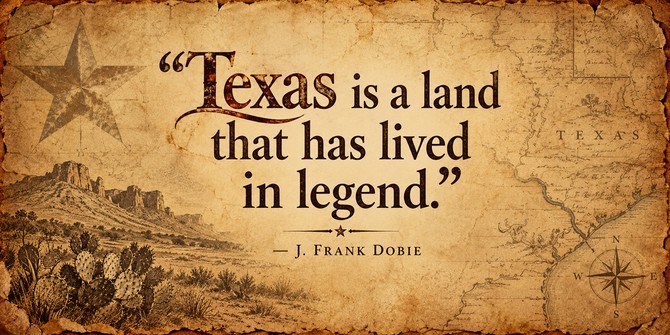
The statement attributed to J. Frank Dobie reflects the powerful influence of legends on Texas identity. It suggests that the state's reputation has been shaped not only by historical facts but also by the stories passed from one generation to another.
The phrase "lived in legend" emphasizes how deeply storytelling has become connected to Texas culture. Its history has inspired tales that continue to influence how people understand its traditions, landscapes, and communities.
J. Frank Dobie and His Love of Texas Folklore
J. Frank Dobie was an influential Texas writer, folklorist, and educator who devoted much of his career to collecting and preserving stories about Texas and the American Southwest.
Born in Live Oak County, Texas, in 1888, Dobie grew up surrounded by ranching traditions and oral storytelling. These early experiences helped develop his interest in folklore, regional history, and the lives of ordinary people.
His books, including Tales of Old-Time Texas, The Longhorns, and Coronado's Children, explored stories involving cowboys, treasure hunters, ranchers, animals, and memorable historical personalities.
Dobie believed that folklore was an important part of understanding a region's cultural identity. By preserving stories shared among communities, he helped ensure that traditions and experiences from earlier generations would not be forgotten.
The Legends That Helped Define Texas
Texas history includes numerous events and individuals who eventually became subjects of widely recognized legends.
The Battle of the Alamo, the Texas Revolution, and the era of cattle drives have inspired generations of writers, historians, and filmmakers. Historical figures such as Sam Houston, Davy Crockett, and James Bowie became familiar characters in stories about courage, independence, and frontier life.
The Texas Rangers also became prominent figures in regional storytelling, appearing in accounts of law enforcement, frontier conflicts, and the development of the state.
As these stories spread, some details were exaggerated or simplified. This transformation illustrates how historical events can gradually become part of a larger cultural mythology.
The Importance of Storytelling in Texas Culture
Storytelling has long been a way for Texas communities to preserve memories, explain traditions, and pass knowledge between generations.
Ranching families shared accounts of cattle drives and life on the open range, while local communities preserved stories about historical events, unusual characters, and familiar landmarks.
Folklore also reflects the contributions of different cultural groups. Indigenous traditions, Mexican and Tejano storytelling, African American folklore, and European influences have all contributed to the stories associated with Texas.
These traditions demonstrate that the state's legends come from many different experiences rather than a single historical narrative.
The Difference Between History and Legend
Although legends are valuable parts of Texas culture, they do not always provide a completely accurate account of the past.
Stories can change as they are retold, with certain details exaggerated and others forgotten. Historical figures may become larger than life, while complicated events are sometimes reduced to simple stories about heroes and villains.
Dobie's work demonstrated the importance of preserving these accounts as expressions of cultural identity. At the same time, understanding Texas history requires distinguishing between documented events and traditional folklore.
Both have value, but they serve different purposes. History helps establish what happened, while legends reveal how people have remembered and interpreted those experiences.
Why Texas Legends Continue to Matter
The legends of Texas remain influential because they connect people to their history and provide a sense of cultural continuity.
Historic landmarks, local museums, books, festivals, and family traditions help preserve these stories for future generations.
Many Texas legends also continue to inspire literature, music, films, and other forms of creative expression. They provide familiar characters and settings while encouraging new interpretations of the state's past.
Through these traditions, storytelling remains an important part of how Texans understand their heritage.
The Lasting Meaning of the Quote
“Texas is a land that has lived in legend” celebrates the enduring influence of folklore on the Lone Star State.
It recognizes that Texas history includes more than recorded events and famous individuals. It also includes generations of stories that reflect the beliefs, experiences, and imaginations of its people.
Ultimately, the quote reminds readers that legends help preserve the character of a place. In Texas, these stories continue to connect the past with the present, keeping the state's traditions and historical memories alive.