


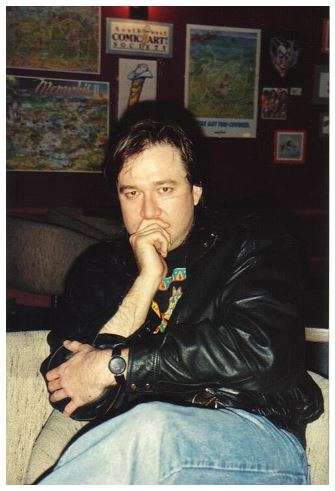
Photo: Bill Hicks at the Laff Stop in Austin, Texas (1991) by Angela Davis (Angela D.), via Wikimedia Commons, licensed under CC BY 2.0.
Known as an audacious Texas-born comedian, Bill Hicks transformed stand-up comedy by confronting societal norms with an incisive blend of dark humor and philosophical insight. Influenced by Woody Allen and Richard Pryor, he began performing at a young age and quickly gained national attention.
Hicks’ routines boldly critiqued politics, religion, and consumerism, leaving a significant legacy that inspired comedians like Joe Rogan and Russell Brand. There’s much more to reveal about his impactful career and legacy.
Early Life and Influences
Though Bill Hicks was born in Valdosta, Georgia, on December 16, 1961, his family eventually settled in Houston, Texas, when he was seven.
In his early life, Hicks’ passion for stand-up comedy blossomed as he drew influences from legends like Woody Allen and Richard Pryor. By 15, he performed at the Comedy Workshop, where he became part of the Texas Outlaw Comics.
Hicks and his friend Dwight Slade co-wrote routines, often challenging the Southern Baptist beliefs they grew up with. This period shaped his introspective style and his tendency to critique societal norms.
Through these formative years, Hicks laid the groundwork for his later comedic voice, which would become both provocative and philosophical.
Beginnings in Comedy
At just 15, Bill Hicks snuck out to perform at Houston’s Comedy Workshop, where his comedic journey truly began.
Hicks, alongside his friend Dwight Slade, crafted routines that cemented his passion for stand-up comedy. His partnership with Slade in high school was vital in shaping his unique comedic voice. Hicks became the youngest regular at the Comedy Workshop and joined the Texas Outlaw Comics, gaining local recognition.
In 1984, Hicks made his television debut on Late Night with David Letterman, introducing his humor to a broader audience.
Although his time in Los Angeles proved disappointing, returning to Houston allowed him to build a loyal fan base through extensive touring.
Hicks’s journey eventually led him to New York City, furthering his stand-up career.
Rise to Fame
Bill Hicks catapulted into the comedy spotlight in 1987 with a standout performance on Rodney Dangerfield’s Young Comedians Special. This appearance greatly enhanced his visibility among stand-up comics and comedy clubs across the nation.
Hicks, a key figure in the Texas Outlaw Comics, started his career in Houston, where he honed his craft at the Comedy Workshop.
In 1990, he released his acclaimed first album, Dangerous, which highlighted his signature social commentary. Hicks didn’t just stop at national fame; he achieved international recognition by touring the UK and Ireland in the early 1990s, where audiences welcomed his sharp critiques of American society.
Performance Style and Themes
When you watch Bill Hicks perform, his blend of blunt honesty and dark humor immediately commands attention. His performance style tackles controversial subjects like politics, religion, and consumerism, engaging you with relaxed banter and impassioned delivery.
This approach creates emotional tension, provoking reflection on societal issues and challenging the status quo. Hicks seamlessly weaves existential themes into his routines, often inspired by psychedelics, urging you to question authority and accepted narratives.
His critique, delivered in a news report style, highlights the absurdities and hypocrisies of mainstream society, advertising, and political correctness. As a crucial figure in counter-culture comedy, Hicks’ discomfort-inducing topics, such as abortion and conspiracy theories, left a lasting influence on future generations of comedians.
Censorship and Controversies
Hicks often challenged mainstream media and consumerism, leading to frequent controversy.
His fallout with comedian Denis Leary, who was accused of appropriating Hicks’ material and style, further fueled the discourse surrounding his career.
One of Hicks’ most controversial moments came when his entire set was removed from Late Show with David Letterman in 1993, sparking a debate on censorship.
The full censored routine was eventually aired in 2009, with Letterman publicly apologizing and taking responsibility for the initial decision.
Battle With Illness
After grappling with controversies, Hicks faced a more personal battle when diagnosed with pancreatic cancer in June 1993—though later confirmed to be stage 4 liver cancer originating from the pancreas.
Despite the illness spreading to his liver, Bill Hicks didn’t let it halt his comedy career. He continued performing, even while undergoing chemotherapy.
Hicks kept his health struggles private, sharing his diagnosis only with close friends and family. His dedication led him to his final performance on January 6, 1994.
Soon after, he returned to his parents’ home to spend his last days surrounded by family. Hicks passed away on February 26, 1994, at the age of 32.
Here are three key moments during this challenging time:
- Continued Performances: Despite illness, he kept entertaining.
- Kept Diagnosis Private: Trusted only a few.
- Final Days with Family: Cherished moments.
Legacy and Impact
Bill Hicks’ legacy is a tribute to his audacity and insight, resonating deeply in the world of comedy and beyond.
As a crucial figure in counter-culture comedy, Hicks challenged societal norms, religion, and consumerism with fearless critiques, leaving a lasting impact. His posthumous albums, Arizona Bay and Rant in E-Minor, solidified his status as a comedic icon, showcasing his profound insights and unique style.
Ranked 6th in Channel 4’s 100 Greatest Stand-Up Comics and 13th in Rolling Stone’s 50 Best Stand-Up Comics of All Time, Hicks’ influence endures. Comedians like Joe Rogan, Russell Brand, and David Cross cite him as a major influence.
Even Radiohead’s dedication of The Bends to Hicks underscores his cultural impact beyond comedy.
Comments (0)
No comments yet. Be the first to share your thoughts.
Leave a comment