


Few events have shaped Texas and its identity quite like the discovery of oil. What began as curiosity, experimentation, and risk-taking in the late 19th century quickly turned into a century-long story of boomtowns and global energy markets. From humble beginnings long before statehood to the dramatic gushers that lit up the world's industrial age, Texas's oil tale is one of ingenuity, ambition, and transformation.
Oil had been known to Indigenous peoples and early explorers in what is now Texas for centuries before it became big business. Natural oil seeps were reported along the Gulf Coast as early as the mid-1500s when Spanish explorer Luis de Moscoso Alvarado's party beached near what is today Galveston Bay, and local tribes reportedly shared knowledge of the dark, sticky substance. While these early sightings didn't immediately launch industrial drilling, they marked the very first inklings of petroleum's presence in the region.
A series of small, scattered oil shows and shallow wells were struck sporadically through the 1800s, but none drew wide attention — until a sleepy agricultural field in Navarro County sparked an early local oil boom. In 1894, a drilling contractor hired to find water instead struck oil on 12th Street in Corsicana, launching what many consider the first commercial oil boom in Texas history.
Though it produced only modest volumes compared to later discoveries, Corsicana's strike quickly made the town a buzzing hub of activity, attracting equipment makers, operators, and early service companies to a place that just months earlier had been a quiet cotton market.
Yet the discovery that would change everything — not just for Texas but for the nation — came a few years later and in a much more dramatic fashion.
Spindletop: The Gusher That Changed Everything
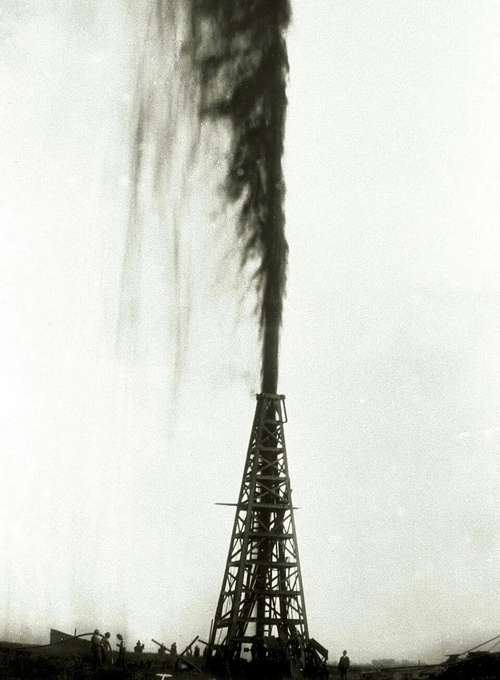
On January 10, 1901, near Beaumont in Southeast Texas, engineers Anthony F. Lucas and Pattillo Higgins finally proved what geological signs and stubborn belief had long hinted: there was treasure deep underground. After years of unsuccessful attempts, Lucas and his team struck oil on a salt dome near Spindletop Hill, and what followed was nothing short of spectacular. A towering geyser of oil erupted — estimated at as much as 100,000 barrels per day — sending columns of black gold shooting skyward for nine days before it could be capped.
The Spindletop discovery marked the birth of the Texas oil boom. Unlike prior small fields, this gusher delivered an unprecedented volume of oil in a single strike, making petroleum commercially viable on a scale never before seen in the United States. Entire industries emerged almost overnight: drillers and wildcatters flooded the region, companies formed to build pipelines and refineries, and new towns sprouted up around fields where nothing had stood before.
This one event helped propel Texas from an agrarian outpost into a powerhouse of industrial energy production and set the stage for the state to dominate global petroleum markets in the decades to follow.
The scale of the Spindletop blowout also had far-reaching consequences. It dramatically lowered oil prices, broke the monopoly once held by Standard Oil, and provided a reliable and affordable energy source that helped power a rapidly industrializing nation. Moreover, the gusher's success triggered investment and exploration across the rest of Texas — and beyond — as companies and prospectors searched for the next big field.
Boomtowns and the Expanding Frontier of Oil
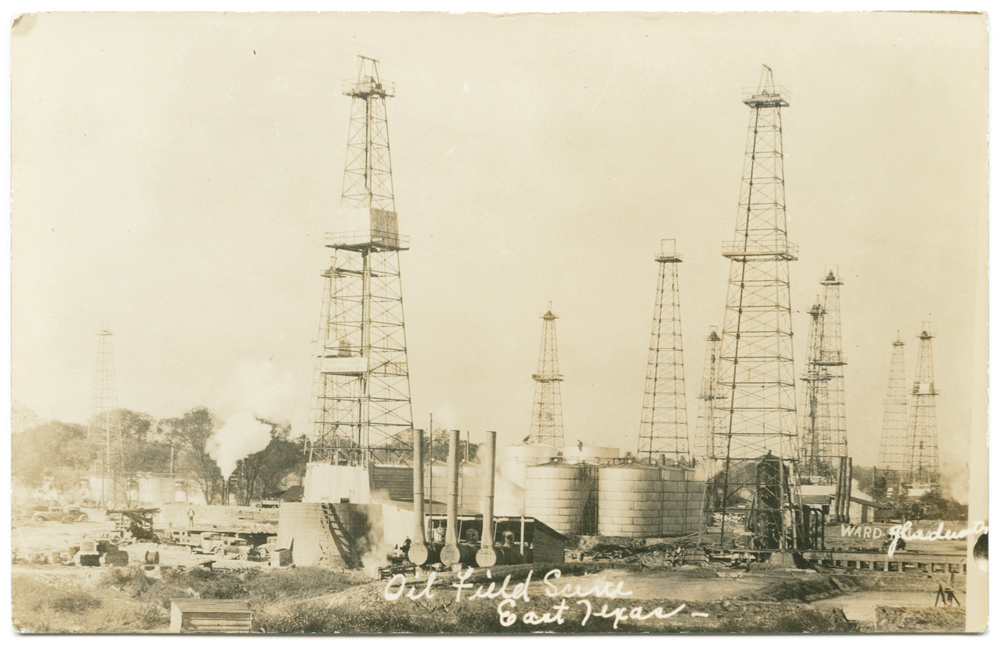
The first great chapter of Texas oil history centered on Southeast Texas fields, but success at Spindletop soon encouraged exploration in other parts of the state. By the early 1900s, fields like Sour Lake, Batson-Old, Humble, and Goose Creek had been discovered around the Gulf Coast, feeding refineries and supporting a growing network of pipelines and transportation infrastructure. Houston's strategic location near the Gulf and its expanding port facilities helped make it one of the nation's leading refinery hubs, a role it would hold and expand throughout the 20th century.
As the industry matured, Texas's oil frontier moved outward. New discoveries in North Texas and the central part of the state added to production, but perhaps none rivaled the importance of the East Texas Oil Field, found in the early 1930s. Stretching across counties like Kilgore, Longview, and Tyler, this field proved one of the largest in the United States and helped sustain production through the Great Depression, even as markets struggled with overproduction and price plunges.
In fact, the boom was so intense that in 1931 the governor ordered the National Guard into the field to enforce production limits and stabilize the market — an early example of Texas's complex relationship between energy production, economics, and regulation.
Meanwhile, West Texas was becoming increasingly important. The discovery of oil near Lubbock in 1936 and the development of fields around Levelland and Scurry County in the 1940s expanded Texas's oil map into the plains that would later become core areas of national energy production. These West Texas fields, along with the Permian Basin farther southwest, helped make Texas a leader not just in Gulf Coast production but in inland plays that would power growth for decades.
Regulation, Innovation, and the Modern Petroleum Era
As oil production grew, so did the need for regulatory oversight and infrastructure. The Texas Railroad Commission emerged as one of the most powerful forces in shaping the industry, especially when it introduced proration laws to prevent overproduction and stabilize markets. These regulatory efforts helped sustain the industry through the boom-and-bust cycles that have characterized oil economics.
Technological advances further propelled the evolution of oil in Texas. Rotary drilling, seismic exploration, and later innovations like hydraulic fracturing and horizontal drilling expanded producers' ability to find and extract oil from previously unreachable formations. Over time, Texas not only extracted more crude but also became a global leader in refining and petrochemical manufacturing, building a comprehensive energy economy that supports jobs, infrastructure, and communities.
The legacy of these discoveries continues to shape the state today. In 2024, Texas set a new record, producing over 2 billion barrels of oil in a single year, highlighting how vital the energy sector remains to the state's economy and to global energy markets.
While modern extraction techniques and shifting energy priorities present new challenges and debates, the historical roots of Texas's oil industry — from natural seeps to Spindletop's geyser — explain why petroleum remains deeply entwined with the state's identity.
The Cultural and Economic Impact
Oil discoveries transformed not only landscapes but also livelihoods. Entire towns and cities grew around fields, new wealth flowed into Texas communities, and the state's population diversified as workers and entrepreneurs moved in search of opportunity. Some of the world's most recognizable energy companies trace their origins back to these early booms, and names like Texaco, Gulf Oil, and Exxon echo the historical roots of Texas's oil legacy.
Even as the industry matured, the cultural imprint of the oil boom — the grit, the roughnecks, the boomtown spirit — has become part of Texas folklore, celebrated in museums, literature, and the collective memory of communities that sprang to life because of black gold.
Whether it's the Lucas Gusher at Spindletop or the rich fields of East and West Texas, oil discoveries have left an indelible mark on the Lone Star State.
Comments (0)
No comments yet. Be the first to share your thoughts.
Leave a comment