


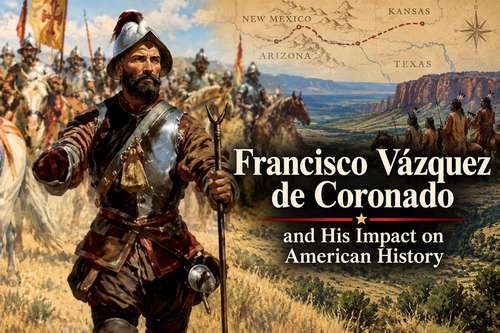
In 1540, Spanish explorer Francisco Vázquez de Coronado set out from Mexico on an ambitious expedition to find the legendary Seven Cities of Cíbola, believed to contain extraordinary wealth. Instead of discovering golden cities, his journey took him across the deserts, pueblos, and grasslands of what are now the southwestern United States and the Great Plains.
Over the next two years, Coronado's expedition traveled through present-day Arizona, New Mexico, Texas, and Kansas. His men encountered established Indigenous communities, explored unfamiliar terrain, and recorded observations that would shape European knowledge of the region.
Although the expedition failed to find the riches it sought, it became an important episode in the history of Spanish exploration in North America. Its legacy, however, also includes warfare, displacement, and violence against Native American communities whose homelands the expedition entered.
Who Was Francisco Vázquez de Coronado?
Francisco Vázquez de Coronado was born in Salamanca, Spain, around 1510. He came from a family with connections to the Spanish nobility and traveled to New Spain, present-day Mexico, in 1535.
There, he developed a relationship with Antonio de Mendoza, the first viceroy of New Spain. Coronado married Beatriz de Estrada, a member of an influential colonial family, and the couple had five children.
His political career advanced quickly. In 1538, Coronado received appointments to the Mexico City council and the governorship of Nueva Galicia, a Spanish colonial province in western Mexico.
His position placed him close to the northern frontier of Spanish-controlled territory, where stories of wealthy cities beyond the established settlements had begun attracting attention.
Those stories would lead to the expedition for which he is best remembered.
The Legend of the Seven Cities of Cíbola
The expedition began with reports of wealthy settlements somewhere north of Mexico.
In 1536, Álvar Núñez Cabeza de Vaca and other survivors of a disastrous Spanish expedition reached Mexico after years of traveling through parts of North America. Their accounts helped generate interest in the peoples and settlements farther north.
In 1539, Franciscan friar Marcos de Niza traveled north to investigate reports of prosperous cities. His account encouraged Spanish officials to believe that a region known as Cíbola might contain considerable wealth.
The stories were often interpreted as descriptions of seven magnificent cities filled with gold and other treasures.
Viceroy Mendoza saw an opportunity to extend Spanish influence and potentially discover new sources of wealth. He selected Coronado to command a large expedition into the northern territories.
For Coronado and his supporters, the journey promised both financial rewards and political prestige.
Coronado's Expedition Begins in 1540
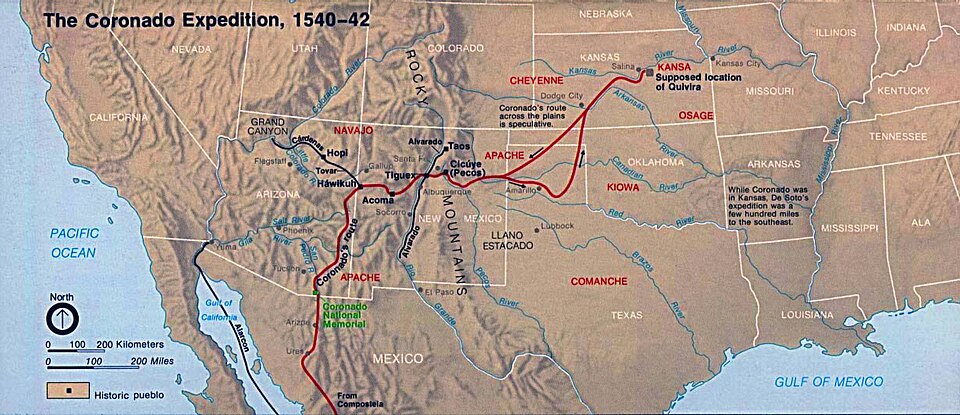
Coronado's expedition assembled in western Mexico in early 1540.
The undertaking included several hundred Spanish soldiers, priests, servants, and more than a thousand Indigenous allies and auxiliaries from Mexico. Horses, mules, cattle, and sheep accompanied the travelers, making the expedition a major logistical operation.
Indigenous participants were essential to its movement and survival. They served in military, labor, and intermediary roles, although their contributions have often received less attention in traditional accounts.
Coronado left Culiacán with an advance party on April 22, 1540, while the main force followed.
Traveling north through what is now northwestern Mexico and Arizona, the expedition eventually reached the Zuni pueblos in present-day New Mexico.
The Spanish identified these communities with the legendary cities of Cíbola.
But the settlements did not contain the gold or other extraordinary riches the expedition had expected.
The Encounter With the Zuni People
In July 1540, Coronado reached Háwikuh, one of the Zuni pueblos.
The settlement was part of a long-established Indigenous society with its own agricultural practices, architecture, political relationships, and traditions.
Rather than discovering an empty land awaiting exploration, the Spanish encountered communities that had lived in the Southwest for generations.
When the Zuni resisted Spanish demands, Coronado's forces attacked Háwikuh on July 7, 1540, and captured the settlement.
The encounter demonstrated the military character of the expedition. Coronado's mission involved not only exploration but also the attempted expansion of Spanish power over Indigenous lands.
Although Cíbola failed to deliver the promised treasure, Coronado continued searching for other wealthy settlements.
The Grand Canyon and Colorado River Expeditions
While Coronado remained in the Southwest, he dispatched smaller parties to investigate surrounding territories.
One group, led by Pedro de Tovar, traveled toward the Hopi pueblos in present-day Arizona.
Another expedition, commanded by García López de Cárdenas, reached the Grand Canyon in 1540.
Cárdenas and his men are generally credited as the first Europeans known to have viewed the Grand Canyon.
However, the canyon and the Colorado River were already familiar to Indigenous peoples who had lived in and around the region for thousands of years.
Other members of the wider Spanish undertaking explored parts of the Colorado River system.
These journeys expanded European geographical knowledge, although the expeditions failed to uncover the wealthy kingdoms the Spanish sought.
The Tiguex War: A Violent Chapter of the Expedition
One of the most consequential episodes of Coronado's expedition occurred during the winter of 1540–1541 in the Rio Grande Valley of present-day New Mexico.
The Spanish established winter quarters among Pueblo communities in a region they called Tiguex.
The arrival of the large expedition placed enormous pressure on local resources. Spanish forces demanded food, clothing, shelter, and supplies from the Indigenous population.
Tensions intensified as soldiers occupied settlements, took provisions, and committed abuses against residents.
The conflict developed into what historians call the Tiguex War.
Pueblo communities resisted the Spanish presence, leading to a series of battles and sieges.
Coronado's forces eventually suppressed the resistance. Many Indigenous people were killed, and several villages were destroyed or abandoned.
The conflict remains a reminder that the expedition's consequences cannot be measured solely by the geographical information it produced.
For the Indigenous communities involved, the Spanish arrival brought violence and disruption to established ways of life.
Coronado's Journey Through Texas in 1541
Coronado's connection to Texas comes primarily from the expedition's movement across the southern Great Plains in 1541.
After hearing reports of another supposedly wealthy region called Quivira, Coronado led his army east from the Rio Grande Valley in April of that year.
The expedition crossed the Llano Estacado, a vast high-plains region extending across eastern New Mexico and the Texas Panhandle.
The travelers encountered expansive grasslands, large herds of bison, and Indigenous peoples whose lives were closely connected to the plains environment.
The Spanish were particularly struck by the scale of the bison herds and the seemingly endless landscape.
Their accounts became some of the earliest surviving European descriptions of the southern Great Plains.
Palo Duro Canyon and the Texas Panhandle
Historians generally place Coronado's expedition in or near the Palo Duro and Tule canyon areas of the Texas Panhandle.
These canyons provided important geographical landmarks amid the broad plains.
By this stage, the expedition was struggling with the challenges of long-distance travel, uncertain directions, and the difficulty of supporting such a large group.
Coronado eventually decided that most of the army should return to the Rio Grande settlements.
He continued north with a smaller party to search for Quivira.
The precise route across the Texas Panhandle remains a subject of historical study, and not every location mentioned in early accounts can be identified with certainty.
Nevertheless, the expedition is an important part of the earliest documented Spanish activity in the region that later became Texas.
The Search for Quivira
The next stage of Coronado's journey centered on Quivira, a supposedly wealthy land farther east.
The Spanish had heard about it from an Indigenous guide whom they called El Turco, or the Turk.
According to the accounts recorded by the expedition, Quivira was described as a prosperous region containing valuable resources.
Coronado followed these reports across the Great Plains.
In 1541, his smaller party reached communities generally associated with the ancestors of the Wichita people, most likely in present-day Kansas.
The Spanish found established settlements, agricultural fields, and communities that combined farming with bison hunting.
They did not find the gold and silver they had expected.
The people of Quivira possessed their own forms of wealth, trade, and social organization, but these did not match the treasure-focused expectations of the Spanish.
The expedition's accounts state that El Turco admitted misleading the travelers, possibly to draw them away from the Pueblo communities.
Coronado ordered his execution.
The exact location of Quivira has been debated by historians, although archaeological and historical evidence generally supports a location in central Kansas.
Why Did Coronado's Expedition Fail?
From the perspective of its Spanish sponsors, the expedition was unsuccessful because it failed to discover the extraordinary wealth it had promised.
Several factors contributed to the disappointing outcome.
First, the stories of golden cities were based on incomplete reports, misunderstandings, and exaggerated expectations.
Second, the expedition traveled across enormous distances through environments that were difficult for such a large force to navigate.
Third, Spanish expectations of wealth did not reflect the economic and cultural realities of the Indigenous societies they encountered.
Coronado and his supporters had invested heavily in the undertaking, expecting discoveries that might justify the expense.
Instead, the expedition returned with substantial losses and no major source of treasure.
Coronado himself suffered a head injury after falling from a horse during the winter of 1541–1542.
By the spring of 1542, he had abandoned the search and begun the journey back to Mexico.
What Happened to Coronado After the Expedition?
Coronado returned to New Spain in 1542 without the riches that had inspired the journey.
His failure to locate the legendary cities damaged his reputation, and authorities investigated his conduct as expedition commander and governor of Nueva Galicia.
He was cleared of charges relating to the expedition itself but faced penalties in connection with other accusations.
He eventually lost his governorship.
Despite these setbacks, Coronado continued participating in civic affairs in Mexico City.
He died there on September 22, 1554, at approximately 44 years old.
His remains were buried in the Church of Santo Domingo in Mexico City.
Coronado's Impact on American History
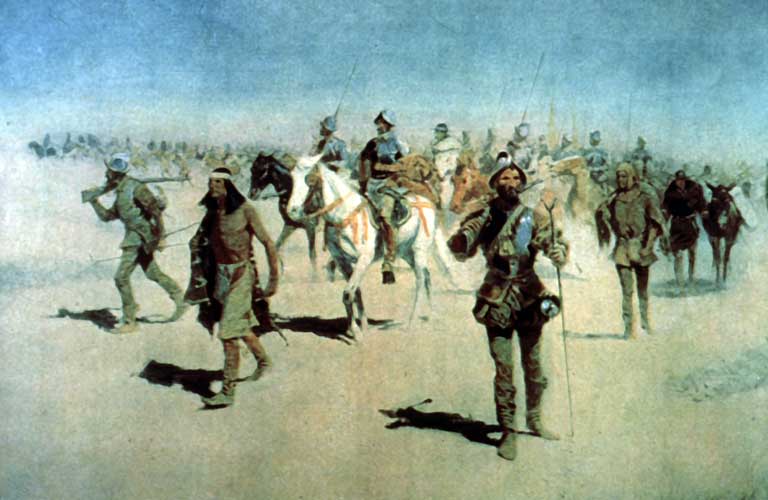
Coronado's expedition had lasting consequences, even though it failed to achieve its principal goal.
1. Expanding European Knowledge of the Southwest
The expedition generated written descriptions of places that were previously unfamiliar to Spanish authorities.
These included Pueblo settlements, the Grand Canyon, the Llano Estacado, and the bison-rich Great Plains.
Such records influenced later Spanish interest in the region.
However, the places described were not unknown to the Indigenous peoples who already inhabited them.
2. Documenting Early Encounters Between Europeans and Indigenous Peoples
Coronado's expedition produced accounts of numerous Native American communities.
These records provide historians with information about Indigenous agriculture, settlement patterns, trade, and regional relationships during the sixteenth century.
Because the documents were written largely from Spanish perspectives, they must be interpreted critically and considered alongside Indigenous histories and archaeological evidence.
3. Contributing to the History of Spanish Texas
The expedition's journey through the Texas Panhandle forms part of the early history of Spanish activity in Texas.
Coronado did not establish a permanent Spanish settlement in Texas.
Nevertheless, his expedition demonstrated the scale of the northern territories and contributed to Spanish geographical knowledge that would influence later exploration.
Permanent Spanish colonization and mission development in Texas occurred much later.
4. Revealing the Consequences of European Conquest
The expedition also illustrates the human costs of Spain's expansion into North America.
The attack on Háwikuh, the Tiguex War, and the demands placed on Indigenous communities show how the search for wealth could lead to violence and displacement.
These events are essential to understanding Coronado's legacy.
His journey was both an expedition of geographical significance and an episode in the broader history of European colonial expansion.
Did Coronado Inspire Texas Treasure Legends?
The search for Cíbola and Quivira became part of a larger tradition of stories about lost cities and hidden wealth in the American Southwest.
Such legends continued to attract explorers, writers, and treasure seekers long after Coronado's death.
However, it would be misleading to describe Coronado's expedition as the direct origin of all later Texas treasure stories.
Texas developed many different treasure legends over the centuries, shaped by Spanish colonial history, frontier conflicts, folklore, and local traditions.
Coronado's search is best understood as one of the earliest and most famous Spanish quests for imagined riches in the region.
Where Can You Learn About Coronado's Texas Journey Today?
Visitors interested in Coronado's expedition can explore places associated with the landscape he crossed and the history of Spanish exploration.
Palo Duro Canyon State Park
Located near Canyon, Texas, Palo Duro Canyon is one of the most important landscapes associated with Coronado's journey across the southern Great Plains.
The dramatic canyon walls and surrounding high plains help visitors appreciate the terrain encountered by the expedition.
The exact movements of Coronado's party remain debated, but the canyon region has a well-established place in historical accounts of his Texas journey.
Panhandle-Plains Historical Museum
Also located in Canyon, the Panhandle-Plains Historical Museum provides broader context for the history of the Texas Panhandle.
Its collections and exhibits explore the region's Indigenous peoples, archaeology, natural history, and later settlement.
These subjects help place Coronado's expedition within the much longer history of the Great Plains.
Coronado National Memorial in Arizona
For a broader understanding of the expedition, Coronado National Memorial near the Arizona–Mexico border preserves and interprets the history of Coronado's journey.
The National Park Service provides educational material about the expedition, its participants, and its effects on Indigenous communities.
Key Facts About Francisco Vázquez de Coronado
Category | Information |
|---|---|
Full name | Francisco Vázquez de Coronado |
Born | Around 1510, Salamanca, Spain |
Arrived in New Spain | 1535 |
Spouse | Beatriz de Estrada |
Governorship | Nueva Galicia, appointed in 1538 |
Major expedition | 1540–1542 |
Main objective | Search for the Seven Cities of Cíbola and later Quivira |
Regions explored | Present-day Arizona, New Mexico, Texas, and Kansas |
Texas connection | Crossed the Texas Panhandle in 1541 |
Major conflicts | Attack on Háwikuh and the Tiguex War |
Expedition outcome | No legendary gold-rich cities discovered |
Died | September 22, 1554, Mexico City |
Conclusion: Understanding Coronado's Complex Legacy
Francisco Vázquez de Coronado remains an important figure in the history of European exploration of North America.
His expedition traveled thousands of miles, recorded information about the Southwest and Great Plains, and contributed to the geographical knowledge available to Spanish authorities.
In Texas, his 1541 journey across the Panhandle remains an early chapter in the region's documented Spanish history.
But Coronado's legacy is more complicated than a story of courage and discovery. His expedition entered lands inhabited by established Indigenous societies and brought warfare, coercion, and suffering to some of those communities.
Understanding both sides of the story offers a fuller picture of the expedition and its place in American history.
Although Coronado never found the golden cities he sought, the history of his journey continues to reveal much about ambition, exploration, cultural encounters, and the consequences of conquest.
Comments (0)
No comments yet. Be the first to share your thoughts.
Leave a comment