


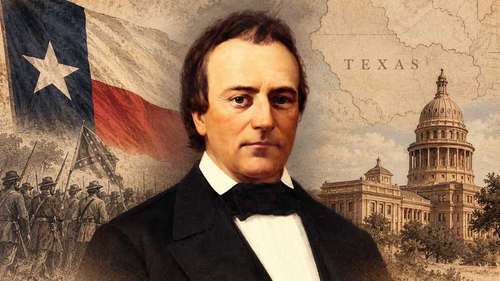
Francis Richard Lubbock served as Texas's ninth governor during one of the most turbulent periods in the state's history. A businessman who became a prominent Democratic politician, he led Texas from 1861 to 1863, when the state was fighting alongside the Confederacy in the American Civil War.
His career extended well beyond the governor's office. Lubbock served under Confederate President Jefferson Davis, was imprisoned after the war, and later returned to Texas politics as state treasurer.
His life offers a revealing look at nineteenth-century Texas, from the early days of the republic to the Civil War and the decades that followed.
Early Life and Arrival in Texas
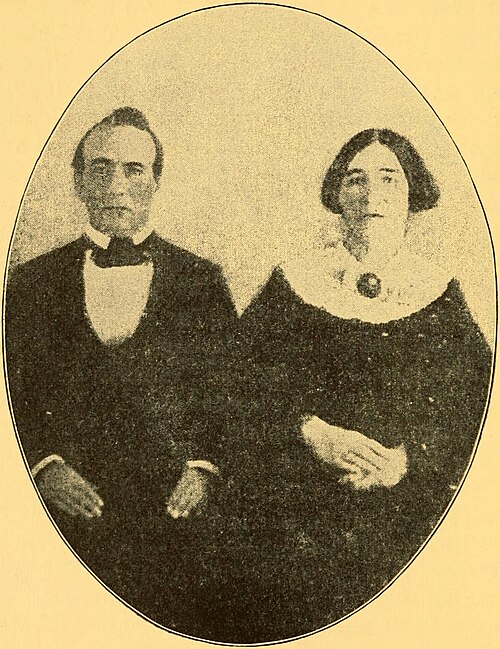
Francis R. Lubbock was born on October 16, 1815, in Beaufort, South Carolina. After his father's death, he entered the business world at a young age, working as a clerk and later pursuing commercial opportunities.
In 1836, the year Texas declared independence from Mexico, Lubbock moved to the newly established Republic of Texas.
He settled in Houston, where he became involved in business and public affairs. As the young republic developed, Lubbock found opportunities to build a political career.
He served as comptroller of the Republic of Texas under President Sam Houston and later held the position of district clerk in Harris County.
These early roles introduced him to the financial and administrative challenges of governing a growing state.
From Lieutenant Governor to Governor
After Texas joined the United States in 1845, Lubbock remained active in Democratic politics.
In 1857, he was elected lieutenant governor under Governor Hardin R. Runnels. His term coincided with increasing tensions between Northern and Southern states over slavery and the future of the Union.
By 1861, Texas had seceded from the United States and joined the Confederate States of America.
Lubbock, a strong supporter of secession and the Confederacy, won the gubernatorial election that year. He took office in November 1861, succeeding Edward Clark.
As the ninth governor of Texas, Lubbock faced the challenge of directing the state's government during a war that demanded soldiers, supplies, money, and political loyalty.
Governing Texas During the Civil War
Lubbock's administration focused heavily on supporting the Confederate war effort.
Texas was an important source of soldiers, horses, cattle, and other supplies. Its location also gave it strategic value, particularly through trade routes connecting the Confederacy with Mexico.
Lubbock encouraged military recruitment and supported measures intended to strengthen Confederate forces.
His administration also faced the growing economic pressures of wartime, including shortages, disrupted trade, and the difficulty of supplying both soldiers and civilians.
One of the greatest challenges was balancing the demands of Confederate military authorities with the needs of Texans at home.
As the war continued, many families struggled with rising prices, scarce goods, and the absence of men serving in the military.
Although Texas avoided the widespread battlefield destruction experienced in parts of the eastern Confederacy, the war still brought serious hardship and political conflict.
Lubbock's leadership was shaped by his determination to keep Texas committed to the Confederate cause.
His Support for the Confederacy and Slavery
Lubbock's political beliefs were closely tied to those of the slaveholding South.
He supported Texas's secession and defended the Confederate government, which was established to preserve a social and economic system built on slavery.
Slavery was central to the political conflict that led to secession, and Texas's own declaration of secession explicitly defended it.
Lubbock's wartime policies must be understood within that context.
His support for the Confederacy was not simply a position on state sovereignty. It also aligned him with a government fighting to protect slavery.
That connection remains essential to understanding his place in Texas history.
Military Service and His Connection to Jefferson Davis
Lubbock's term as governor ended in November 1863, when Pendleton Murrah succeeded him.
Rather than retire from public life, Lubbock entered Confederate military service.
He initially served on the staff of Major General John Bankhead Magruder, a Confederate commander responsible for military operations in Texas.
Lubbock later joined the staff of Confederate President Jefferson Davis, serving as an aide-de-camp.
This position placed him close to the Confederate leadership during the final stages of the war.
In April 1865, Confederate forces were collapsing, and Davis fled Richmond as Union troops advanced.
Lubbock accompanied the Confederate president during his attempt to escape capture.
On May 10, 1865, Union troops captured Davis and members of his party near Irwinville, Georgia.
Lubbock was taken into custody and subsequently imprisoned at Fort Delaware.
He remained a prisoner until his release in 1866.
Returning to Texas After the War
Following his release, Lubbock returned to a Texas transformed by Confederate defeat and emancipation.
The state was undergoing Reconstruction, a period marked by federal oversight, political struggles, and efforts to establish new civil and political rights for formerly enslaved people.
Former Confederate officials faced restrictions on political participation, but many eventually returned to public office as those restrictions changed.
Lubbock resumed his involvement in Democratic politics and remained an influential figure among former Confederate supporters.
His political comeback became especially visible in 1878, when he was elected Texas state treasurer.
Thirteen Years as Texas State Treasurer
Lubbock served as Texas state treasurer from 1879 to 1891, during a period of economic growth and expanding state institutions.
His responsibilities included overseeing the state's treasury operations and the management of public funds.
He served under several governors, including Oran M. Roberts, John Ireland, Lawrence Sullivan Ross, and James Stephen Hogg.
Lubbock's long tenure reflected his continued standing in Texas Democratic politics decades after the Civil War.
He left office in 1891, ending a public career that had stretched from the Republic of Texas through the post-Reconstruction era.
Later Years and Historical Legacy
In his later years, Lubbock remained interested in Texas history and public affairs.
In 1900, he published his memoir, Six Decades in Texas; or, Memoirs of Francis Richard Lubbock, Governor of Texas in War-Time, 1861–63.
The book recounts his experiences in the Republic of Texas, his political career, and his service during the Civil War.
It remains a valuable historical source, although, like other personal memoirs, it reflects the author's own perspective and political loyalties.
Lubbock died on June 22, 1905, in Austin, Texas, at the age of 89.
He was buried in the Texas State Cemetery.
Lubbock County, established in 1876, was named in his honor. The city of Lubbock later took its name from the county.
Understanding Francis R. Lubbock's Place in Texas History
Francis R. Lubbock lived through extraordinary changes in Texas.
He arrived when it was an independent republic, helped administer its early government, served as governor during the Civil War, and returned to state office after Reconstruction.
His long political career made him a significant figure in nineteenth-century Texas government.
At the same time, his commitment to the Confederacy and its defense of slavery is inseparable from his historical legacy.
Understanding Lubbock means recognizing both his decades of public service and the political cause he chose to support.
His story reflects the ambitions, divisions, and lasting consequences of a defining period in Texas history.

Comments (0)
No comments yet. Be the first to share your thoughts.
Leave a comment