


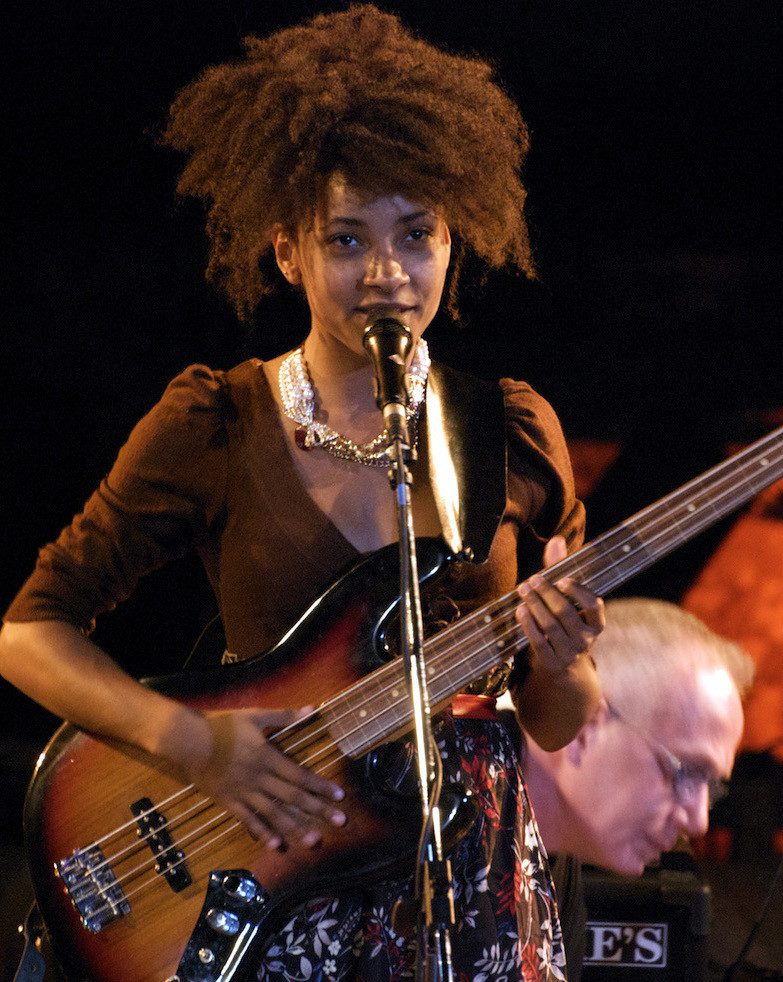
Image: Andrea Mancini, Esperanza Spalding, 2009, CC BY-SA 4.0
Esperanza Spalding, raised in Portland, Oregon, and now reshaping music on a national level, is a Grammy-winning jazz musician who challenges conventions. She made history as the first jazz artist to win Best New Artist at the Grammys in 2011.
Blending jazz, rock, and Brazilian influences, she has collaborated with greats like Prince and Janelle Monáe. Spalding advocates for gender representation in jazz and uses music as a healing tool. Her groundbreaking projects continue to expand jazz’s creative boundaries.
A Journey From Portland to Global Acclaim
Born in Portland, Oregon, Esperanza Spalding’s musical journey began early, marked by versatility and a passion for exploration.
She transitioned from classical violin to jazz bass during her teens. By age 20, she had graduated from the Berklee College of Music, becoming one of its youngest-ever instructors.
Her debut album, Junjo (2006), introduced her globally, but it was her 2010 release, Chamber Music Society, that solidified her stature in modern jazz.
Spalding’s creative blend topped Billboard’s Contemporary Jazz Chart, leading to her historic 2011 Grammy Award for Best New Artist.
Her path exemplifies the bold possibilities awaiting artists who challenge musical boundaries.
Breaking Boundaries: A Grammy Win for Jazz
Spalding’s Grammy win in 2011 was unprecedented—she became the first jazz artist ever to win Best New Artist, surpassing nominees like Justin Bieber and Drake.
Her win challenged mainstream assumptions and signaled a turning point for jazz visibility. It also spotlighted female excellence in a male-dominated genre.
While the reaction from some pop fans was heated, it underscored the cultural friction between commercial popularity and artistic depth. Spalding’s victory affirmed the relevance of jazz in contemporary music.
Diverse Musical Influences and Collaborations
Blending a wide range of musical styles, Spalding fluidly merges jazz, rock, funk, soul, R&B, and Brazilian rhythms in her performances and recordings.
As both bassist and vocalist, she seamlessly adapts to different genres, constantly pushing creative limits.
She has collaborated with Prince, Q-Tip, Janelle Monáe, Joe Lovano, and Patti Austin, bringing nuanced depth to her work.
Her 2016 album Emily’s D+Evolution was hailed as one of the Best Albums of the Year by multiple outlets for its theatrical, conceptual sound.
Her Exposure project, recorded live in 77 hours, further exemplified her commitment to real-time, boundary-breaking creation.
Currently, she is co-writing the opera Iphigenia with the late Wayne Shorter, blending jazz with operatic storytelling.
Redefining Gender Roles in the World of Jazz
Although jazz has long been male-dominated, Spalding is reshaping the narrative.
Her performance style—singing and playing upright bass simultaneously—defies gender expectations and showcases technical and artistic excellence.
Her work with Terri Lyne Carrington on The Mosaic Project, an all-female ensemble, underscored her commitment to elevating women in jazz.
Spalding’s artistic ethos centers on experimentation and inclusion, helping redefine jazz for a more equitable and modern generation.
Impact on Contemporary Jazz and Future Innovations
Spalding’s contributions to contemporary jazz are transformative. She fuses tradition with innovation, proving that the genre can evolve without losing its roots.
Her 2018 album 12 Little Spells, which won the Grammy Award for Best Jazz Vocal Album, explored the healing properties of sound, pushing jazz into wellness and spiritual domains.
As a Harvard faculty member, she mentors emerging artists and designs programs that explore music’s role in social transformation.
Her opera Iphigenia fuses theatrical narrative and jazz improvisation, illustrating her multi-disciplinary approach and her deep collaboration with jazz icon Wayne Shorter.
Artistic Philosophy and Approach to Music
When exploring Spalding’s philosophy, one finds an unwavering belief in music as a tool for healing and justice.
She rejects rigid categories, urging jazz musicians to experiment, innovate, and engage meaningfully with their audiences.
Spalding believes in artistic integrity and full self-expression, insisting that music must connect, challenge, and heal.
By fusing past influences with new techniques, she ensures that jazz remains relevant and forward-moving.
Educational Contributions and Community Engagement
Spalding’s teaching work reflects her dedication to music as a transformative social force.
Since 2017, she has served as a professor of practice at Harvard University, where she explores the intersections of music, culture, and activism.
Early in her career, she participated in Portland’s Chamber Music Society and Culture Recreation Band, initiatives that emphasized youth music education.
Through her Songwrights Apothecary Lab, Spalding combines scientific research and songwriting to explore how music can enhance emotional and physical wellness.
Her projects empower communities and inspire musicians to use art as a vehicle for healing and personal growth.
Exploring Themes of Identity and Social Justice
Spalding’s artistry is deeply embedded in themes of identity, justice, and healing.
Her project We Are America was a collaboration advocating for the rights of prisoners held at Guantanamo Bay, demonstrating her commitment to activism through music.
In Songwrights Apothecary Lab, she worked with therapists, neurologists, and musicologists to compose songs that respond to emotional and mental health challenges.
Spalding also speaks out against gender and racial inequality in the music industry, modeling leadership in the arts and driving important cultural conversations.
Notable Projects and Continued Legacy
Spalding continues to innovate with genre-blurring, thought-provoking projects.
Emily’s D+Evolution dazzled with theatrical flair and concept-driven storytelling.
12 Little Spells won a Grammy and was praised for merging science and soul in its exploration of human anatomy and healing.
Her opera Iphigenia, developed with Wayne Shorter, reimagines a classical myth through a jazz and operatic lens, expanding what jazz performance can be.
With Exposure, she set a bold example of creative transparency by producing an entire album live on social media over 77 hours.
As a Harvard educator and cultural leader, she continues to shape the future of music through experimentation, activism, and community building.

Comments (0)
No comments yet. Be the first to share your thoughts.
Leave a comment