


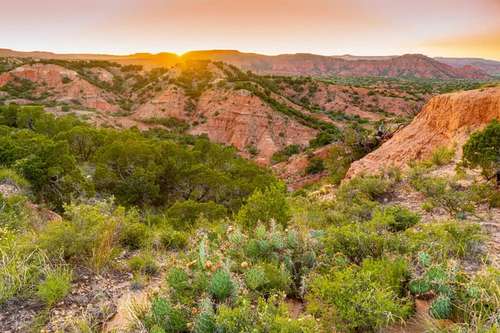
Caprock Canyons State Park and Trailway has long been one of the Texas Panhandle's most impressive outdoor destinations. Visitors come for its towering red-rock cliffs, rugged hiking trails, historic railroad tunnel, and the official Texas State Bison Herd, but beginning in late 2025, the park gained another distinction that has attracted a growing number of outdoor enthusiasts.
Caprock Canyons is now the newest Texas state park to receive International Dark Sky Park designation, joining a select group of parks recognized for protecting some of the darkest and most impressive night skies in the state. The designation reflects years of work by park staff to reduce light pollution, improve outdoor lighting, and preserve one of Texas's increasingly rare natural resources: true darkness.
For visitors, the result is more than an award. It means one of Texas's most dramatic landscapes becomes just as memorable after sunset as it is during the day.
A Landscape That Already Feels Vast
Caprock Canyons State Park and Trailway is located near the small town of Quitaque in the Texas Panhandle, roughly halfway between Amarillo and Lubbock. Covering more than 15,000 acres—and expanded to approximately 17,500 acres through recent land acquisitions—it protects part of the rugged Caprock Escarpment, where the High Plains suddenly give way to colorful canyons carved by wind and water over millions of years.
The park's landscape is unlike much of Texas. Layers of red sandstone, gypsum, and shale form steep canyon walls that contrast with broad grasslands above the escarpment. Wide valleys, mesas, and rocky overlooks create uninterrupted views that seem to stretch for miles, giving visitors a sense of openness that defines the Texas Panhandle.
During the day, those views are impressive enough. After sunset, they become an ideal backdrop for one of the darkest skies in the state.
Becoming an International Dark Sky Park
The International Dark Sky Park designation is not simply awarded because a place is remote.
DarkSky International evaluates parks on several criteria, including sky quality, outdoor lighting, long-term conservation policies, public education, and ongoing stewardship. Parks must demonstrate that they actively protect natural darkness rather than simply benefiting from a fortunate location.
Caprock Canyons officially received its designation in late 2025, with Texas Parks and Wildlife announcing the achievement in January 2026 after the certification process was completed. It became the fifth Texas state park to earn International Dark Sky Park status, joining Big Bend Ranch State Park, Copper Breaks State Park, South Llano River State Park, and Enchanted Rock State Natural Area.
According to Texas Parks and Wildlife, park staff spent years working toward certification by improving lighting practices, adopting policies that reduce unnecessary nighttime illumination, and promoting public awareness about the effects of light pollution.
Why the Night Sky Is So Good Here
Caprock Canyons benefits from something that has become increasingly difficult to find across much of Texas: distance from major urban development.
The park sits in a sparsely populated part of the Panhandle where there are few large cities, relatively little commercial development, and long stretches of ranchland separating communities. Without significant sky glow from nearby metropolitan areas, visitors experience much darker conditions than they would across most of Central, North, or Southeast Texas.
On clear, moonless nights, the Milky Way appears as a bright band stretching across the sky. Thousands of stars become visible without binoculars, while planets, satellites, and seasonal constellations stand out with remarkable clarity.
Unlike heavily wooded parks, Caprock's broad canyons and open prairie provide expansive horizons in nearly every direction. Those unobstructed views allow visitors to follow constellations from horizon to horizon without trees or buildings blocking the skyline.
The Landscape Makes Stargazing Even Better
Dark skies are only part of what makes Caprock Canyons memorable after sunset.
The park's geology creates dramatic foreground scenery that adds depth to the nighttime experience. Massive red cliffs, rugged mesas, winding canyon walls, and prairie grasslands create silhouettes beneath the stars that photographers and amateur astronomers find especially appealing.
The park also contains the 120-foot-high Clarity Tunnel, an abandoned railroad tunnel that now serves as the summer home for one of Texas's largest maternity colonies of Mexican free-tailed bats. While the bats emerge before full darkness during warmer months, many visitors combine an evening bat flight with a night of stargazing, making Caprock one of the few places where two remarkable natural spectacles can be experienced in a single visit.
The transition from sunset to darkness is particularly striking because the canyon walls continue reflecting warm red and orange tones long after the sun has disappeared from the horizon.
Bison Beneath the Stars
Perhaps nothing makes Caprock Canyons more distinctive than its wildlife.
The park protects the official Texas State Bison Herd, descendants of animals preserved by famed ranchers Charles and Mary Ann Goodnight during the late nineteenth century. These genetically important Southern Plains bison represent one of the state's most significant wildlife conservation successes.
Seeing bison during daylight is already a highlight for many visitors. Under dark skies, however, the experience becomes even more unusual. It is one of the few places in Texas where visitors may see these iconic animals grazing beneath a sky filled with stars, creating a scene that feels remarkably similar to what the Southern Plains may have looked like generations ago.
Park officials encourage visitors to observe wildlife from a safe distance, especially after dark when visibility is naturally reduced.
More Than 90 Miles of Trails
The park's nighttime appeal is supported by an impressive range of daytime activities.
Caprock Canyons offers approximately 90 miles of trails for hiking, mountain biking, horseback riding, and backpacking. Routes vary from relatively easy walks through canyon bottoms to challenging climbs across rocky terrain and elevated ridgelines.
Popular destinations include the Upper Canyon Trail, Eagle Point Trail, Haynes Ridge Overlook, and sections of the Caprock Canyons Trailway. Each provides different perspectives of the park's geology while showcasing the broad landscapes that later become ideal for nighttime viewing.
Many visitors spend the day exploring the trails before settling into a campground and waiting for darkness to arrive.
Camping Makes the Experience Complete
Camping plays an important role in experiencing Caprock Canyons after dark.
Rather than leaving shortly after sunset, overnight visitors can remain in the park as astronomical darkness develops. This allows enough time for eyes to fully adjust to natural darkness while providing opportunities to observe the Milky Way, meteor showers, planets, and changing constellations throughout the evening.
The park offers developed campsites with varying amenities as well as more primitive camping opportunities for visitors seeking additional solitude. Because the park remains relatively less crowded than some of Texas's better-known destinations, campers often enjoy quieter evenings than they might find elsewhere.
That peaceful atmosphere is one reason many experienced stargazers appreciate Caprock Canyons despite its growing popularity.
The Importance of Protecting Dark Skies
Artificial light has become one of the fastest-growing forms of environmental pollution worldwide.
Poorly directed outdoor lighting reduces visibility of stars, disrupts wildlife behavior, wastes energy, and affects natural day-night cycles for both animals and people. DarkSky International estimates that a significant portion of outdoor lighting is either unnecessary or inefficiently directed upward instead of toward the ground.
The certification process required Caprock Canyons to demonstrate responsible lighting practices throughout the park. Fixtures were evaluated for brightness, shielding, and placement to reduce unnecessary sky glow while maintaining visitor safety.
Texas Parks and Wildlife also uses the designation as an educational opportunity, helping visitors understand why preserving darkness matters not only for astronomy but also for ecosystems and wildlife.
Planning the Best Stargazing Visit
A little planning goes a long way when visiting Caprock Canyons for its night skies. Keep these tips in mind before you go:
- Plan your trip around the new moon. The darkest skies occur during the new moon, when moonlight won't wash out faint stars or the Milky Way. If stargazing or astrophotography is your main goal, check the lunar calendar before choosing your dates.
- Watch the weather forecast. Clear skies are essential for good viewing. The Texas Panhandle's dry climate often provides excellent conditions, especially during spring and fall, when humidity is generally lower and the atmosphere is clearer.
- Protect your night vision. Once it gets dark, give your eyes 20 to 30 minutes to fully adjust. Use a flashlight with a red filter instead of a bright white beam so you can move around safely without losing your ability to see faint stars.
- Pack for a remote destination. Services are limited around Caprock Canyons, so bring plenty of water, food, appropriate clothing, and any other essentials. If you plan to explore beyond the main park facilities, it's also a good idea to download offline maps before you arrive since cell service can be unreliable in some areas.
A Growing Destination for Dark-Sky Tourism
Dark-sky tourism has grown steadily across Texas over the past decade.
As urban areas continue expanding, more travelers are seeking places where they can experience a naturally dark night sky. International Dark Sky Park designations help identify locations where visitors can enjoy exceptional stargazing while supporting communities that prioritize responsible conservation.
Caprock Canyons now joins an increasingly respected network of Texas parks known for protecting natural darkness. Unlike some destinations where stargazing is the only attraction, Caprock combines astronomy with hiking, wildlife viewing, mountain biking, photography, geology, camping, and one of the state's most important conservation herds.
That variety makes the park appealing to families, photographers, outdoor enthusiasts, and first-time stargazers alike.
Why Caprock Canyons Deserves the Recognition
Caprock Canyons State Park was already one of the Texas Panhandle's most impressive outdoor destinations before receiving its International Dark Sky Park designation. The certification simply highlighted something visitors had quietly appreciated for years: this is a place where darkness remains part of the natural landscape.
Its wide-open canyons, expansive prairie views, roaming bison, and remarkably clear night skies combine to create an experience that feels increasingly rare in modern Texas. The designation also reflects the commitment of park staff who spent years improving lighting practices and educating visitors about why darkness deserves protection.
For anyone looking to experience one of Texas's newest dark-sky destinations, Caprock Canyons offers far more than an evening under the stars. It provides a chance to see the Panhandle much as earlier generations did—with broad horizons, minimal artificial light, and a sky that once again becomes the main attraction.

Comments (0)
No comments yet. Be the first to share your thoughts.
Leave a comment