


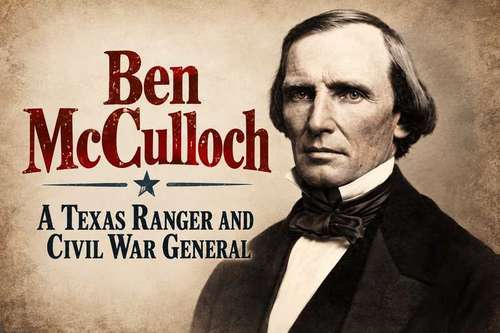
Ben McCulloch fought in three major conflicts that shaped nineteenth-century Texas and the United States: the Texas Revolution, the Mexican-American War, and the Civil War.
A frontiersman, Texas Ranger, and military commander, McCulloch earned a reputation for his scouting abilities and knowledge of frontier warfare. He fought alongside Sam Houston at San Jacinto, served under General Zachary Taylor in Mexico, and later became a Confederate brigadier general.
His military career ended at the Battle of Pea Ridge in Arkansas in 1862, where he was killed while scouting Union positions.
Early Life and Friendship with Davy Crockett
Benjamin McCulloch was born on November 11, 1811, in Rutherford County, Tennessee. His parents, Alexander and Frances LeNoir McCulloch, raised their family on the American frontier, moving several times before settling near Dyersburg, Tennessee.
McCulloch received little formal education. Instead, he spent much of his youth farming, hunting, and working on the rivers of Tennessee.
Two prominent frontier figures influenced his early life: Sam Houston and David "Davy" Crockett, both family acquaintances.
When Crockett headed for Texas in 1835, McCulloch decided to follow him. He planned to meet Crockett in Nacogdoches, but delays prevented them from traveling together.
McCulloch later continued toward San Antonio, hoping to join the Texans defending the Alamo. However, illness kept him from reaching the fort before it fell on March 6, 1836.
He would soon find another opportunity to fight for Texas independence.
Fighting at the Battle of San Jacinto
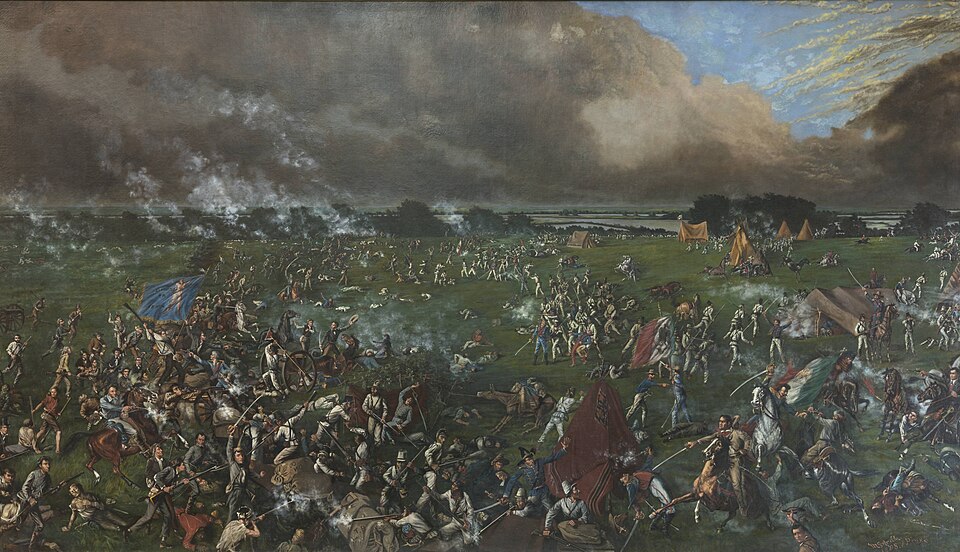
After recovering, McCulloch joined General Sam Houston's army as it retreated eastward ahead of Mexican forces.
On April 21, 1836, he participated in the Battle of San Jacinto, the decisive engagement of the Texas Revolution.
Rather than serving primarily as a scout, as some accounts suggest, McCulloch commanded one of the two artillery pieces known as the "Twin Sisters."
These cannons, donated by supporters in Cincinnati, Ohio, helped support the Texan attack against General Antonio López de Santa Anna's army.
The battle ended in a Texan victory, and Santa Anna was captured the following day.
McCulloch's service earned him a battlefield commission as a first lieutenant.
Although his role at San Jacinto was relatively brief, it marked the beginning of a military career that would span more than two decades.
Life as a Texas Ranger and Frontier Scout
After the Texas Revolution, McCulloch worked as a surveyor in the growing communities around Gonzales and Seguin.
He also joined the Texas Rangers, serving under Captain John Coffee "Jack" Hays.
During the Republic of Texas era, the Rangers carried out patrols, reconnaissance missions, and military operations along the frontier.
McCulloch participated in campaigns against Native American groups and Mexican forces. These conflicts formed part of the violent struggle over territory as Anglo-American settlement expanded across Texas.
His reputation grew through his scouting abilities and his willingness to operate in difficult terrain.
At the Battle of Plum Creek in August 1840, McCulloch helped command Texan forces fighting a large Comanche raiding party.
He also took part in operations against Mexican incursions into Texas in 1842.
McCulloch's career was not limited to military service. In 1839, he was elected to the House of Representatives of the Republic of Texas.
He later served in the first Texas Legislature after statehood in 1846.
These experiences made him a recognizable figure in both frontier military affairs and Texas politics.
His Role in the Mexican-American War
When the Mexican-American War began in 1846, McCulloch organized a company of Texas Rangers that joined Colonel Jack Hays's mounted volunteers.
He soon became chief of scouts for General Zachary Taylor, who commanded American forces in northern Mexico.
McCulloch's responsibilities included gathering intelligence, locating enemy positions, and identifying routes through unfamiliar territory.
His reconnaissance missions brought him national attention.
At the Battle of Monterrey in September 1846, he led his men in combat as mounted infantry.
Before the Battle of Buena Vista in February 1847, his scouting helped Taylor understand Mexican troop movements and prepare for the approaching battle.
His service earned him a promotion to major in the United States Volunteers.
By the end of the war, McCulloch was widely known for his skill as a frontier scout and military leader.
From California Gold Seeker to U.S. Marshal
McCulloch's adventures continued after the Mexican-American War.
In 1849, he traveled to California during the Gold Rush, hoping to find his fortune. Although he did not become wealthy through mining, he was elected sheriff of Sacramento.
He eventually returned to Texas.
In the 1850s, McCulloch was appointed United States marshal for the Eastern District of Texas, serving under Presidents Franklin Pierce and James Buchanan.
The position involved enforcing federal court orders and carrying out other law-enforcement responsibilities.
Despite his military experience, McCulloch had never received formal military training. His reputation rested largely on practical frontier experience rather than education at a military academy.
That distinction would become important when the Civil War began.
Joining the Confederacy in 1861
When Texas moved toward secession in 1861, McCulloch supported the Confederate cause.
He helped organize Texas forces that demanded the surrender of federal military installations in San Antonio.
In February 1861, Union General David E. Twiggs agreed to surrender federal military property in Texas, an important early success for the secessionists.
McCulloch was subsequently commissioned as a brigadier general in the Confederate Army in May 1861.
He was assigned to command forces operating in Arkansas and the surrounding region, including parts of Missouri and Indian Territory.
His military responsibilities now extended far beyond the Texas frontier.
McCulloch also helped negotiate Confederate alliances with several Native American nations in Indian Territory.
These agreements became part of the broader Civil War struggle, as Indigenous nations faced internal divisions and difficult decisions over their involvement in the conflict.
McCulloch's Confederate service placed him on the side of a government established to preserve slavery, a central cause of Southern secession.
The Battle of Wilson's Creek
On August 10, 1861, McCulloch commanded Confederate troops at the Battle of Wilson's Creek in southwestern Missouri.
He fought alongside Missouri State Guard forces under Major General Sterling Price against a Union army led by Brigadier General Nathaniel Lyon.
The Confederate-aligned forces won the battle, and Lyon was killed during the fighting.
Wilson's Creek was one of the earliest major Civil War battles west of the Mississippi River.
Although McCulloch's forces achieved a battlefield victory, disagreements between him and Price complicated Confederate operations.
The two commanders differed over military strategy, authority, and the direction of the campaign.
Their disputes eventually led Confederate President Jefferson Davis to place both forces under Major General Earl Van Dorn in early 1862.
That decision set the stage for McCulloch's final battle.
Death at the Battle of Pea Ridge
In March 1862, Confederate forces under Van Dorn advanced into northwestern Arkansas to challenge a Union army commanded by Major General Samuel R. Curtis.
The resulting Battle of Pea Ridge, also called the Battle of Elkhorn Tavern, took place on March 7–8, 1862.
McCulloch commanded the Confederate right wing.
Early in the fighting, his troops captured a Union artillery position and forced federal soldiers to withdraw from part of the battlefield.
But the situation changed quickly.
While riding forward through thick brush to locate Union positions, McCulloch was shot and killed on March 7, 1862.
He was 50 years old.
Brigadier General James McIntosh, who briefly assumed command, was killed soon afterward. Another senior officer, Colonel Louis Hébert, was captured.
The rapid loss of several commanders disrupted the Confederate attack.
Without effective leadership, McCulloch's troops became disorganized, contributing to the Confederate defeat at Pea Ridge.
The Union victory helped secure federal control of Missouri and strengthened the Union position in northern Arkansas.
Ben McCulloch's Legacy in Texas History
Ben McCulloch's military career reflected the changing conflicts of nineteenth-century Texas.
He fought for Texas independence, served as a Ranger during the republic's frontier wars, and gained national recognition during the Mexican-American War.
He also held public office and served as a federal marshal before joining the Confederacy.
His ability to scout unfamiliar territory and lead mounted troops made him a valuable commander, particularly in campaigns where knowledge of the landscape mattered.
At the same time, his participation in frontier campaigns against Native Americans and his later service to the Confederacy remain important parts of his historical record.
McCulloch was initially buried near the battlefield at Pea Ridge. His remains were later moved to Little Rock, Arkansas, and eventually to the Texas State Cemetery in Austin.
McCulloch County in Central Texas was named in his honor.
Today, his story provides a window into the Texas Revolution, the expansion of the Texas frontier, the Mexican-American War, and the Civil War.
From the artillery lines at San Jacinto to his final moments at Pea Ridge, McCulloch spent much of his life in military service during an era of profound conflict and change.

Comments (0)
No comments yet. Be the first to share your thoughts.
Leave a comment