


Texas law did not develop in a straight line. The territory passed through Mexican rule, an independent republic, United States statehood, the Confederacy, Reconstruction, and several different constitutions before arriving at the legal structure Texans live under today.
Some changes reorganized the entire government. Others determined who could vote, attend public schools, own and borrow against property, carry firearms, obtain an abortion, or seek damages through the courts. The timeline below is not a list of every important Texas statute, but it covers many of the turning points that most clearly changed public power and everyday life.
1824–1827: Mexican Federalism Created the First State Government
Source: silviamariee2u
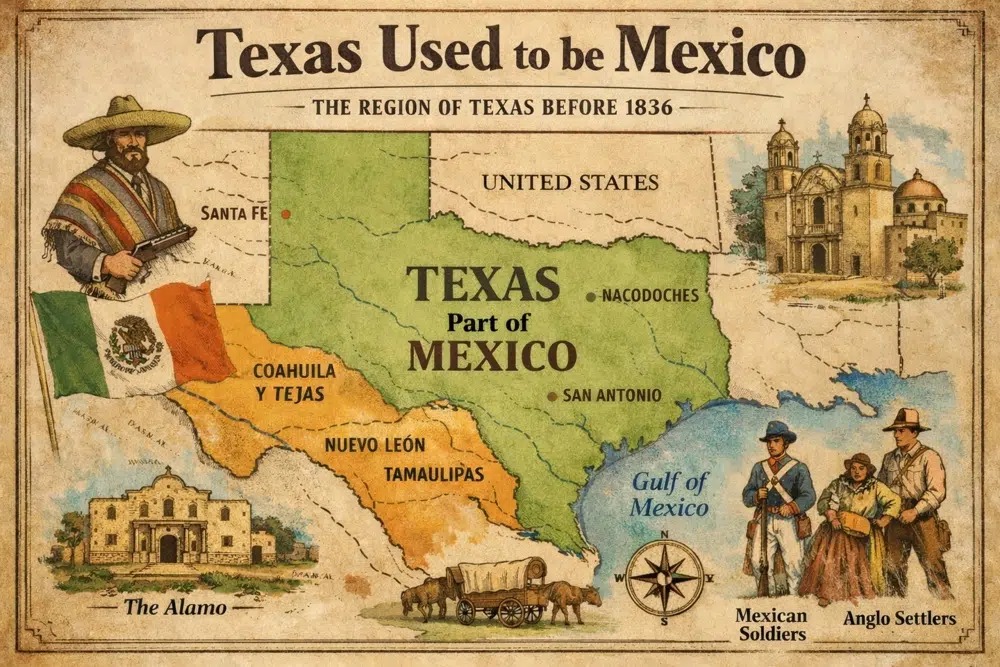
Before Texas became a republic or a U.S. state, it was part of Mexico. The Mexican Constitution of 1824 created a federal system and combined Texas with Coahuila to form the state of Coahuila y Tejas.
That state adopted its own constitution in 1827. It established a legislature, executive branch, courts, local governments, and legal rules for a territory whose population included Tejanos, Indigenous peoples, Mexican officials, and increasing numbers of Anglo-American settlers.
Mexican law shaped early Texas land grants, local administration, marital property, and civil-law traditions. Although later Texas governments replaced much of this system, some of its influence survived, particularly in areas such as community property and land titles.
1836: The Republic of Texas Adopted Its Own Constitution
The Texas Revolution produced a new legal order. Delegates declared independence from Mexico on March 2, 1836, and adopted the Constitution of the Republic of Texas later that month.
The document created an independent presidential republic with executive, legislative, and judicial branches. It also defined citizenship, established a bicameral Congress, protected private property, and placed limits on presidential terms.
The constitution simultaneously protected slavery and restricted the rights of enslaved and free Black people. Congress could not emancipate enslaved people without compensating owners, and free people of African descent generally could not remain in the republic without legislative permission. The legal foundations of the new republic therefore combined representative government for some residents with explicit racial exclusion for others.
1845: Annexation Turned Texas into a U.S. State
Texas voters approved annexation and a new state constitution in 1845. The United States formally admitted Texas as the 28th state on December 29 of that year.
The Constitution of 1845 replaced the institutions of the republic with a state government operating under the U.S. Constitution. It preserved slavery, maintained a relatively strong governor, created a legislature and court system, and continued protections for homesteads and married women’s property.
Annexation brought Texas under federal constitutional authority, but state law retained considerable influence over property, elections, crime, education, and local government. The relationship between state and federal power would become one of the most persistent themes in Texas legal history.
1861: Secession Rewrote Texas Law Around the Confederacy
Texas held a secession convention in 1861 and withdrew from the United States to join the Confederacy. Delegates altered the state constitution to remove references to the United States and align Texas government with the Confederate Constitution.
The new legal order reaffirmed slavery and placed Texas within a national government built partly to protect it. Many Texans opposed secession, including Governor Sam Houston, who refused to swear allegiance to the Confederacy and was removed from office.
Secession affected military obligations, trade, public finance, and political loyalty throughout the state. Its legal basis did not survive the Civil War, and the U.S. Supreme Court later held in Texas v. White that states could not unilaterally leave the Union.
1866: Texas Formally Recognized the End of Slavery
After the Confederacy’s defeat, Texas had to create another constitution before restoring civil government. The Constitution of 1866 acknowledged that slavery had ended and repudiated the state’s secession ordinance.
The change was enormous but incomplete. Formerly enslaved Texans were legally free, yet the state did not grant Black men equal political rights or full access to public power. Texas and other Southern states also adopted restrictive laws and practices intended to preserve white control after emancipation.
Congress concluded that the first phase of Presidential Reconstruction did not adequately protect freedpeople. Texas was therefore placed under military Reconstruction and required to write yet another constitution.
1869: Reconstruction Expanded Rights and Centralized State Power
The Constitution of 1869 reflected the requirements of Congressional Reconstruction. It recognized Black male suffrage, expanded public education, strengthened the state government, and provided greater legal protection for formerly enslaved Texans.
The constitution also created a more centralized administration than many white political leaders in Texas preferred. State officials gained broader authority, and the governor exercised greater appointment power.
Texas was readmitted to congressional representation in 1870 after ratifying the Fourteenth and Fifteenth Amendments. However, Reconstruction protections weakened as conservative Democrats regained control, and many of the 1869 constitution’s provisions were reversed or narrowed within a few years.
1876: Texas Adopted the Constitution It Still Uses
Texas voters ratified the current state constitution in 1876. Written after Reconstruction, it was designed to prevent the concentration of power that its authors associated with the previous state government.
The document created a fragmented executive branch, limited the governor’s authority, restricted legislative sessions, provided for the election of many judges and officials, and placed detailed limits on taxation and public spending. It also strengthened local control and placed numerous policy rules directly into the constitution.
This structure has had a lasting consequence: Texas frequently needs constitutional amendments to make changes that another state might handle through ordinary legislation. Voters have approved hundreds of amendments since 1876, producing one of the longest and most frequently amended state constitutions in the country.
The constitution’s durability makes 1876 one of the most important dates in Texas legal history. Modern debates over the governor’s authority, property taxes, public debt, judicial elections, education funding, and constitutional amendments all take place within the framework created that year.
1891: The Railroad Commission Marked the Rise of Economic Regulation
Railroads had become central to Texas trade, settlement, and agricultural life by the late nineteenth century. Farmers and small businesses complained about freight rates, discriminatory practices, and the power of large railroad corporations.
A constitutional amendment permitted the legislature to delegate regulatory authority, leading to the creation of the Railroad Commission of Texas in 1891. The agency originally focused on railroad rates and operations but later became far more important as the state’s regulator of oil and gas production.
Its development marked a major shift in Texas law. State government was no longer limited to courts, taxation, and criminal enforcement; it was beginning to supervise powerful industries whose decisions affected the wider economy.
1918–1920: Women Gained Voting Rights
Texas women won the right to vote in primary elections in 1918 after years of organizing by suffrage groups. Because Democratic primaries often determined the eventual winner in the one-party politics of that period, primary suffrage gave many women meaningful electoral influence before the federal Nineteenth Amendment was ratified.
Texas ratified the Nineteenth Amendment on June 28, 1919, becoming the first Southern state to do so. The amendment took effect nationally in 1920 and prohibited denying the vote on the basis of sex.
The victory did not produce equal access for all women. Poll taxes, white primaries, discriminatory registration practices, citizenship rules, and intimidation continued to restrict Black, Mexican American, Indigenous, and poor women. Women’s suffrage was therefore a major legal expansion, but not the end of the fight over voting rights.
1923–1944: The White Primary Was Created and Then Struck Down
In the early twentieth century, the Democratic primary was usually the decisive election in Texas. Excluding Black Texans from that primary therefore excluded them from much of the state’s meaningful political process.
Texas authorized political parties to set membership qualifications, allowing the Democratic Party to maintain an all-white primary. The state repeatedly changed the legal structure in an effort to preserve racial exclusion after courts challenged earlier versions.
The system fell in 1944 when the U.S. Supreme Court decided Smith v. Allwright. The Court held that Texas could not delegate control over primary elections to a political party and then permit the party to discriminate by race.
The ruling opened an important path for Black political participation, although poll taxes, intimidation, and discriminatory administration remained serious obstacles. Smith became one of the most consequential voting-rights decisions to originate in Texas.
1954–1965: Federal Civil Rights Law Overrode Segregation
Texas maintained legally segregated public schools and many other forms of racial separation well into the twentieth century. Federal court decisions and civil-rights legislation gradually dismantled the legal structure supporting that system.
The U.S. Supreme Court’s 1954 decision in Brown v. Board of Education declared state-mandated public-school segregation unconstitutional. Implementation was often delayed, resisted, or handled through limited plans that left many Texas schools segregated for years.
The Civil Rights Act of 1964 prohibited discrimination in public accommodations, employment, and federally funded programs. The Voting Rights Act of 1965 attacked literacy tests and discriminatory voting procedures, while the Twenty-Fourth Amendment and later court rulings ended poll taxes in federal and state elections.
These were federal rather than Texas laws, but their effect on Texas was profound. They changed education, elections, employment, public facilities, and the ability of state and local governments to maintain racial exclusion.
1972: Texas Added an Equal Rights Guarantee
Texas voters approved the state Equal Rights Amendment in 1972. Article I, Section 3a of the Texas Constitution states that equality under the law may not be denied or abridged because of sex, race, color, creed, or national origin.
The provision gave Texans a state constitutional basis for challenging discriminatory laws and government actions. It also went beyond the federal Equal Rights Amendment, which Texas ratified but which did not become part of the U.S. Constitution.
Its adoption reflected broader changes in civil-rights law and women’s legal status. Courts and lawmakers were increasingly confronting unequal rules involving employment, education, property, family law, and public institutions.
1973: Open-Government Laws Expanded Public Access
The Watergate era increased public demand for transparency across the United States. Texas responded with stronger laws governing public meetings, government records, political ethics, and campaign disclosure.
The Texas Open Records Act, later renamed the Texas Public Information Act, established a general presumption that government records should be available to the public unless a legal exception applies. The Open Meetings Act required many state and local government bodies to deliberate and act in meetings accessible to the public.
These laws became essential tools for journalists, residents, businesses, attorneys, and civic groups. Requests for contracts, spending records, police documents, correspondence, and other public information now play a routine role in monitoring Texas government.
The system still contains exemptions, delays, fees, and legal disputes over what must be released. Even so, open-government law fundamentally changed the public’s ability to examine how officials use authority and taxpayer money.
1995: Texas Created a Modern Concealed-Handgun Licensing System
For much of the twentieth century, Texas tightly restricted the carrying of handguns in public. That began to change in 1995 when the legislature established a licensing system for carrying concealed handguns.
Eligible Texans could obtain a license after meeting requirements involving age, training, background checks, and other qualifications. Later changes renamed it the License to Carry and expanded where and how licensed handguns could be carried.
The 1995 law began a longer shift in Texas firearms policy. Over the following decades, lawmakers approved concealed carry, licensed open carry, campus carry, and eventually permitless carry for many adults.
1997–1998: Texans Could Finally Borrow Against Home Equity
Texas had long maintained unusually strong homestead protections. For more than a century, homeowners generally could not take out conventional home-equity loans secured by their primary residences.
Voters changed that rule through a constitutional amendment approved in 1997 and implemented in 1998. The amendment allowed regulated home-equity lending while preserving detailed limits intended to protect homeowners, including caps on borrowing and special closing requirements.
The change opened a major new source of household credit. Texans could use accumulated home equity for renovations, debt consolidation, education, emergencies, or other expenses, although foreclosure became possible when borrowers failed to repay qualifying loans.
Because the rules were written into the state constitution, Texas home-equity lending remains more restricted than in many other states. The change illustrates how the 1876 constitution continues to shape modern financial law.
2003: Tort Reform Changed Civil Lawsuits and Medical Liability
In 2003, Texas enacted a broad package of civil-justice changes. House Bill 4 revised rules governing medical-malpractice suits, product liability, proportionate responsibility, class actions, and several other kinds of civil claims.
Voters also approved Proposition 12, allowing the legislature to limit certain noneconomic damages in medical-liability cases. State law generally capped noneconomic damages against individual physicians and healthcare institutions while leaving economic damages, such as medical costs and lost income, subject to different rules.
Supporters argued that the changes reduced unpredictable lawsuits, lowered liability pressure, and encouraged physicians and businesses to remain in Texas. Critics maintained that damage caps and procedural restrictions made it harder for seriously injured people to obtain full compensation and secure legal representation.
Whatever position one takes, the 2003 package significantly altered the balance between plaintiffs, defendants, healthcare providers, insurers, and trial lawyers. It remains one of the defining changes in modern Texas civil law.
2015: Same-Sex Marriage Became Legal in Texas
Texas law and the state constitution prohibited same-sex marriage. That changed when the U.S. Supreme Court decided Obergefell v. Hodges in June 2015.
The Court held that the Fourteenth Amendment required states to license and recognize marriages between two people of the same sex. Texas counties consequently began issuing marriage licenses to same-sex couples despite the conflicting state constitutional provision.
The decision affected marriage licensing, inheritance, divorce, parental rights, insurance, taxes, medical decision-making, and other legal areas connected to marital status. It was another example of federal constitutional law overriding an existing Texas rule.
2021: Permitless Handgun Carry Took Effect
ouse Bill 1927, commonly called the constitutional-carry or permitless-carry law, took effect on September 1, 2021. It allowed many adults age 21 or older who were not otherwise prohibited from possessing a firearm to carry a handgun in public without obtaining a Texas License to Carry.
The law did not eliminate every restriction. Firearms remained prohibited or regulated in certain places, property owners retained some authority to bar guns, and people legally disqualified from firearm possession could not carry.
Supporters described the change as a restoration of constitutional rights and an end to unnecessary licensing. Opponents argued that removing mandatory training and background-screening requirements for carrying could increase public-safety risks.
The measure completed a major reversal from the state’s earlier approach. Texas moved from broadly restricting public handgun carry to allowing many people to carry without a state permit.
2021–2022: Texas Abortion Law Changed Dramatically
Senate Bill 8 took effect in September 2021 and prohibited most abortions after embryonic cardiac activity could be detected, usually around six weeks of pregnancy. Instead of relying primarily on state officials, the law created a private civil-enforcement system allowing individuals to sue certain people who performed or assisted prohibited abortions.
That unusual structure was designed to make the law harder to block before enforcement. Most Texas abortion providers stopped offering procedures covered by the ban while litigation continued.
The legal landscape changed again in June 2022 when the U.S. Supreme Court overturned Roe v. Wade in Dobbs v. Jackson Women’s Health Organization. Texas’s previously enacted trigger law then took effect, prohibiting nearly all abortions except when a physician determines that a pregnant patient faces a qualifying life-threatening condition or serious risk of substantial impairment.
The shift ended the federal constitutional right to abortion that had governed Texas for nearly five decades. It affected patients, physicians, hospitals, clinics, employers, insurers, prosecutors, and families, while producing continuing disputes over medical emergencies and the precise boundaries of the exceptions.
Texas Legal History Is Still Being Written
The most important Texas legal changes usually emerged from conflict over who held power and who received legal protection. Independence changed sovereignty, Reconstruction changed citizenship, suffrage laws changed the electorate, civil-rights rulings changed public institutions, and modern legislation has continued to reshape property, litigation, firearms, healthcare, and personal rights.
These changes also reveal that legal progress has rarely been complete or uncontested. A law expanding rights for one group could leave another excluded, while a court ruling could establish a principle that took years to enforce in practice.
Texas law remains a mixture of old constitutional structures and rapidly changing modern policies. The Constitution of 1876 still organizes the government, but Texans live under a legal system repeatedly altered by voters, legislators, courts, federal law, and social movements.
Understanding that timeline helps explain why Texas government works the way it does today—and why nearly every major legal debate carries a much longer history behind it.

Comments (0)
No comments yet. Be the first to share your thoughts.
Leave a comment