


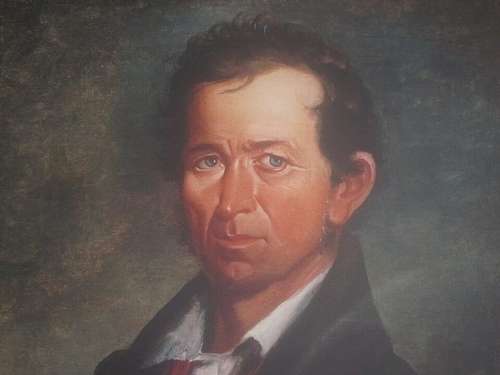
Image: Billy Hathorn, Deaf Smith Portrait, Deaf Smith County Museum, Hereford (2010), CC BY-SA 3.0.
Erastus “Deaf” Smith is a name that stands out in Texas history, known for his remarkable contributions during the Texas Revolution. His role as a scout and spy, despite his hearing impairment, made him a pivotal figure in several key battles.
Smith was a remarkable figure in early Texas history. Despite losing his hearing to a childhood illness, he became one of the most trusted scouts under Sam Houston. Born on April 19, 1787, in Dutchess County, New York, Smith moved to the Mississippi Territory with his family at age eleven. His first visit to Texas was brief in 1817, but in 1821, he returned to the region to recover his health and made Texas his home.
Role in the Texas Revolution
Erastus “Deaf” Smith played a critical role in the Texas Revolution, serving as a scout and spy for General Sam Houston. Beginning his service in 1835, Smith’s intelligence-gathering skills were essential in several key battles. His keen observation and ability to navigate the terrain despite his hearing impairment made him an invaluable asset. One of his notable achievements was during the Battle of Concepción on October 28, 1835, where his reconnaissance helped the Texian forces secure a significant victory.
Smith’s most impactful contribution came during the Battle of San Jacinto on April 21, 1836. His scouting reports and strategic advice were pivotal in General Houston’s surprise attack on the Mexican forces led by General Santa Anna. This decisive battle resulted in a Texian victory, securing Texas’ independence from Mexico. Smith’s efforts during the revolution demonstrated his courage and tactical acumen, solidifying his place as a key figure in Texas history.
After the fall of the Alamo, Smith was tasked by Houston with gathering critical information. He returned with Susannah Dickerson and her child, survivors of the siege, to Houston’s camp. Deaf Smith’s valor and effectiveness earned him command of a company of Texas Rangers post-revolution, tasked with defending frontier settlements from raids.
Smith’s contributions extended beyond the battlefield. Known for his calm demeanor even in dangerous situations, he was a vital courier and messenger during the Texas Revolution. His network of connections and knowledge of the terrain made him invaluable in espionage and reconnaissance missions.
Capture of Mexican Couriers
In December 1835, Erastus “Deaf” Smith achieved a significant feat by capturing Mexican couriers carrying critical dispatches. These couriers were en route to deliver important messages to Mexican forces, but Smith intercepted them, securing the documents. The intelligence contained in these dispatches provided the Texian army with valuable insights into Mexican troop movements and strategies.
Smith’s capture of the couriers demonstrated his exceptional skills and the vital role he played in the Texian fight for independence. The information he obtained allowed the Texian leadership to make informed strategic decisions, contributing to their subsequent victories. This act of bravery and cunning further solidified Smith’s reputation as a key asset to the Texian cause, showcasing his unwavering commitment to the fight for Texas independence.
Later Life and Death
After the Texas Revolution, Erastus “Deaf” Smith continued to serve the newly established Republic of Texas in various military and civilian roles. He remained active in the defense of Texas, participating in campaigns against Native American tribes and assisting in maintaining the security of the new republic. Despite his hearing impairment, Smith’s dedication and skills were consistently recognized and valued by his peers and leaders.
Erastus Smith’s health began to decline in the late 1830s, leading to his death on November 30, 1837, in Richmond, Texas. He was buried in the town of Richmond, where a monument stands in his honor, commemorating his significant contributions to Texas history. Smith’s life and service left an enduring legacy, and he is remembered as one of the pivotal figures in the fight for Texas independence.
Conclusion
Erastus “Deaf” Smith’s exceptional skills as a scout and spy, despite his hearing impairment, made him an invaluable asset in key battles and strategic operations. From his early life and involvement in critical battles like Concepción and San Jacinto to his continued service in the Republic of Texas, Smith’s dedication and bravery were exemplary.

Comments (0)
No comments yet. Be the first to share your thoughts.
Leave a comment