


By the early 1890s, the open-range era was fading, but some cowboys refused to retire quietly.
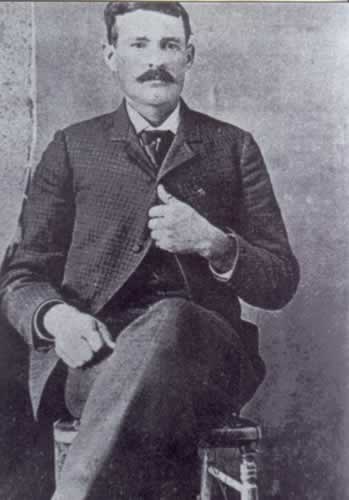
One of them was Thomas Edward “Black Jack” Ketchum, a San Saba County native who traded ranch work for outlaw life.
Born in San Saba County, Texas, in 1863, Ketchum drifted west as a young man, working as a cowboy in the Pecos River Valley of New Mexico. By 1890, his older brother Sam Ketchum had joined him there, and the two slipped into the gray zone between ranch hands and full-time troublemakers.
They were Texans by birth and habit, but their most famous score would happen just across the state line—on a payroll train running through the New Mexico Territory. That job became known as the Santa Fe train robbery of 1892, and it would bankroll the Ketchum gang’s wildest years.
The Setup: A Santa Fe Payroll Train to Deming
In 1892, the Atchison, Topeka & Santa Fe Railway was carrying more than passengers and cattle.
It hauled serious money—payrolls, cash shipments, and valuables—across long, lightly protected stretches of track.
According to multiple historical accounts, Ketchum, his brother Sam, and several accomplices learned that a Santa Fe train was headed to Deming, New Mexico Territory, carrying a large payroll.
The gang decided that this train would be their big move out of simple rustling and into high-stakes robbery.
They picked their spot near Nutt, New Mexico, a small water station about 20 miles north of Deming.
It was remote enough for an ambush but important enough that the payroll train had to slow down and stop.
In the late 19th century, this was a familiar pattern.
Long, isolated stretches of track made railroads tempting targets for outlaws who knew the land—and the Ketchums knew this country well.
The Robbery at Nutt
The Santa Fe payroll train rolled toward Nutt carrying the money that would keep railroad operations and workers paid. The Ketchum gang planned to take that cash in one decisive strike.
Accounts agree on the core outline: the gang held up the train at gunpoint just outside Nutt, forced crew members to cooperate, and went to work on the valuables aboard. They weren’t there for small items—they were there for the payroll.
Contemporary and later sources estimate that the gang made off with around $20,000 from the robbery. That’s an enormous sum for the 1890s—worth hundreds of thousands of dollars in modern terms.
Reports say the gang escaped cleanly, vanishing back into the ranch country and outlaw hideouts they knew so well. There was no dramatic shootout that night, no heroic last-minute rescue—just a quiet, efficient holdup that stunned the railroad and caught the region’s attention.
Texas Hears About It
Even though the holdup happened in the New Mexico Territory, the impact of the Santa Fe train robbery rippled straight into Texas.
The Ketchums were already known as Texas cowboys, and Texas papers and storytellers took note that “homegrown” outlaws had pulled off a major hit on a big railroad. Later Texas-focused histories would describe how “ever since their Santa Fe train robbery in 1892 which netted the gang $20,000, Tom and Sam Ketchum and their gang had been living it up.”
That one robbery gave the gang the money they needed to drift between New Mexico, Colorado, and West Texas, buying supplies, horses, and time. In the process, the Ketchum name became part of the same outlaw conversation as other Western train robbers who haunted Texas headlines.
Living High After the Heist
With the Santa Fe payroll in their pockets, the Ketchum brothers and their associates didn’t exactly lay low.
Texas history notes that after 1892, the gang began “living it up,” spending freely and leaning harder into outlaw work rather than drifting back to ordinary ranch jobs. The Santa Fe robbery had done more than pay them; it had turned them into full-time professionals.
They roamed a broad region—eastern Arizona, northeastern New Mexico, and West Texas—stealing livestock, planning more holdups, and mixing with other outlaw circles tied to the Hole-in-the-Wall country. Even when the robberies themselves happened out of state, the gang’s roots and refuge points often looped back through Texas ranch country.
In the public imagination, the Santa Fe train robbery became the job that elevated them from minor trouble to major outlaw threat.
The Turn Back Toward Texas: The Jap Powers Killing
For all the money and temporary glamour, the gang’s Texas ties eventually pulled them into deeper trouble.
In 1895, Tom “Black Jack” Ketchum and several associates were involved in the killing of their neighbor John N. “Jap” Powers in Tom Green County, Texas. The motive isn’t entirely clear in surviving accounts, but the result was: a neighbor dead, and pressure mounting on the Ketchums.
After the killing, Tom and Sam left Texas again and headed back into the New Mexico Territory.
By then, lawmen were paying close attention.
The Santa Fe burglary had shown just how much money was at stake when a gang hit a train.
Now, with the Powers killing on top of that, the Ketchums weren’t just distant train robbers—they were wanted men with Texas blood on their hands.
From the Santa Fe Heist to the Gallows
The 1892 Santa Fe train robbery wasn’t the last time Ketchum tangled with a railroad. Over the rest of the decade, he and his associates were linked to other holdups in the region along lines in New Mexico and Colorado.
Then came the final mistake.
In 1899, Ketchum attempted to rob a train single-handedly at a familiar spot along the Colorado & Southern line near Twin Mountain in New Mexico. This time, the plan went wrong. The conductor recognized him, shot him, and Ketchum was eventually captured and taken into custody.
Territorial New Mexico had recently toughened its laws, making the attempted derailment or robbery of a train a capital offense—even if no one was killed. Ketchum was convicted and sentenced to death.
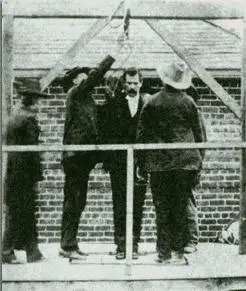
In 1901, he was hanged in Clayton, New Mexico Territory, in an execution so badly miscalculated that the rope decapitated him. It was one of the most gruesome hangings of the era—and it cemented his infamy.
Why the 1892 Santa Fe Robbery Still Sticks in Texas Memory
The Santa Fe train robbery of 1892 didn’t happen inside Texas borders, but it sits squarely in the story of Texas outlaws.
The gang’s leader was a Texan, born and raised. The money they stole helped fuel years of crime that bounced back and forth across the Texas line, affecting ranchers, neighbors, and lawmen.
For Texans following the news at the time, the message was clear:
Train robbery wasn’t some distant Kansas or Missouri problem. It was tied to men who came from towns and counties they recognized, who rode the same trails and worked the same ranch country.
The 1892 heist also highlights how the railroads changed the risk and reward of crime.
Once money began traveling by rail in big, predictable shipments, a small group of armed men could walk away with a fortune in a single night.
And as that happened, law enforcement in Texas and beyond had to adapt—tracking gangs across state lines, coordinating with railroad detectives, and treating train holdups as a serious frontier threat rather than isolated stunts.
Takeaway
The Santa Fe train robbery of 1892 is remembered as the job that turned Tom “Black Jack” Ketchum and his crew from rough cowboys into headline outlaws. It took place near Nutt, New Mexico, but it was planned and carried out by men whose lives and crimes were deeply tied to Texas.
That one night’s work—about $20,000 in railroad payroll—funded years of drifting, dealing, and danger, and helped set the stage for the violence that followed in Tom Green County and beyond.
Today, the robbery sits alongside other famous Texas-connected train holdups in Old West lore, a reminder of the moment when rails, money, and desperate men collided. It’s part crime story, part cautionary tale, and part snapshot of a time when a single train under a big Western sky could carry enough cash to tempt a cowboy into becoming an outlaw.
Comments (0)
No comments yet. Be the first to share your thoughts.
Leave a comment