


Some places are difficult to describe in just a few words, but Texas has developed an identity that is immediately recognizable. Its enormous size, distinctive traditions, complicated history, and strong regional pride have made it one of the most talked-about states in America.
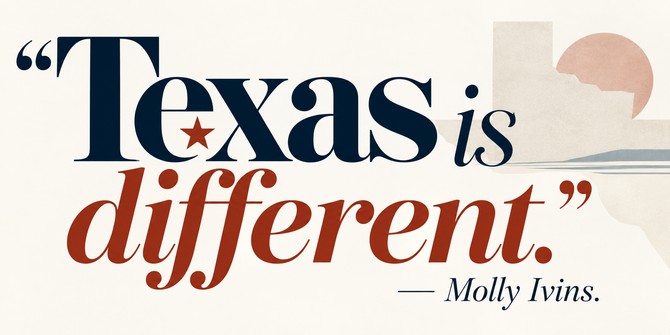
The statement attributed to Molly Ivins captures this uniqueness with remarkable simplicity. It suggests that Texas operates according to its own customs, attitudes, and expectations, often standing apart from the rest of the country.
However, the quote can also be interpreted with a touch of humor. Being different does not necessarily mean being better or worse. It simply means that Texas has characteristics that make it difficult to compare with anywhere else.
Molly Ivins and Her Perspective on Texas
Molly Ivins was an American journalist, author, and political commentator known for her sharp humor and observations about Texas politics and culture.
Born in California and raised in Houston, Ivins developed a deep familiarity with the state's political personalities, social traditions, and distinctive attitudes. Her writing frequently examined the contradictions of Texas life, combining affection for its people with criticism of political decisions and social inequalities.
Unlike writers who portrayed Texas only through its romanticized history, Ivins often highlighted its complexities. She recognized that the state's independent spirit could produce both admirable qualities and frustrating contradictions.
The statement reflects the kind of observation associated with her writing: brief, direct, and open to several interpretations.
A State Shaped by Contrasts
One of the most distinctive characteristics of Texas is the contrast between its different regions and communities.
West Texas is known for its deserts, mountains, and expansive landscapes, while East Texas features forests and a more humid environment. Central Texas has rolling hills and growing urban centers, while the Gulf Coast supports major ports, industries, and coastal communities.
These geographic differences are matched by cultural and economic diversity. Texas includes small agricultural towns, historic ranching communities, major technology centers, and some of the largest metropolitan areas in the United States.
The result is a state where different ways of life exist alongside one another, making any single description of Texas incomplete.
The Influence of Texas History
Texas's unusual political history has also contributed to its distinct identity. After declaring independence from Mexico in 1836, Texas existed as an independent republic before joining the United States in 1845.
This period remains central to the state's historical identity and is reflected in symbols such as the Lone Star Flag.
Texas history also includes the experiences of Indigenous peoples, Spanish colonists, Mexican communities, enslaved African Americans, and later generations of immigrants. Their contributions have shaped the state's culture, economy, and social development.
These different historical influences help explain why Texas cannot be understood through a single tradition or perspective.
The Humor and Contradictions of Texas Culture
Molly Ivins was known for using humor to point out the unusual and sometimes contradictory aspects of Texas society.
Texas has a reputation for celebrating independence and self-reliance, yet its communities also depend on cooperation and shared institutions. The state is famous for its rural traditions, but much of its population lives in large urban areas.
These contrasts provide an interesting way to understand the quote. Texas is different not because everyone shares the same beliefs or experiences, but because its many identities exist within a strong sense of regional pride.
What Makes Texas Memorable
Part of Texas's appeal comes from its recognizable cultural traditions. Barbecue, rodeos, country music, Tex-Mex cuisine, and historic landmarks all contribute to the state's reputation.
However, Texas's character extends beyond these familiar symbols. Its contributions to science, technology, literature, business, and the arts demonstrate that the state continues to develop while maintaining connections to its past.
This combination of tradition and change makes Texas a place that inspires curiosity, affection, debate, and sometimes criticism.
The Lasting Meaning of the Quote
“Texas is different” may sound like a simple observation, but it expresses a broader idea about the importance of regional identity.
For Molly Ivins, Texas was a place worth examining, celebrating, and questioning. Its unusual personalities, political traditions, and cultural contradictions provided material for much of her writing.
Ultimately, the quote reminds us that Texas cannot be defined by a single stereotype. Its distinctiveness comes from the combination of people, places, history, and attitudes that continue to shape the Lone Star State.