


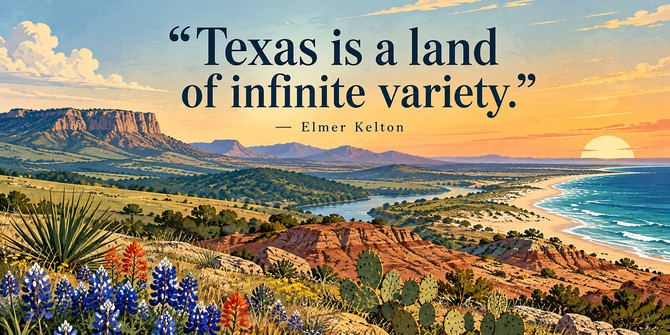
Few places in the United States offer the range of landscapes, cultures, traditions, and experiences found across Texas. From expansive deserts and rugged mountains to coastal communities and growing metropolitan areas, the Lone Star State is known for its remarkable diversity.
Elmer Kelton's words celebrate this variety, suggesting that Texas cannot be defined by a single landscape, lifestyle, or cultural identity. Instead, its character comes from the many different places and people that make up the state.
The phrase "infinite variety" is an expression of admiration, emphasizing how much there is to discover and appreciate within Texas.
A State of Remarkably Different Landscapes
Texas covers an enormous geographic area, and its natural surroundings change dramatically from one region to another. West Texas is known for its deserts, mountains, and wide-open spaces, while East Texas features forests, lakes, and a more humid climate.
Central Texas offers rolling hills, rivers, and limestone landscapes, while the Gulf Coast is characterized by beaches, bays, wetlands, and coastal communities. The Panhandle, meanwhile, is home to vast plains and dramatic canyon formations.
This geographic diversity creates different environments for wildlife, agriculture, recreation, and everyday living. Traveling across Texas can feel like visiting several distinct regions within a single state.
The Cultural Diversity of Texas
Beyond its geography, Texas is home to a wide range of cultural traditions shaped by centuries of history and migration. Indigenous peoples, Spanish and Mexican communities, African Americans, European immigrants, and more recent arrivals have all contributed to the state's identity.
These influences can be seen in Texas cuisine, architecture, music, festivals, and local customs. Tex-Mex dishes, German-influenced communities in the Hill Country, and the cowboy traditions of ranching regions are just a few examples of this cultural variety.
Rather than having one uniform identity, Texas brings together traditions that differ by region while contributing to a shared sense of belonging.
Elmer Kelton's Perspective on Texas
Elmer Kelton was a celebrated Texas author best known for his Western novels and stories about ranching life. Born in Andrews County, Texas, in 1926, he developed a deep understanding of the state's rural communities, landscapes, and history.
His writing often portrayed the challenges faced by ranchers, cowboys, and families adjusting to changing economic and social conditions. Through his characters, Kelton explored the practical realities of life in Texas rather than relying solely on romanticized images of the American West.
His observation about Texas's variety reflects the perspective of someone familiar with the differences between its regions and communities.
More Than Cowboys and Wide-Open Spaces
Texas is frequently associated with cowboy hats, cattle ranches, rodeos, and expansive landscapes. Although these traditions remain important parts of its heritage, they represent only a portion of what the state offers.
Modern Texas is also home to major centers of technology, medicine, education, energy, and international commerce. Cities such as Houston, Dallas, Austin, and San Antonio each have distinct histories, economies, and cultural identities.
The contrast between rural communities and large cities further illustrates Kelton's point. Texas is a place where longstanding traditions exist alongside modern development and new ideas.
The Lasting Meaning of the Quote
Elmer Kelton's words encourage people to recognize Texas as a place of contrasts and possibilities. Its geography, history, communities, and traditions cannot be reduced to a single description.
The quote also serves as a reminder that understanding Texas requires looking beyond familiar stereotypes. Every region has its own stories, landscapes, and cultural contributions.
Ultimately, “Texas is a land of infinite variety” celebrates the many qualities that make the Lone Star State distinctive. It suggests that the true character of Texas lies not in one particular feature, but in the remarkable diversity found throughout its vast territory.