


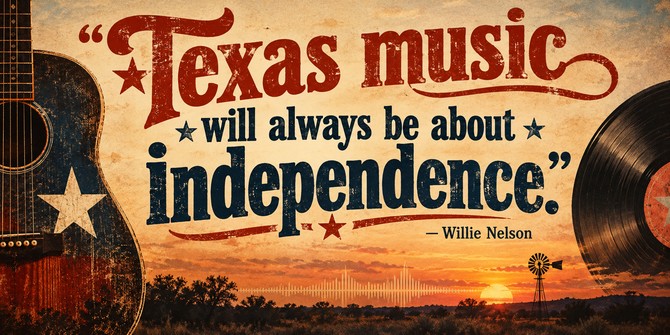
Texas music has never been limited to one sound, style, or set of rules. From traditional country and Western swing to blues, rock, Tejano, and Americana, the state's musical heritage reflects a willingness to experiment and create something distinctive.
Willie Nelson's words express the belief that independence is one of the defining qualities of Texas music. Rather than simply following industry trends or established expectations, Texas musicians have often emphasized artistic freedom, originality, and staying true to their personal experiences.
The quote suggests that the spirit of Texas music is not determined by a particular genre but by the freedom musicians have to express themselves.
Willie Nelson and the Rise of Outlaw Country
Willie Nelson played a major role in changing the direction of country music during the 1970s. After years of working within the Nashville music industry, he returned to Texas, where he found a creative environment that allowed him to develop a more personal musical style.
Alongside artists such as Waylon Jennings, Nelson became closely associated with the outlaw country movement. This movement challenged conventional approaches to country music production and gave artists greater control over their recordings, performances, and musical identities.
Austin became an important center for this musical transformation, bringing together country musicians, rock audiences, and performers from different backgrounds.
Nelson's career demonstrates how independence can encourage artists to challenge expectations while remaining connected to their musical roots.
Texas Music and Its Many Influences
The independence of Texas music is also reflected in its remarkable diversity. The state's musical traditions have developed through the contributions of different communities, cultures, and generations.
Texas blues artists helped shape American popular music, while Western swing combined country music with jazz and dance rhythms. Tejano music developed through the interaction of Mexican, American, and European musical traditions, creating sounds closely associated with South Texas.
Country, rock, gospel, folk, and conjunto music have also contributed to the state's musical identity.
These styles demonstrate that Texas music has never followed a single formula. Its character comes partly from the willingness of musicians to combine influences and explore new creative directions.
The Importance of Artistic Freedom
For many Texas musicians, independence means having the freedom to write honest songs, develop an individual sound, and connect with audiences without compromising their artistic vision.
This attitude has helped Texas develop a reputation for producing performers who value authenticity and personal expression.
Artists such as Townes Van Zandt, Guy Clark, Stevie Ray Vaughan, and Willie Nelson followed different musical paths, yet each became associated with a distinctive approach to songwriting or performance.
Their contributions illustrate how creative independence can produce music that remains influential across generations.
Music as an Expression of Texas Identity
The connection between music and independence reflects a broader cultural characteristic associated with Texas. The state has long celebrated self-reliance, individuality, and the freedom to follow one's own path.
These values frequently appear in Texas songs about traveling, working, relationships, hardship, and life in small towns or large cities.
Music also provides a way for Texans to express their connection to particular places and communities. Songs about the Hill Country, West Texas, and other regions preserve local experiences while introducing listeners to different aspects of the state's identity.
Through these stories, Texas music becomes both a form of entertainment and a reflection of the people who create it.
The Lasting Meaning of the Quote
Willie Nelson's statement emphasizes that the strength of Texas music comes from its independent character. Musical styles may change, new artists may emerge, and technology may influence how songs are produced, but the desire for creative freedom remains an important part of the state's musical heritage.
The quote also recognizes that independence does not mean rejecting tradition. Many Texas musicians honor earlier generations while finding new ways to interpret familiar sounds and stories.
Ultimately, “Texas music will always be about independence” celebrates the freedom to create music without unnecessary limitations. It reflects a musical culture where individuality, experimentation, and personal expression continue to shape the songs and artists associated with the Lone Star State.