


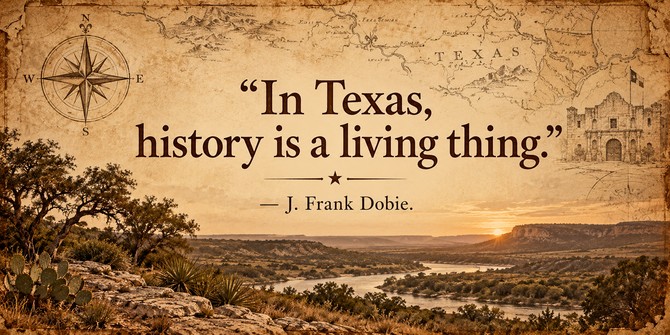
History is often associated with old books, preserved documents, and events that happened long ago. In Texas, however, the past remains visible in everyday life through historic landmarks, family traditions, local celebrations, and stories passed down through generations.
The statement attributed to J. Frank Dobie suggests that Texas history is not something confined to museums or textbooks. Instead, it continues to influence the way people understand their communities, preserve their heritage, and identify with their home state.
The expression "a living thing" emphasizes that history remains meaningful because people continue to remember, discuss, and interpret it.
The Deep Historical Roots of Texas
Texas has a long and complex history shaped by different peoples, cultures, and political changes. Indigenous communities inhabited the region for thousands of years before European exploration and settlement.
Spanish colonization, Mexican governance, the Texas Revolution, and the establishment of the Republic of Texas all contributed to the state's development.
Texas later joined the United States in 1845, experienced the Civil War and Reconstruction, and underwent major economic transformations through agriculture, cattle ranching, railroads, and oil production.
These historical developments continue to influence the state's geography, cultural traditions, political institutions, and communities.
J. Frank Dobie's Passion for Texas History
J. Frank Dobie was an influential Texas writer, folklorist, and educator known for preserving stories about the American Southwest.
Born in Live Oak County, Texas, in 1888, Dobie developed a lifelong interest in the region's history, ranching traditions, folklore, and natural environment.
His books, including Tales of Old-Time Texas, The Longhorns, and Coronado's Children, explored the legends, personalities, and historical experiences that shaped Texas and the Southwest.
Dobie believed that stories told by ordinary people were valuable parts of history. His work helped preserve oral traditions that might otherwise have disappeared as communities and lifestyles changed.
The quote reflects the importance of historical memory and storytelling found throughout his writing.
History Preserved Through Stories and Traditions
One reason Texas history remains so visible is the importance of storytelling in its cultural identity.
Accounts of early settlements, cattle drives, frontier communities, and major historical events have been passed down through families, books, music, and local traditions.
Historic places such as the Alamo, the San Jacinto Battleground, and the Spanish missions of San Antonio also provide physical connections to the past.
These locations allow people to encounter history through preserved buildings, monuments, landscapes, and educational programs.
However, historical stories are not always complete or universally interpreted. Different communities may remember the same events in different ways, making continued research and discussion essential to understanding the past.
The Influence of History on Modern Texas
Texas continues to draw on its history when celebrating holidays, naming streets and buildings, preserving architectural landmarks, and maintaining regional traditions.
Texas Independence Day, Juneteenth, and other commemorations connect present-day communities with important historical experiences.
The state's musical heritage, food traditions, and cultural festivals also reflect influences that developed over generations.
Even as Texas grows and modernizes, these historical connections help residents understand how their communities developed and why particular customs remain important.
Why Keeping History Alive Matters
Preserving history involves more than remembering famous leaders and major battles. It also means recognizing the experiences of families, workers, Indigenous peoples, immigrants, and communities whose contributions helped shape Texas.
Personal letters, photographs, oral histories, historic buildings, and local archives provide valuable information about everyday life in earlier generations.
By preserving these materials and sharing their stories, communities help future generations develop a more complete understanding of the past.
This process also allows historical interpretations to change as new evidence and perspectives emerge.
The Lasting Meaning of the Quote
“In Texas, history is a living thing” expresses the idea that the past continues to influence the present.
The statement recognizes that Texas history survives not only through official records and monuments but also through cultural traditions, family memories, and the stories people choose to preserve.
Ultimately, the quote reminds us that history is an ongoing connection between past and present generations. In Texas, that connection remains especially visible through the places, people, and traditions that continue to shape the identity of the Lone Star State.