


Long before Texas became known for its modern cities, major industries, and thriving cultural communities, it occupied a special place in American stories about exploration, adventure, and opportunity. Its expansive landscapes and frontier history helped shape an image of a place where people could pursue new possibilities and build different futures.
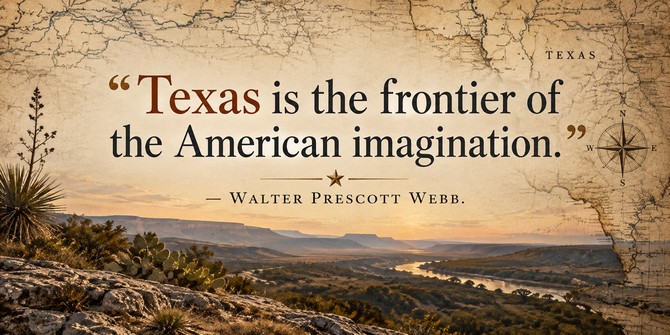
The statement attributed to Walter Prescott Webb captures this connection between Texas and the American imagination. It suggests that Texas represents more than a physical frontier. It is also a symbol of ambition, independence, and the human desire to discover what lies beyond familiar boundaries.
The quote emphasizes how geography, history, and storytelling have contributed to Texas's distinctive place in American culture.
Texas and the Idea of the American Frontier
The American frontier has often been associated with westward expansion, settlement, and the search for new opportunities. Texas became an important part of this historical narrative because of its vast territory, ranching traditions, and role in the development of the American West.
During the nineteenth century, Texas experienced major changes as settlers, ranchers, merchants, and expanding transportation networks transformed its economy and communities.
However, the region was already home to Indigenous peoples with established societies, territories, and traditions long before European colonization and American expansion.
Understanding the frontier therefore requires recognizing both the opportunities imagined by newcomers and the displacement and conflicts experienced by existing communities.
Walter Prescott Webb's Understanding of Texas
Walter Prescott Webb was an influential American historian born in Panola County, Texas, in 1888. He became particularly known for studying the relationship between geography, environment, and historical development.
His influential book The Great Plains, published in 1931, examined how the environment of the Great Plains shaped settlement patterns, agriculture, transportation, and everyday life.
Webb believed that the physical characteristics of a region could significantly influence its history. His work helped explain how people adapted their tools, institutions, and lifestyles to the challenges of the American West.
The quote reflects themes associated with his historical perspective, particularly the connection between Texas landscapes and the ideas that developed around them.
The Power of Texas Landscapes
Texas's geography has played an important role in shaping how people imagine the state. Its wide plains, rugged mountains, deserts, forests, and coastal regions create a sense of scale and variety.
Places such as the Big Bend region, the Texas Panhandle, and the Hill Country have inspired generations of writers, artists, photographers, and travelers.
The openness of these landscapes often symbolizes possibility and independence. They encourage images of long journeys, unfamiliar horizons, and the freedom to explore.
This symbolic meaning helps explain why Texas has remained closely connected to frontier imagery even as its population and economy have become increasingly urban.
Texas in Literature and Popular Culture
Texas has occupied a prominent place in American storytelling for generations. Novels, Western films, country songs, and historical accounts have helped establish its reputation as a land of adventure and memorable personalities.
Stories about cattle drives, frontier settlements, and independent individuals often present Texas as a setting where people face difficult choices and pursue ambitious goals.
These portrayals have sometimes romanticized the past, but they have also helped preserve public interest in Texas history.
The state's influence on popular culture demonstrates how a real place can become a powerful symbol, representing ideas that extend far beyond its geographic boundaries.
From the Historical Frontier to Modern Possibilities
Although the era of westward settlement has ended, the frontier remains a useful metaphor for innovation and discovery.
Modern Texas is home to major industries in energy, aerospace, technology, medicine, and scientific research. These fields represent different kinds of frontiers, where progress depends on experimentation, investment, and new ideas.
The connection between historical exploration and modern innovation gives the quote an additional meaning. Texas can represent the willingness to explore unfamiliar possibilities, whether through geographic expansion in the past or technological development today.
The Lasting Meaning of the Quote
“Texas is the frontier of the American imagination” expresses the powerful role that Texas has played in stories about freedom, opportunity, adventure, and national identity.
Its history and landscapes have inspired an enduring image of a place where people challenge boundaries and imagine different futures.
Ultimately, the statement suggests that Texas is not only a destination on a map. It is also an idea that continues to influence how Americans understand ambition, independence, and the possibilities of the future.