


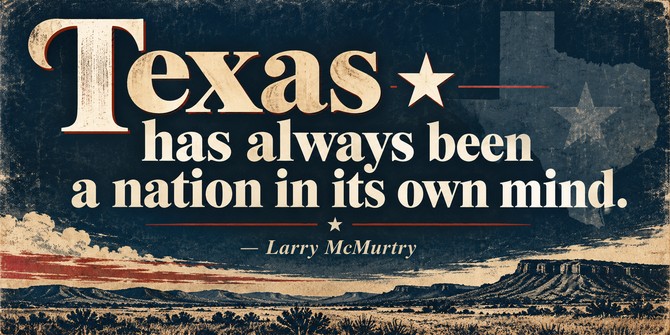
Texas has a reputation for seeing itself as something more than an ordinary American state. Its independent history, distinctive traditions, and strong sense of regional pride have contributed to an identity that often feels separate from the rest of the country.
The statement attributed to Larry McMurtry captures this unusual relationship between Texas and its place within the United States. It suggests that Texans have maintained a sense of individuality and independence even after becoming part of a larger nation.
The phrase “a nation in its own mind” also carries a hint of humor. It recognizes the confidence with which Texas celebrates its identity, sometimes treating its traditions, history, and accomplishments as though they belong to a country of their own.
The Historical Roots of Texas Independence
Texas has a unique political history that helps explain its strong sense of independence. After declaring independence from Mexico on March 2, 1836, Texas became a separate republic with its own government, laws, and national identity.
The Republic of Texas existed for nearly a decade before joining the United States in 1845. During this period, Texas operated as an independent nation, maintained diplomatic relations, and faced the challenges of governing its territory.
This history remains an important part of Texas culture. The Lone Star Flag, Texas Independence Day, and numerous historical landmarks continue to reflect the state's years as a republic.
Although Texas is now firmly part of the United States, the memory of its independent past contributes to the state's distinctive identity.
Larry McMurtry's Perspective on Texas Culture
Larry McMurtry was an acclaimed Texas novelist and screenwriter whose works frequently explored the relationship between Texas history, cultural identity, and changing social traditions.
Born in Archer City, Texas, McMurtry grew up surrounded by the ranching culture that would later influence much of his writing. His novels, including Lonesome Dove, The Last Picture Show, and Horseman, Pass By, examined both the romantic image of Texas and the everyday realities of its people.
McMurtry often challenged idealized portrayals of the American West, revealing the complexities behind its celebrated traditions and personalities.
The statement reflects themes associated with his writing, particularly the way Texas has developed a powerful image of itself through history, storytelling, and regional pride.
A Strong Sense of Texas Identity
For many Texans, state identity holds considerable personal meaning. Traditions involving music, food, sports, rodeos, and historical celebrations help reinforce a shared connection to the Lone Star State.
Texas also has recognizable cultural symbols, including the Lone Star Flag, the Alamo, cowboy heritage, and the familiar saying that everything is bigger in Texas.
These symbols contribute to a sense of belonging that can extend beyond state borders. Texans who move elsewhere often maintain connections to their home state through family traditions, regional customs, and community celebrations.
This attachment helps explain why Texas is sometimes described as having a personality of its own.
The Difference Between Pride and Independence
Although the quote refers to Texas as a nation, its meaning does not necessarily suggest a desire for political separation from the United States.
Instead, it can be understood as a description of cultural independence. Texas has developed traditions, attitudes, and historical narratives that distinguish it from other states.
This distinction is important because Texas identity is not uniform. The state includes major metropolitan areas, rural communities, border regions, and culturally diverse populations with different perspectives on history and public life.
The idea of Texas as a nation within a nation is therefore best understood as a cultural expression rather than a literal description of its political status.
The Role of Texas Pride in Shaping Its Reputation
Texas pride has influenced how the state is represented in literature, entertainment, tourism, and popular culture.
Stories about frontier life, cattle ranching, oil discoveries, and independent personalities have helped establish an image of Texas as a place that values confidence and self-reliance.
At the same time, this larger-than-life reputation can create stereotypes that overlook the diversity and complexity of modern Texas.
McMurtry's literary work frequently explored the contrast between these popular legends and the realities of life in the state.
The quote can therefore be read as both an acknowledgment of Texas pride and a lighthearted observation about the state's tendency to celebrate its own uniqueness.
The Lasting Meaning of the Quote
“Texas has always been a nation in its own mind” expresses the enduring strength of Texas's regional identity.
Its history as an independent republic, recognizable cultural traditions, and reputation for self-reliance have contributed to a sense of individuality that continues to distinguish it within the United States.
Ultimately, the quote suggests that Texas's identity is shaped not only by its political boundaries but also by the stories, memories, and traditions its people share. It captures the confidence, humor, and historical awareness that have helped make the Lone Star State one of the most recognizable places in America.