


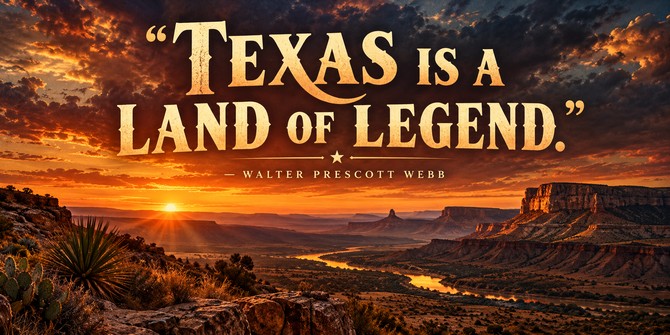
From stories of frontier life and cattle drives to accounts of famous historical figures, Texas has inspired generations of legends that continue to shape its identity. Its vast landscapes, dramatic history, and memorable personalities have helped establish a reputation that extends far beyond its borders.
The statement attributed to Walter Prescott Webb captures the importance of these stories. It suggests that Texas is not defined solely by historical events but also by the way those events have been remembered, retold, and sometimes transformed into legends.
The quote reflects the powerful relationship between history and storytelling, showing how the past can influence a place's identity long after the original events have occurred.
The Legends That Shaped Texas
Texas history includes numerous figures and events that have become important parts of American folklore. The Battle of the Alamo, the Texas Revolution, and the era of cattle drives have inspired countless books, films, and historical accounts.
Figures such as Sam Houston, Davy Crockett, and James Bowie became closely associated with stories of courage, independence, and frontier adventure.
Over time, some of these accounts developed into larger-than-life narratives, blending documented historical events with popular interpretations and imaginative storytelling.
These legends helped create the familiar image of Texas as a place of adventure, determination, and extraordinary personalities.
Walter Prescott Webb's Understanding of Texas History
Walter Prescott Webb was an influential Texas historian whose work examined the relationship between geography, environment, and the development of the American West.
Born in Panola County, Texas, in 1888, Webb became known for his research on frontier life and the historical forces that shaped settlement across the Great Plains.
His influential book The Great Plains, published in 1931, explored how geography influenced agriculture, transportation, technology, and social development. He also wrote The Texas Rangers: A Century of Frontier Defense, examining the history of one of the state's most recognizable institutions.
Webb's work provides a useful perspective on the quote because he studied the historical realities behind many of the stories that contributed to the legend of Texas.
The Role of the Frontier in Texas Folklore
The Texas frontier occupies an important place in the state's popular imagination. Stories about cowboys, ranchers, lawmen, and settlers have become closely connected to its cultural identity.
Cattle drives during the nineteenth century contributed to the development of cowboy traditions that later became famous through Western novels and films.
However, frontier history was more complicated than these popular portrayals suggest. Indigenous peoples had lived in the region for thousands of years, and territorial expansion brought conflict, displacement, and major changes to established communities.
Understanding these experiences helps distinguish historical reality from romanticized frontier legends.
How Legends Become Part of Texas Identity
Legends play an important role in how communities remember their past. They often focus on extraordinary individuals, significant events, or experiences that capture the imagination.
In Texas, these stories have contributed to traditions involving rodeos, country music, historical reenactments, and local festivals. They also appear in the names of streets, schools, landmarks, and public institutions.
As stories are passed from one generation to another, they help create a shared sense of identity and belonging.
However, legends can change over time. Historical research is important because it helps separate documented events from exaggerations and popular myths.
The Importance of Preserving Texas Stories
Preserving the stories of Texas means recognizing the experiences of many different communities, not only those of its most famous historical figures.
Indigenous traditions, Mexican and Tejano heritage, African American history, immigrant experiences, and local folklore all contribute to the state's historical identity.
Museums, archives, historians, and storytellers help preserve these accounts so future generations can better understand the past.
By examining different perspectives, Texans can appreciate their state's legends while developing a more complete understanding of the events and people behind them.
The Lasting Meaning of the Quote
“Texas is a land of legend” reflects the remarkable influence of storytelling on the Lone Star State's identity.
Its history has inspired memorable characters, dramatic narratives, and cultural traditions that continue to capture public interest.
Ultimately, the quote suggests that Texas is remembered not only for what happened within its borders but also for the stories people continue to tell about it. These legends connect the past with the present, helping shape how Texans and visitors understand the state's distinctive character.