


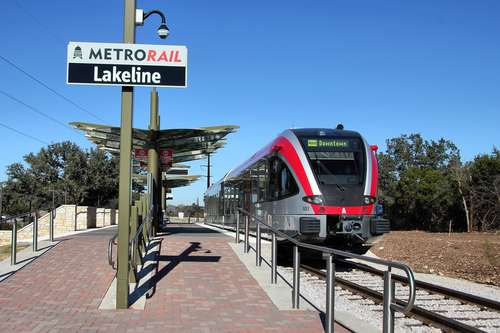
Image: Larry D. Moore, Lakeline metrorail station 2014, CC BY 4.0
One of the biggest challenges people face after moving to Austin is transportation.
The city continues growing rapidly, and while Austin offers strong job opportunities, entertainment, restaurants, outdoor access, and culture, traffic remains one of the most common frustrations for both newcomers and longtime residents.
Commute times can change dramatically depending on where someone lives.
A neighborhood that seems close on a map may involve major delays during rush hour because of congestion on:
- Interstate 35
- Mopac
- Highway 183
- Loop 360
- or Highway 71
That is why many people relocating to Austin now prioritize commuting convenience almost as heavily as housing itself.
Some residents want access to public transportation like CapMetro rail or bus routes. Others simply want neighborhoods with better highway access or shorter drives into Downtown Austin, the Domain, the airport, or major tech corridors.
The good news is that several Austin neighborhoods and nearby suburbs work especially well for commuters.
Some areas offer direct access to CapMetro’s MetroRail system. Others provide strategic positioning near major employment hubs, allowing residents to avoid crossing the entire city every day.
For anyone trying to settle near Austin while keeping commuting stress more manageable, these are some of the best areas worth considering.
The Domain and North Austin
For many professionals, North Austin has become one of the most practical places to live in the city.
The area surrounding The Domain now functions almost like Austin’s second urban center. Major employers including tech companies, corporate offices, healthcare operations, and business campuses continue concentrating heavily in North Austin, reducing the need for many residents to commute downtown at all.
The area offers:
- apartments
- restaurants
- offices
- shopping
- bars
- coffee shops
- and entertainment
all within a relatively compact district.
One reason North Austin works so well for commuting is highway access.
Residents can quickly connect to:
- Mopac
- Highway 183
- Loop 360
- and portions of Interstate 35
depending on destination.
The area also benefits from nearby CapMetro MetroRail access through stations like Kramer Station and McKalla Station, giving some commuters alternatives to driving.
For professionals working in Austin’s tech sector especially, North Austin often provides one of the easiest overall commuting lifestyles in the metro area.
Cedar Park
Located northwest of Austin, Cedar Park remains one of the most popular suburban choices for commuters.
The city appeals heavily to:
- families
- professionals
- remote workers
- and longtime Austin-area residents
because it balances suburban living with relatively practical access into the city.
Cedar Park offers:
- newer residential neighborhoods
- parks
- schools
- shopping centers
- restaurants
- and expanding commercial development
One major advantage is transit access.
The CapMetro MetroRail Red Line includes the Lakeline Station near Cedar Park, allowing some residents to avoid driving directly into central Austin altogether. For commuters working downtown, the train can significantly reduce the stress tied to Interstate 35 traffic.
The area also provides direct access to Highway 183 and the 183 Toll Road, which many commuters rely on for faster travel into Austin employment centers.
Round Rock
For people working in North Austin, Round Rock often becomes one of the most practical suburban choices in the region.
Located directly north of Austin along Interstate 35, Round Rock combines:
- strong employment access
- suburban neighborhoods
- schools
- parks
- and retail infrastructure
into one of Central Texas’ most established commuter cities.
The area works especially well for residents employed near:
- The Domain
- tech campuses
- healthcare facilities
- and northern office corridors
Round Rock also benefits from a growing local economy, meaning some residents can work entirely within the city itself rather than commuting into Austin daily.
Traffic along Interstate 35 can still become intense during peak hours, but living in Round Rock often allows commuters to avoid the more difficult cross-city driving patterns that affect many Austin residents.
Downtown Austin
While suburban commuting receives most of the attention, living in Downtown Austin can actually eliminate commuting stress entirely for some residents.
Professionals working downtown, near the Capitol, in government offices, or around central business districts often choose downtown apartments specifically to avoid spending hours in traffic.
Downtown Austin provides strong access to:
- walkability
- bike infrastructure
- CapMetro bus routes
- MetroRail access
- and scooter-friendly transportation
Residents can often walk to:
- offices
- restaurants
- grocery stores
- gyms
- bars
- coffee shops
- and entertainment venues
without relying heavily on cars.
The tradeoff is cost.
Downtown housing tends to be significantly more expensive and usually involves smaller living spaces. Still, many professionals decide that avoiding long Austin commutes outweighs the higher rent.
East Austin
East Austin has become one of the city’s most popular residential areas partly because of location.
The neighborhood provides relatively quick access to:
- Downtown Austin
- the airport
- Interstate 35
- Highway 183
- and several major employment corridors
At the same time, East Austin offers strong local identity through:
- coffee shops
- restaurants
- breweries
- food trucks
- and creative spaces
For commuters, the area works especially well because residents can often reach multiple parts of Austin without needing to cross the city entirely.
East Austin also benefits from growing transit infrastructure and increasing bike accessibility, making it one of the easier central neighborhoods for people trying to reduce driving dependence.
Mueller
For residents wanting a highly organized and centrally located neighborhood, Mueller remains one of Austin’s most commuter-friendly developments.
Built on the site of Austin’s former airport, Mueller combines:
- apartments
- single-family homes
- parks
- trails
- restaurants
- grocery stores
- and offices
into one of the city’s most walkable master-planned communities.
The neighborhood’s central location allows relatively easy access to:
- Downtown Austin
- the University of Texas
- East Austin
- and North Austin employment areas
Mueller also has strong public transportation connectivity through CapMetro bus routes and nearby road access to Interstate 35 and Airport Boulevard.
For many residents, Mueller offers one of the best overall balances between urban convenience and neighborhood comfort.
Leander
For commuters willing to live farther from central Austin in exchange for more space and housing value, Leander remains highly popular.
Located northwest of Austin beyond Cedar Park, Leander has grown rapidly because of its:
- newer housing developments
- schools
- parks
- and expanding infrastructure
One major reason Leander stands out is transportation access.
The city serves as the northern endpoint for the CapMetro MetroRail Red Line, giving commuters a direct train route into Downtown Austin.
That rail access significantly changes the experience of living farther from the city center.
Instead of depending entirely on Interstate 35 or Mopac traffic, many residents use MetroRail to reach central Austin more predictably during peak commute hours.
South Austin and Buda
For residents working south of Downtown Austin or near the airport corridor, parts of South Austin and nearby Buda can provide easier commuting patterns than northern suburbs.
South Austin neighborhoods offer relatively quick access to:
- Downtown
- South Congress
- the airport
- and Highway 71
while still maintaining strong neighborhood identity.
Buda, meanwhile, has become increasingly attractive for residents wanting:
- more affordable housing
- suburban neighborhoods
- and manageable access into Austin
The area benefits from Interstate 35 access, although traffic can still become heavy during peak periods.
For many commuters, though, living south of the city helps avoid some of the cross-town congestion that affects east-west travel across Austin.
Public Transportation in Austin
Austin is still a heavily car-dependent city overall, but public transportation options continue expanding.
CapMetro remains the region’s primary transit provider and operates:
- MetroRail
- bus routes
- rapid bus services
- and park-and-ride facilities
The MetroRail Red Line currently connects:
- Leander
- Cedar Park area stations
- North Austin
- East Austin
- and Downtown Austin
For residents living near rail stations, transit can dramatically reduce commuting stress.
Austin also continues investing in additional transit improvements through long-term infrastructure projects and expanded transportation planning.
Still, many residents combine multiple commuting methods rather than relying entirely on public transportation alone.
Why Commute Quality Matters So Much in Austin
Many newcomers underestimate how heavily commuting shapes daily life in Austin.
A stressful drive can quickly affect:
- work-life balance
- social schedules
- family time
- and overall quality of life
That is why choosing the right location often matters more than simply finding the biggest home or trendiest neighborhood.
Some residents ultimately decide smaller living spaces closer to work improve daily life significantly more than larger homes farther away.
Others prioritize suburban comfort and use transit or hybrid work schedules to reduce commuting pressure.
The best solution depends heavily on lifestyle and priorities.
Finding the Right Balance
There is no single “perfect” commuter neighborhood in Austin.
Some people want walkability and urban access.
Others want larger homes and quieter suburbs.
Some rely heavily on public transportation.
Others simply want strategic highway access that reduces time spent in traffic.
Fortunately, the Austin area now offers multiple strong options depending on commuting patterns and lifestyle goals.
And for many residents, choosing the right neighborhood ultimately becomes one of the biggest factors in whether daily life in Austin feels manageable — or exhausting.
Comments (0)
No comments yet. Be the first to share your thoughts.
Leave a comment