


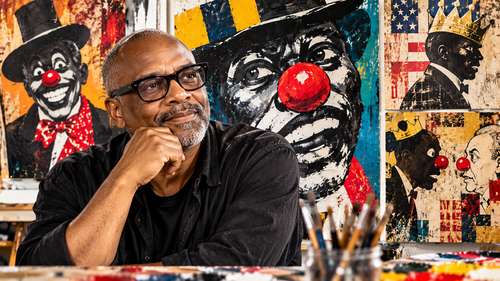
Michael Ray Charles, based in Austin, boldly challenges racial stereotypes and examines identity through his art. With a fearless approach, he combines humor with social critique in series like Before Black and After Black, exploring the development of racial imagery.
His work invites conversation about race by recasting cultural symbols into powerful caricatures. As a former professor at the University of Texas, his legacy continues to impact future generations. There’s much more to explore about his artistic journey.
The Artistic Journey of Michael Ray Charles
Though Michael Ray Charles’s journey as an artist began in Lafayette, Louisiana, his impact has resonated far beyond. His work critically examines stereotypes of African Americans, using found imagery and humor to deliver sharp social commentary.
With a BFA from McNeese State University and an MFA from the University of Houston, Charles built a strong academic foundation. His Before Black and After Black series juxtapose historical and contemporary racial depictions, pushing viewers to rethink perceptions of Blackness in American art.
As a former professor at the University of Texas, Charles has influenced emerging artists, encouraging meaningful conversations about art and racial representation.
His work has been exhibited internationally, including at The Museum of Modern Art, affirming his significance in the art world.
Exploring Racial Stereotypes in Art
When viewing Michael Ray Charles’s art, you quickly see his fearless approach to racial stereotypes. He critically examines American culture by appropriating imagery from the history of advertising.
Through his series Before Black and After Black, Charles highlights the evolution of Black representations, juxtaposing historical and modern portrayals. This confronts viewers with enduring racial imagery and identity issues. His use of humor and exaggerated caricatures exposes uncomfortable truths about Blackness and the legacy of minstrelsy.
Works like “Target of Opportunity Gameboard” and “White Power” draw parallels between past and present portrayals, provoking critical discourse. By distorting familiar symbols, Charles compels you to re-evaluate race and identity in America.
His art is both unsettling and transformative.
The Influence of Advertising and Pop Culture
Michael Ray Charles’s exploration of racial imagery extends into a powerful critique of advertising and pop culture.
By analyzing American commercial aesthetics, he reveals how racial stereotypes endure. He transforms familiar cultural figures into extreme caricatures, forcing you to confront inherited biases.
His art draws heavily from minstrel imagery, emphasizing the continuity of racial tropes in modern media. Series like Before Black and After Black contrast 19th-century visuals with today’s portrayals, showing how deeply rooted stereotypes adapt to new platforms.
His expressive, high-contrast paintings challenge assumptions shaped by advertising and mainstream culture.
Symbolism and Color in Charles’s Work
Vivid tones and muted shades work together across Michael Ray Charles’s canvases, each hue carefully chosen to elicit emotional and intellectual reactions. The symbolism in his work is central to his interrogation of race and identity.
Charles’s color palette helps communicate complex ideas. The recurring bright red clown nose, for example, distracts but also confronts the viewer, opening dialogue on the dynamics between Blackness and whiteness.
In works like Forever Free, his use of materials like acrylic latex and actual pennies showcases unconventional techniques that enhance meaning.
- Muted and bold hues evoke emotional contrasts
- The red nose serves as symbolic satire
- Materials like copper pennies reinforce themes of value and commodification
- Color choices provoke deep reflection on racial narratives
Notable Works and Their Impact
Michael Ray Charles’s notable works confront race and identity in contemporary culture with unflinching directness. His Before Black and After Black series trace the shifting imagery of Black identity through time.
In “Target of Opportunity Gameboard,” he critiques American advertising’s portrayal of Black figures, using irony to disrupt the narrative. Liberty Bros. Permanent Daily Circus employs nostalgic design to challenge viewers’ assumptions about representation.
In Forever Free, Charles delves into themes of liberation with colorful symbolism and cartoon-like exaggeration. His collaboration with Spike Lee on the film Bamboozled extended his impact, as Charles designed promotional art tied to the film’s commentary on minstrelsy and race.
Critical Reception and Controversy
While Michael Ray Charles’s work commands attention for its unapologetic critique of racial stereotypes, it also invites controversy and debate. His bold use of satire and irony can stir discomfort, particularly among African American audiences.
Charles’s intent is to provoke thought, not reinforce caricature, though some argue the commercial art market’s appetite for such imagery complicates interpretation.
- Irony in his work creates both fascination and discomfort
- His art challenges conventional aesthetics in representation
- Reactions are mixed—some feel empowered, others unsettled
- The tension between critique and consumption remains central
Charles remains committed to sparking vital conversations about antiblack racism and cultural identity.
Exhibitions and Recognition
Michael Ray Charles’s works have been showcased in prominent institutions around the world. His solo exhibitions in the U.S., France, and Belgium have expanded awareness of racial issues in global contexts.
His paintings reside in esteemed venues like The Museum of Modern Art, the San Antonio Museum of Art, and numerous private collections. In 2001, Charles’s contributions were featured in PBS’s Art:21, cementing his standing as a pivotal figure in American art.
He served on Austin’s Art in Public Places jury, reflecting his ongoing civic engagement.
His provocative pieces continue to challenge viewers and institutions to confront racial myths head-on.
The Legacy of Michael Ray Charles
From the moment he entered the art world, Michael Ray Charles has redefined how contemporary artists address race. His work critiques racial archetypes and reveals the persistence of visual racism in American culture.
Using a balance of satire, historical imagery, and social commentary, Charles opens vital discussions around identity. His Before Black and After Black series are landmark contributions to the study of racial representation.
- His art is held in major global institutions
- His career is the subject of a retrospective by scholar Cherise Smith
- His bold commentary has inspired new waves of American artists
- Charles’s influence is deeply woven into conversations about race in visual art
Comments (0)
No comments yet. Be the first to share your thoughts.
Leave a comment