


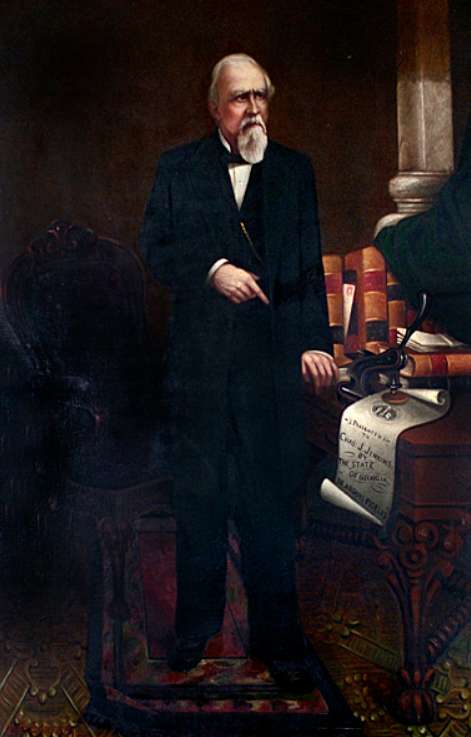
You’re curious about Charles J. Jenkins, aren’t you? He’s remembered as a Georgia governor, former state legislator, and influential jurist. In his legal career, he built a strong reputation and played a key role in upholding the rule of law.
As a politician, Jenkins advocated for constitutional principles and state governance. His commitment to public service helped shape Georgia’s political evolution during Reconstruction. Enthusiastic to see how his influence continues to inspire and impact governance? There’s much more to uncover.
Early Life and Education
Born on January 6, 1805, in Beaufort, South Carolina, Charles J. Jenkins moved with his family to Jefferson County, Georgia, during his youth.
His academic path led him to the University of Georgia, though he transferred and completed his education at Union College in Schenectady, New York, graduating in 1824.
This strong educational background launched his legal and political career. From 1831 to 1834, Jenkins served as the Attorney General of Georgia, highlighting his early commitment to legal principles.
His role marked the beginning of a life dedicated to constitutional law and public leadership.
Legal and Judicial Career in Georgia
After serving as Georgia’s Attorney General, Charles J. Jenkins continued his influential legal career in Georgia.
He played a central role in constitutional debates and legal interpretation during the 19th century.
Jenkins’s dedication to rule of law led to his service on the Georgia Supreme Court and as a delegate to the Georgia Constitutional Conventions, where he shaped the legal direction of the state during pivotal times.
He later served as Governor of Georgia from 1865 to 1868 during the tumultuous Reconstruction Era, becoming a symbol of resistance against federal intervention in state governance.
Political Career and Legislative Contributions
Although Charles J. Jenkins wore many hats, his role as Governor of Georgia stood out for its courage and historical significance.
During Reconstruction, Jenkins opposed military occupation and resisted congressional measures he viewed as unconstitutional. He famously refused to allocate state funds for a federal military order and was forcibly removed from office in 1868.
His commitment to the Georgia Constitution and principle of state sovereignty earned him national attention and praise among states’ rights advocates.
Jenkins’s legislative legacy reflected a deep belief in limited federal power and legal integrity.
Advocacy and Civic Engagement
While Jenkins did not practice law in Austin, Illinois, his civic involvement in Georgia shaped local and state institutions.
As a public servant, he emphasized education, constitutional rights, and legal reform. He supported civic institutions and contributed to the development of Georgia’s legal system post-Civil War.
His actions during and after his governorship helped maintain a sense of state autonomy and identity during federal occupation.
Major Achievements in Office
As Governor, Jenkins stood firm on constitutional principles, notably refusing to support Reconstruction acts he deemed unlawful.
His 1868 removal from office by federal authorities drew attention, and his symbolic act of taking the state seal and treasury records to prevent misuse became legendary in Georgia’s political history.
He was later vindicated when the state legislature placed his portrait in the Capitol rotunda, recognizing his defense of state integrity.
Challenges and Opposition Faced
Charles J. Jenkins encountered formidable opposition during Reconstruction.
The post-Civil War political climate was rife with tensions between federal mandates and southern governance. Jenkins clashed with Republican-led Reconstruction policies that sought to overhaul state institutions.
He stood virtually alone in defying federal orders, ultimately costing him his position—but gaining him recognition as a defender of constitutionalism.
Impact on Georgia State Politics
Though removed from office, Jenkins’s actions had lasting consequences on Georgia’s political identity.
He represented resistance to Reconstruction policies and helped shape the discourse on states’ rights versus federal oversight.
His legacy influenced future Georgia leaders who emphasized local governance and the preservation of legal tradition.
Jenkins’s actions became a historical reference point for debates on constitutional authority and civil governance.
Personal Life and Legacy
Jenkins’s life was marked by deep commitment to public service, law, and the Constitution. He married and had children, living much of his life in Augusta, Georgia.
In 1872, Jenkins declined an offer to serve as Vice President of the United States on the Liberal Republican ticket, choosing instead to remain committed to Georgia.
He passed away in 1883, leaving behind a legacy of principled leadership, legal integrity, and dedication to state autonomy.
Commemoration and Recognition
Charles J. Jenkins is honored in Georgia’s political history for his legal wisdom and governance during Reconstruction.
His portrait hangs in the Georgia Capitol, and his story is preserved through state historical records and educational institutions.
He is remembered not only for his legal and political achievements but for the courage he showed in defending constitutional values during one of America’s most turbulent eras.
Comments (0)
No comments yet. Be the first to share your thoughts.
Leave a comment