


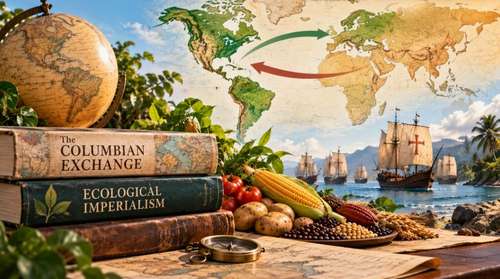
Alfred Crosby, an esteemed historian, transformed how history is understood by helping found the field of environmental history. His seminal work, The Columbian Exchange, highlighted how biological and ecological factors shaped global histories, shifting focus from traditional political narratives.
Crosby’s interdisciplinary approach—integrating history with geography and biology—revealed hidden causes behind societal changes. His pioneering ideas continue to influence contemporary historical studies and interpretations.
A Pioneering Approach to Environmental History
Although historians often focus on political narratives, Alfred W. Crosby transformed historical inquiry by helping establish environmental history. His groundbreaking book, The Columbian Exchange, emphasized ecological consequences over purely political events.
By introducing terms like “Neo-Europes” and highlighting the devastating impact of diseases on Indigenous populations, Crosby exposed historical causes behind dramatic demographic shifts. His work showed how biological exchanges linked to colonization contributed to regional wealth disparities.
Crosby’s integration of history, geography, and biology offered a broader understanding of how environmental forces shaped civilizations. His scholarship challenged conventional approaches and helped establish environmental dynamics as key drivers in history.
The Columbian Exchange: Transforming Historical Narratives
While traditional histories often center on events and leaders, Crosby’s concept of the Columbian Exchange shifted attention to biological and ecological interactions following Columbus’s voyages.
He documented how the transfer of plants, animals, and diseases between the Americas and Eurasia reshaped societies across continents. Crops like maize and potatoes revolutionized global diets, while wheat and rice transformed American agriculture.
The introduction of smallpox and other diseases had catastrophic effects on Indigenous peoples, enabling European colonization. This biological exchange has had enduring implications, deepening our understanding of global interconnectedness.
Academic Journey and Influential Works
Crosby’s academic journey began at Harvard University, where he graduated in 1952, later earning a master’s in teaching and a Ph.D. in history from Boston University.
His scholarly breakthrough came with The Columbian Exchange in 1972, which detailed the ecological relationships between the Old and New Worlds.
He followed this with Ecological Imperialism (1986), which examined how Europeans were able to dominate temperate zones through their transported diseases, animals, and crops.
His interdisciplinary approach influenced scholars like Jared Diamond, merging biology, demography, and historical analysis to reshape academic thought.
Key Achievements:
- The Columbian Exchange: Helped establish environmental history.
- Ecological Imperialism: Explored biological bases of colonization.
- Interdisciplinary Research: Merged historical and scientific methods.
Personal Life and Lasting Legacy
Born January 15, 1931, in Boston, Alfred W. Crosby lived with Parkinson’s disease for nearly two decades before passing away on March 14, 2018.
Despite these challenges, Crosby remained intellectually active, continuing to publish and inspire. His work shaped the field of environmental history and contributed to a greater awareness of the ecological dimensions of global events.
He shared his life with his wife, Frances Karttunen, a respected linguist and scholar, and was father to Kevin and Carolyn.
Crosby’s ideas remain foundational to how history is written and taught, securing his legacy as one of the most influential historians of the 20th century.
Recognizing the Impact on Contemporary Historians
Crosby’s innovative thinking transformed how historians view causes and consequences in global history.
By focusing on disease transmission, demographic changes, and biological exchanges, he compelled scholars to reassess long-held assumptions. His concept of “Virgin Soil Epidemics” reshaped interpretations of Indigenous depopulation.
Crosby’s model inspired interdisciplinary works from figures like Jared Diamond (Guns, Germs, and Steel) and Charles C. Mann (1491), extending his impact well beyond academia.
Key Influences:
- Neo-Europes: Framing settler colonialism and environmental transformation.
- Virgin Soil Epidemics: Understanding Indigenous population collapse.
- Interdisciplinary Thinking: Pioneering a broader method of historical analysis.
Crosby’s legacy continues to guide new generations of scholars toward a richer, more nuanced understanding of global history.
Comments (0)
No comments yet. Be the first to share your thoughts.
Leave a comment