


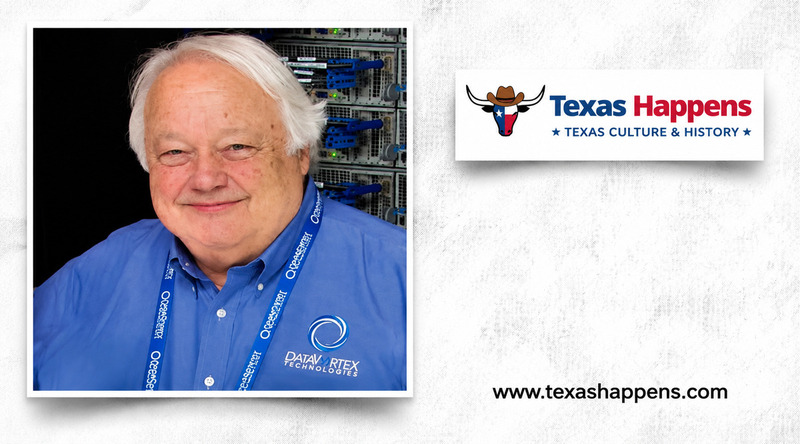
Jtransue, Coke Reed DV206, CC BY-SA 4.0
Coke Reed, based in Austin, transformed the high-performance computing world with his Data Vortex technology. His breakthrough came after solving a complex three-dimensional problem, changing how data flows between processors.
With his innovations, latency was minimized to a mere 10 nanoseconds, drastically speeding up computations. Influences from Taoism and Zen guided his distinctive approach. With numerous patents, his work sparked significant growth in computing capabilities. There’s more to explore about his transformative impact.
Early Life and Education
Born with a keen aptitude for mathematics, Dr. Coke Reed pursued his academic path at the University of Texas at Austin, where he earned his PhD in 1966. Under the guidance of Dr. Hubert S. Wall, he acquired the foundational knowledge that propelled him into a remarkable career.
He began his professional career at the Institute for Defense Analyses and Los Alamos National Laboratory, contributing significantly to high-performance computing and data movement. His early education and training set the stage for future innovations.
Collaborating with Dr. Krystyna Kuperberg, he addressed Problem #110 from the Scottish Book—a key milestone leading to his later contributions. His academic appointments at respected institutions further bolstered his standing as a leader in mathematics and computing.
Breakthrough With Problem #110
During a seemingly ordinary lunch in 1976, Dr. Coke Reed experienced a profound mathematical insight. He solved Problem #110 from the Scottish Book, a challenge posed by Stanislaw Ulam that concerned particle dynamics in three-dimensional space.
Working alongside Dr. Krystyna Kuperberg, Reed’s findings were published in Fundamenta Mathematicae in 1981.
This breakthrough did more than resolve a theoretical puzzle—it laid the mathematical foundation for the Data Vortex technology, which revolutionized data traffic in computing systems.
Development of the Data Vortex
The development of the Data Vortex technology redefined how data moves within high-performance computing networks. Sparked by the solution to Problem #110, Dr. Reed’s innovation applied dynamical systems theory to overcome latency and routing issues.
The Data Vortex architecture enabled seamless processor-to-processor communication. Implemented on FPGA chips, it delivered high throughput and extremely low latency at facilities including the Texas Advanced Computing Center.
Data Vortex Technologies, under Reed’s leadership, introduced solutions such as the Network-on-Chip design, achieving latencies as low as 10 nanoseconds. These systems support complex graph analytics and large-scale data processing, benefiting domains like defense, academia, and scientific research. This architecture became foundational in addressing data bottlenecks in next-generation computing systems.
Impact on High-Performance Computing
Thanks to Dr. Coke Reed’s pioneering work, high-performance computing (HPC) advanced significantly. His Data Vortex network facilitated fast, congestion-free data flow, with performance gains claimed to reach up to 32,100 times in specific configurations. The system’s sub-10-nanosecond latency proved transformative for data-intensive applications.
Reed held over 30 patents, highlighting his creative and practical solutions to long-standing challenges in data routing. The adoption of the Data Vortex on FPGA platforms empowered research institutions and government entities with enhanced computation speed and efficiency.
In recognition of these efforts, HPCwire honored Data Vortex Technologies with the Editors’ Choice Award for Best Government/Industry Collaboration, reinforcing the platform’s importance to the HPC field.
Philosophical Influences and Inspirations
Influenced by Eastern philosophy, Dr. Coke Reed embraced the practice of mental clarity and insight through reflection. His philosophy wasn’t theoretical—it was instrumental in solving real-world scientific problems.
Key inspirations included:
- Taoism: Encouraged harmony with nature and insight through simplicity.
- Robert Pirsig’s Zen and the Art of Motorcycle Maintenance: Used in his teaching to promote critical thinking and reflection.
- Einstein’s advice: Urged deep observation of nature to derive understanding.
- Eureka moment: The core idea for the Data Vortex reportedly occurred in Rocky Mountain National Park, highlighting spontaneous insight.
- Problem-solving mindset: Favored non-linear, multidisciplinary thinking.
Dr. Reed’s approach shows how philosophical principles can fuel scientific creativity and innovation.
Legacy and Continued Innovations
Since inventing the Data Vortex architecture in 1995, Dr. Coke Reed’s contributions have had lasting effects on the computing world. Holding more than 30 patents, his designs advanced data movement strategies that outperformed traditional network topologies, with claimed scalability exceeding 32,000 times in specific applications. His work was adopted by federal labs, universities, and computational science teams.
Professionals in sectors such as defense and energy have benefited from Reed’s contributions, especially through tools optimized for graph theory problems and large-scale parallel processing.
His ongoing developments—such as the Network-on-Chip Data Vortex—push computing efficiency forward, tackling challenges in scalable systems and real-time data routing. Dr. Reed’s mathematical legacy continues to shape the landscape of high-speed computing and remains an enduring influence on the future of innovation.

Comments (0)
No comments yet. Be the first to share your thoughts.
Leave a comment