


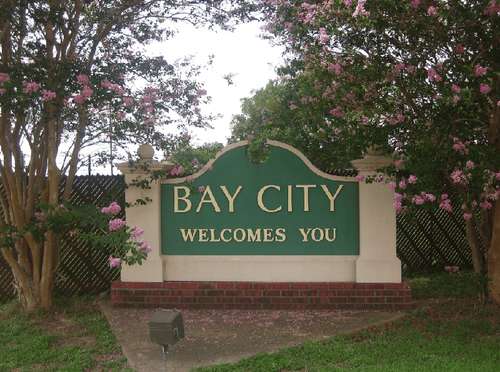
Image: Billy HathornBilly Hathorn at en.wikipedia, Bay City, TX, sign IMG 1047, CC BY-SA 3.0
Bay City, Texas, began with an unusual advantage. Many towns grow first and gain importance later. Bay City was imagined with a public purpose from the start. It was planned to become the county seat of Matagorda County, and its founders chose its location with that goal in mind.
The town rose on Bay Prairie, an open stretch of coastal prairie between the Colorado River bottomlands and Caney Creek. That location gave Bay City room to grow, access to rich agricultural land, and a more central position within the county than the older coastal town of Matagorda. Over time, those advantages helped turn a planned community into the political, commercial, and cultural center of Matagorda County.
Bay City’s story is about planning, promotion, farming, railroads, floods, industry, and adaptation. It is also a story about the Texas coastal prairie itself. The land shaped the town, and the town grew by learning how to use that land.
A County With Deep Coastal Roots
Long before Bay City appeared on a map, Matagorda County already held an important place in Texas history. The county lies in the Coastal Prairie region, bordered by bays, rivers, creeks, and the Gulf of Mexico. Its geography made it attractive to Native peoples, explorers, settlers, farmers, ranchers, traders, and later industrial developers.
The area that became Matagorda County was part of the early settlement pattern of Stephen F. Austin’s colony. Anglo-American settlement began in the 1820s near the mouth of the Colorado River. Matagorda, located closer to the coast, became one of the early centers of the region. It was founded in 1829 and became the original county seat after Matagorda County was organized in 1836 as one of the first counties of the Republic of Texas.
For decades, Matagorda made sense as the county seat. Early transportation depended heavily on water routes, and coastal access mattered. Boats, bays, rivers, and creeks shaped movement more than roads did. But as the nineteenth century moved forward, the county’s needs began to change.
Matagorda’s coastal position became less practical as settlement spread inland. Commerce shifted. Farms and ranches developed away from the bay. Improved roads and railroads became more important than older water routes. By the late 1800s, many residents saw the need for a more central county seat.
That opening created the opportunity for Bay City.
A Town Planned Before It Existed
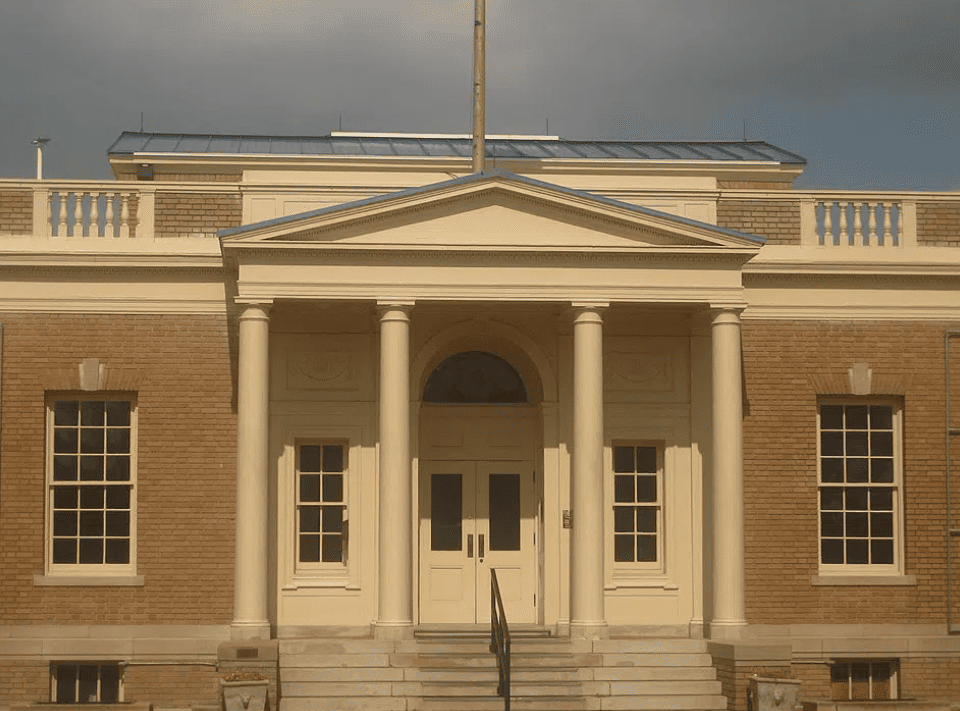
Billy Hathorn at en.wikipedia, Matagorda County Museum in Bay City, TX IMG 1034, CC BY-SA 3.0
Bay City was established in 1894 by the Bay City Town Company. The group included David Swickheimer, G. M. Magill, N. M. Vogelsang, and Nicholas King. Swickheimer, a Colorado mining millionaire, provided financial weight, while his partners helped promote the new town and shape its early public image.
The founders had a clear goal. They wanted Bay City to replace Matagorda as the county seat. To make that possible, they selected land near the geographic center of Matagorda County. The site consisted of two cow pastures on Bay Prairie. It was practical land, not a romantic setting. Yet its location gave it political value.
The Bay City Town Company bought 320 acres and began promoting the new community. In August 1894, before buildings had gone up, Magill and Vogelsang released the first issue of the Bay City Breeze. The newspaper promoted the town countywide and helped make the case for moving the county government.
The promoters also made a powerful offer. They promised to build a new courthouse if the county seat moved to Bay City. That promise gave voters a reason to support a town that still existed mostly on paper.
On September 18, 1894, Matagorda County voters chose Bay City as the new county seat. A week later, Vogelsang announced the victory in the Bay City Breeze and admitted that the town had not yet fully materialized. Lots still needed surveying. Buildings still needed construction. For a brief time, Bay City was closer to a campaign promise than a finished place.
That detail makes Bay City’s beginning especially interesting. It did not stumble into county-seat status after years of growth. It won the role first, then built itself around that responsibility.
From Tent City To Courthouse Town
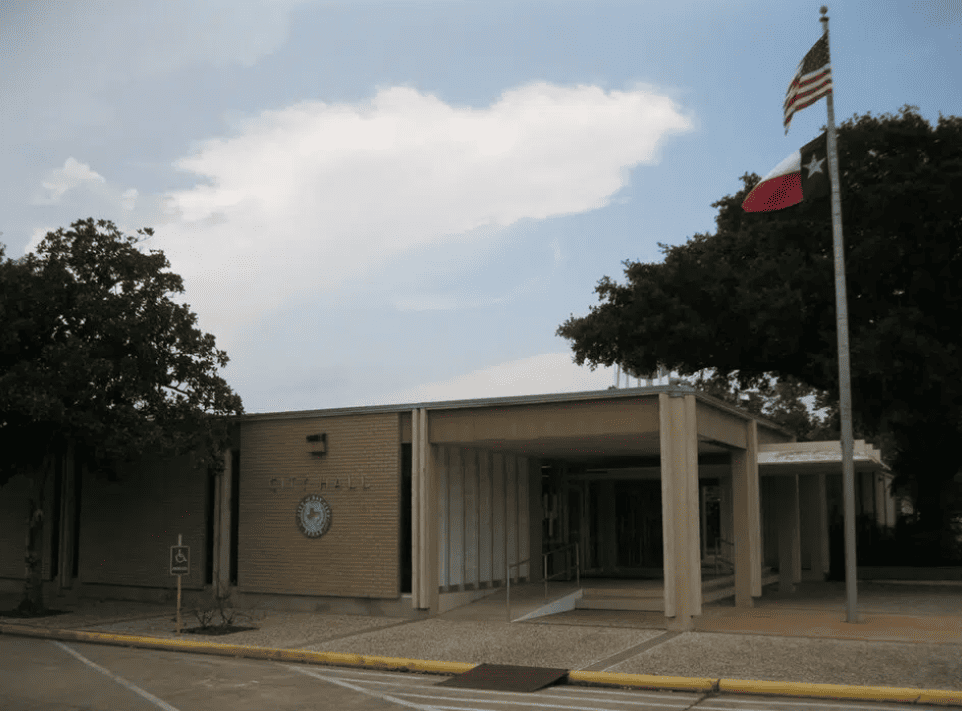
Djmaschek, Bay City TX City Hall, CC BY-SA 4.0
The early Bay City was rough, temporary, and practical. Before permanent buildings appeared, it functioned as a tent city. Its first structures served basic needs: government, printing, trade, mail, and shelter.
One of the first completed buildings housed the Bay City Town Company office and the printing presses of the Bay City Breeze. A small frame building from Matagorda, once used as a grand jury room, was moved overland to Bay City to serve as a makeshift courthouse. D. P. Moore’s dry-goods store was also moved and used as the post office.
These early moves show how quickly the new county seat had to become functional. A county seat needed courts, records, offices, businesses, and public services. Bay City had to create those things almost immediately.
Education also began early. Schools opened for Black and White children soon after the town’s founding. That fact reflects the social realities of the era, including segregated education, while also showing how quickly residents began forming the institutions of everyday life.
By 1900, Bay City had its first telephone. In 1903, the Wharton-Bay City Telephone Company received a franchise. These early communication improvements helped connect the young town to nearby communities and markets.
Bay City’s earliest years were not polished, but they were active. The town had a public role to fill, and growth followed that role.
The Prairie Economy Takes Shape
Bay City’s location on Bay Prairie mattered because the surrounding land could produce wealth. The region’s bottomlands, creeks, and prairie soils supported farming, ranching, and trade. As the town developed, agriculture became one of the engines of local growth.
Rice played a major role. Bay City Rice Mills completed a rice warehouse in 1901 and opened the town’s first mill the next year. That development linked Bay City’s future to one of the most important crops of the Texas coastal prairie.
The early business scene grew quickly. Around the turn of the twentieth century, Bay City had groceries, implement stores, saloons, butcher shops, barbershops, drugstores, dry-goods stores, a bakery, a laundry, a blacksmith shop, a brickmaking plant, a broom factory, a cotton gin, and a lumberyard.
That mix of businesses tells us a lot about the town. Bay City served farmers, families, tradesmen, travelers, and county officials. It was not only a courthouse location. It became a service center for rural Matagorda County.
In 1902, Bay City incorporated with about 2,000 residents. Incorporation gave the community a formal municipal structure, but some improvements took time. The town still relied on plank roads before proper streets came later.
Bay City’s growth was steady because it had several things working together: county government, land development, farming, trade, and transportation.
Railroads Changed Everything
Railroads gave Bay City its next major push. In 1901, the Cane Belt Railroad reached the town. The New York, Texas and Mexican Railway arrived in 1902. In 1904, the St. Louis, Brownsville and Mexico Railway also came through the area.
Railroads mattered because they connected Bay City to larger markets. Crops, cattle, supplies, building materials, and manufactured goods could move more efficiently. Farmers gained better access to buyers. Merchants gained better access to inventory. New residents could reach the town more easily.
By 1914, Bay City stood at the center of what was described as the largest rice-producing area in the nation. It was served by three railroads and had grown into a busy community with banks, rice mills, cotton gins, a brick and tile factory, a creamery, an ice factory, municipal waterworks, and a cooling station for fruits and vegetables.
The railroads also helped Matagorda County grow beyond its old coastal pattern. By 1913, rail lines had helped establish or expand several county communities, and Bay City flourished because it sat at the junction of three railroad lines.
This shift marked a major turning point. The county that once depended heavily on water transportation had entered a new age of rail-connected agriculture and commerce. Bay City benefited because it was placed where that new system could work.
Floods, Levees, And Life Near The Colorado River
Bay City’s location brought advantages, but it also brought challenges. The Colorado River helped shape the region’s land and economy, yet it also created flood risk. Bay City experienced regular flooding until levees and dams were built along the river in 1924.
Flood control was essential for a growing town. Businesses, schools, roads, homes, and public buildings needed stability. Farmers also needed more predictable conditions for planting, harvesting, and moving crops.
The effort to manage water became part of Bay City’s long-term development. In later decades, water control and river use continued to matter. A barge canal connected Bay City to the Gulf Intracoastal Waterway, and an inflatable rubber dam helped impound water for rice irrigation.
This relationship with water is one of the defining parts of Bay City’s history. The town grew because of its prairie and river setting, but it also had to engineer solutions to live with that setting.
Civic Growth In The Early Twentieth Century
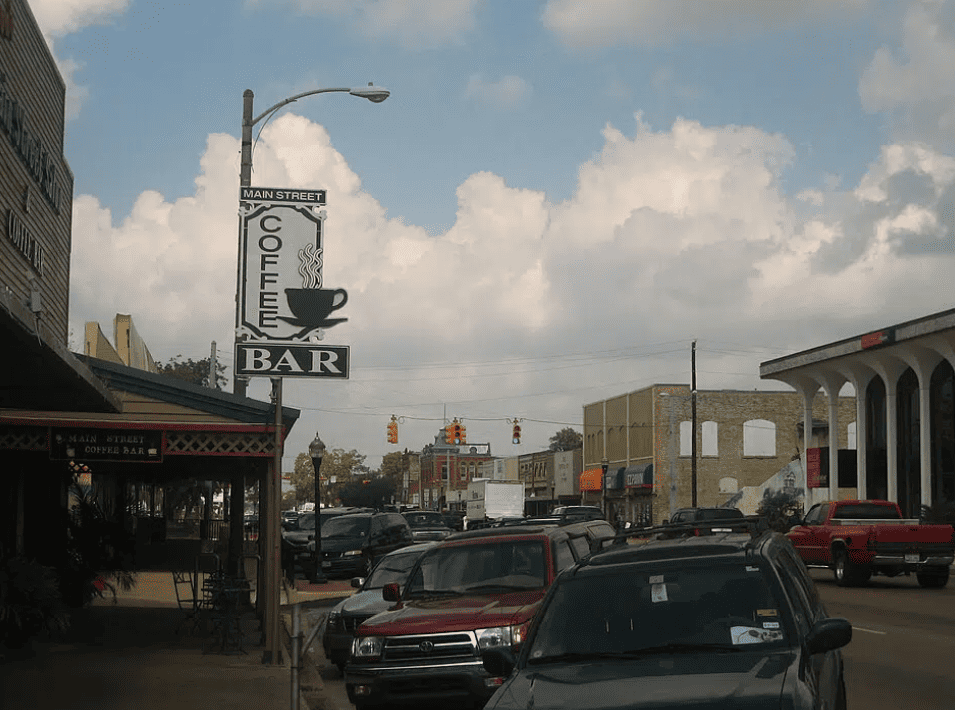
Billy HathornBilly Hathorn at en.wikipedia, Downtown Bay City, TX IMG 1041, CC BY-SA 3.0
As Bay City matured, it built the institutions that gave it a stronger civic identity. Churches formed early, including Methodist, Baptist, Christian, Episcopalian, and Presbyterian congregations. Schools expanded, and an eight-room, two-story frame school building opened in the early years of the twentieth century.
By the 1910s, Bay City had become much more than a new county seat. It had newspapers, teachers, doctors, lawyers, business owners, religious congregations, and civic organizations. In 1915, residents built a library, and Bay City Business College offered the community’s first higher education opportunity.
These details matter because they show the transition from promotion to permanence. A land company could sell lots and advertise opportunities, but a community became real through schools, libraries, churches, newspapers, and local leadership.
Bay City’s population reached 3,156 by 1914 and 3,454 by 1920. Growth was not explosive, but it was steady enough to confirm the town’s role as the county center.
Depression-Era Resilience
Like many Texas communities, Bay City faced the difficulties of the Great Depression. Yet the town continued to function as an agricultural and business center. In the 1930s, it had a canning plant, bottling works, hollow-tile factory, rice mills, gins, hatcheries, and dairies.
LeTulle Park was developed in 1934, during the Depression. Named for local rice grower Victor L. LeTulle, the park reflected a commitment to public life even during hard economic times.
The local school system also continued to serve a growing population, though under segregation. During the 1937 to 1938 school year, the district employed teachers for White students through the eleventh grade and Black students through the tenth grade.
By 1940, Bay City’s population had reached 9,427. That was a major increase from the small incorporated town of 1902. The planned county seat had become a substantial community.
War, Infrastructure, And A Broader Economy
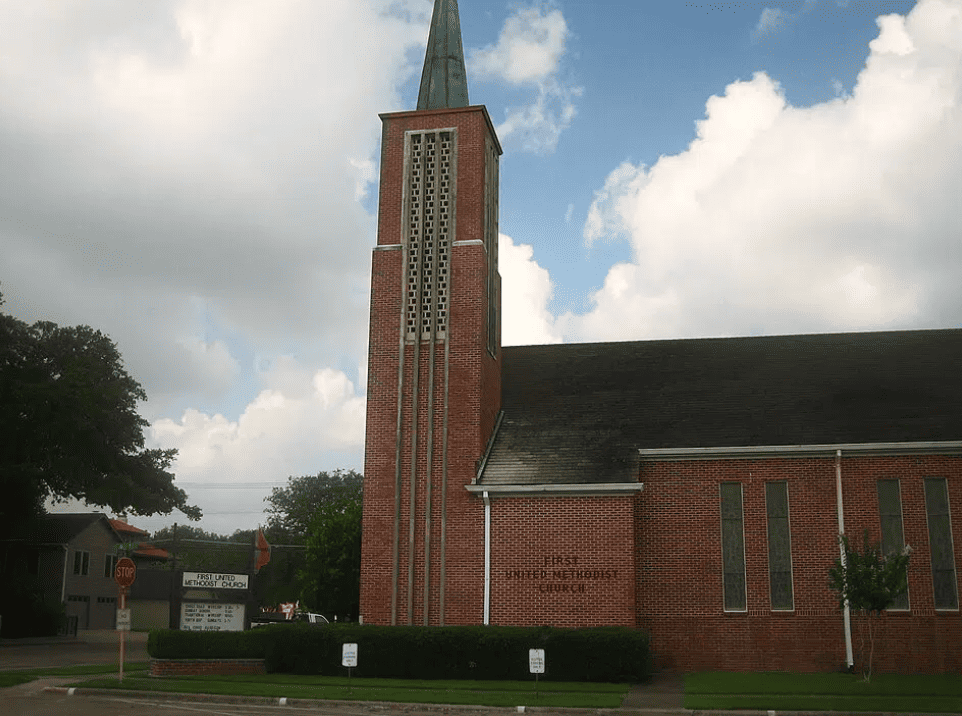
Billy Hathorn at en.wikipedia, First United Methodist Church of Bay City, TX IMG 1040, CC BY-SA 3.0
World War II brought new activity to Bay City and Matagorda County. A United Service Organizations building was constructed in 1941, and wartime needs helped spur local building. By 1949, Bay City had completed a new football stadium and high school.
The 1950s and 1960s brought further infrastructure growth. A new public library and a United States Army Reserve building were completed. Between 1960 and 1970, Bay City gained an airport and a barge canal linking it to the Gulf Intracoastal Waterway.
These improvements helped prepare Bay City for a broader economy. Agriculture remained important, but the town and county were also moving toward industrial development.
In 1960, Celanese Chemical Company built a petrochemical plant that became Bay City’s largest employer. Other industrial employers later entered the county, including Occidental Chemical Company and the South Texas Project, a major nuclear power facility. Bay City’s population grew in the 1970s and early 1980s as these employers expanded the region’s economic base.
By the late twentieth century, Bay City was no longer defined only by rice, cotton, ranching, and railroads. It had become a county center tied to agriculture, energy, chemicals, transportation, public services, and regional commerce.
The Prairie Identity Still Matters
Even as Bay City modernized, its prairie setting remained central to its identity. The name itself points back to Bay Prairie. The town was built between fertile bottomlands and creek country, in a region shaped by water, grassland, and agricultural possibility.
That setting helped explain why the founders chose the site. It also explains why the town survived beyond its first political purpose. A county seat needs people, trade, transportation, and surrounding economic activity. Bay City had all of those because the prairie around it could support them.
Today, Bay City remains the county seat of Matagorda County. It sits at the junction of State Highways 35 and 60 and continues to serve as a regional hub. Its local attractions and institutions, including the Matagorda County Museum and community events such as Market Days, help preserve and share the area’s history.
The town’s history also invites a wider look at how communities are made. Bay City was planned, promoted, voted into importance, and built piece by piece. Its founders chose a location with strategy. Its residents turned that location into a working town.
Why Bay City’s Story Stands Out
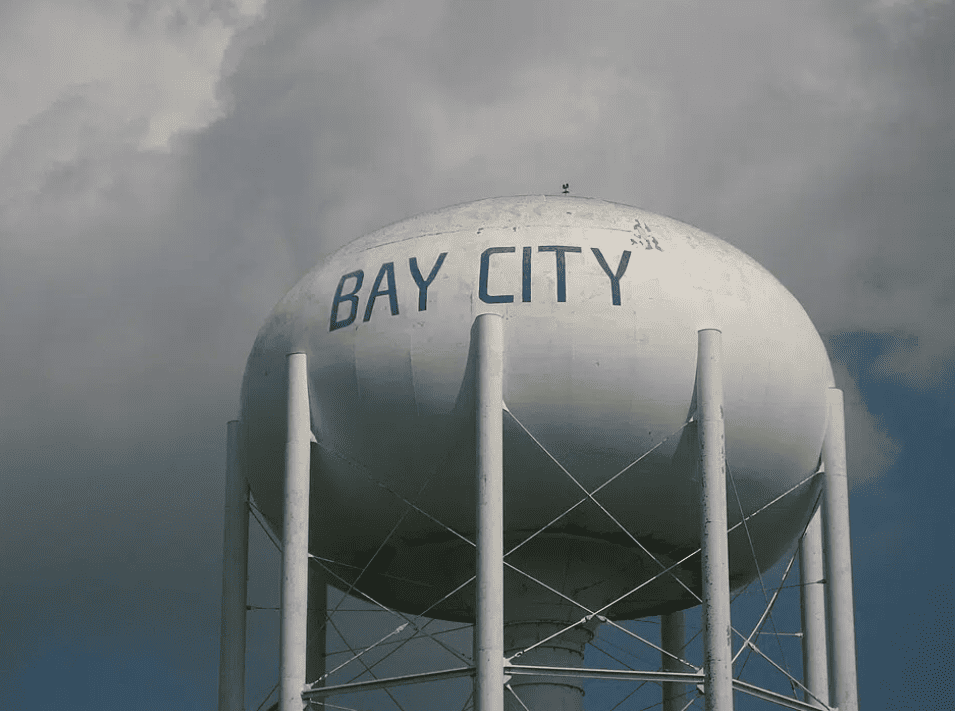
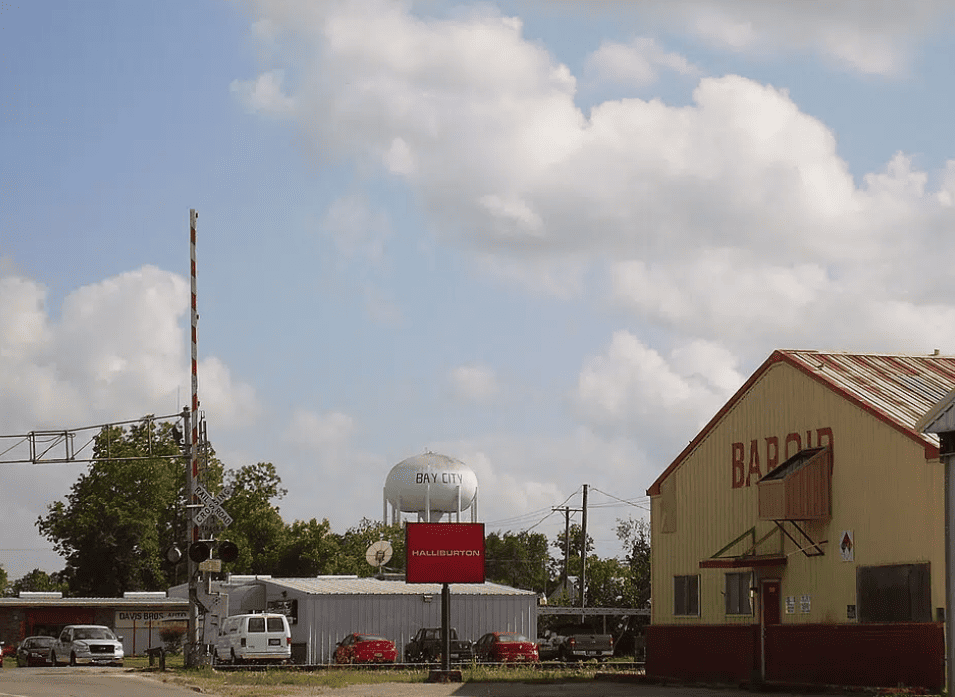
`Billy Hathorn, Bay City, TX, Water tower IMG 1037, CC BY-SA 3.0
Bay City stands out because its beginning was unusually deliberate. It was not a mining camp, a river landing, a mission town, or a railroad stop that happened to grow into political importance. It was designed to become the center of county government.
That plan could have failed. A town without buildings had to convince voters, attract residents, build institutions, survive floods, develop trade, and keep pace with changing transportation and economic systems. Bay City managed to do those things.
Its story also reflects larger patterns in Texas history. Older coastal settlements gave way to more centrally located towns. Railroads reshaped rural counties. Agriculture drove early growth. Flood control made permanent settlement safer. Industry changed local economies in the twentieth century.
Bay City contains all of those patterns in one place.
A Planned Town With Lasting Roots
Bay City began with a vote, a promise, and a patch of prairie. Its earliest supporters saw potential in a central location where few permanent structures stood. They used newspapers, political persuasion, and practical planning to move the county seat from Matagorda to a new inland town.
From there, Bay City grew through work. It built a courthouse presence, schools, stores, mills, roads, rail connections, churches, parks, public buildings, and industrial ties. It faced floods and economic hardship. It adapted as Matagorda County changed from a coastal and agricultural region into a more diverse economy.
The town’s planned beginning did not make its success automatic. People had to build the community after the election was won. That is what gives Bay City’s history its lasting interest.
Bay City grew with the prairie because it was rooted in the needs of the land around it. It served farmers, county residents, business owners, students, workers, and families. More than a century after its founding, it still carries the purpose its founders imagined in 1894: a central place for Matagorda County to gather, work, remember, and move forward.

Comments (0)
No comments yet. Be the first to share your thoughts.
Leave a comment